As technology advances, AI is no longer a buzzword in the corporate world. Rather, it is slowly becoming the new norm.
Especially for remote companies, the adoption of AI is becoming the new trend to improve efficiency and quality of work in various fields.
Since most of their work is handled using technology, the incorporation of AI models in various departments helps in streamlining the overall workflow.
Just like other departments, Human Resources is also taking the chance to incorporate AI in its functions. Simplifying the complexities of HR activities and reducing the workload.
But the real question is— “How is AI transforming HR management?” Well, that’s what your remote buddy is going to delve into today.
In this blog, I am going to discuss the diverse aspects of AI in HR, exploring—
- Its benefits,
- How to apply in HR activities,
- Its challenges and ethical considerations, and more.
So, come dive right in!
What Are The Benefits Of AI In HR?
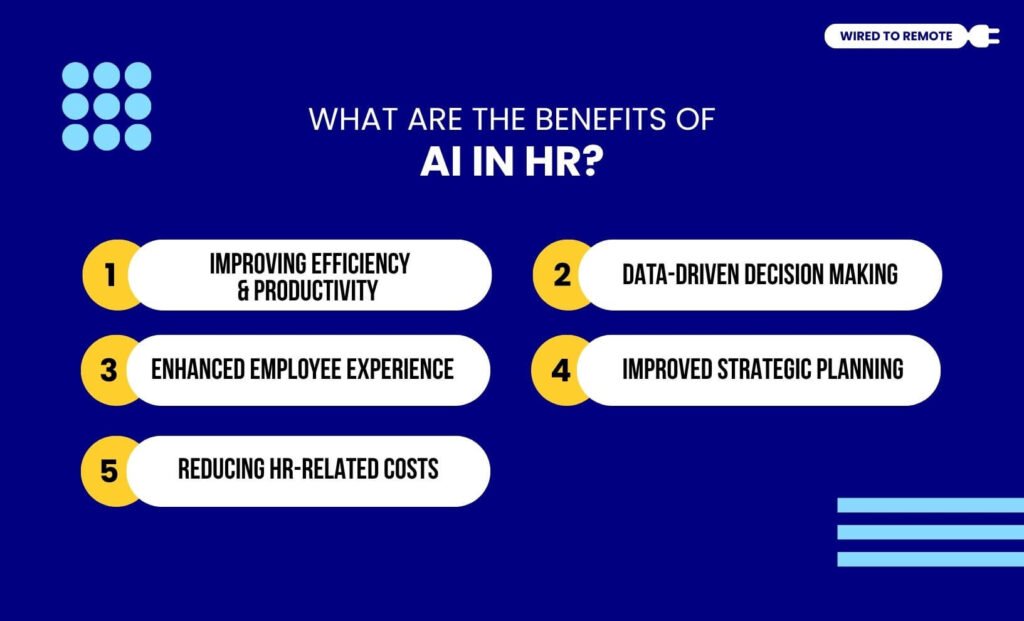
Since implementing AI in HR activities offers ample benefits, managers are readily adopting the tools and models. Some of these benefits include—
1. Improving Efficiency And Productivity
Firstly, AI implementation helps automate routine tasks and simplify complexities. So, naturally, the productivity and efficiency increase with reduced workload and streamlined workflows.
2. Data-Driven Decision Making
Moreover, AI uses real-time data analysis to provide insightful reports. This helps in enabling managers to proactively manage the HR processes. So, they can make better and informed decisions based on data insights over simple assumptions or intuition.
3. Enhanced Employee Experience
In addition to this, AI implementation personalizes the employee navigation on the HR portal based on their needs and preferences. So, employees get to experience better HR management that satisfies them and leads to their retention in the firm.
4. Improved Strategic Planning
Along with this, AI helps with analyzing employee data to understand the dynamic needs for developing talent management strategies. So, HR managers can leverage these data insights to strategically plan for future human capital.
5. Reducing HR-Related Costs
Finally, incorporating AI in HR can significantly reduce the overall HR-related costs. That is, it can automate inefficient HR processes, reduce hiring time, and optimize the human resource allocation. So, this helps in decreasing the combined costs of HR processes.
How To Apply AI In HR Activities?
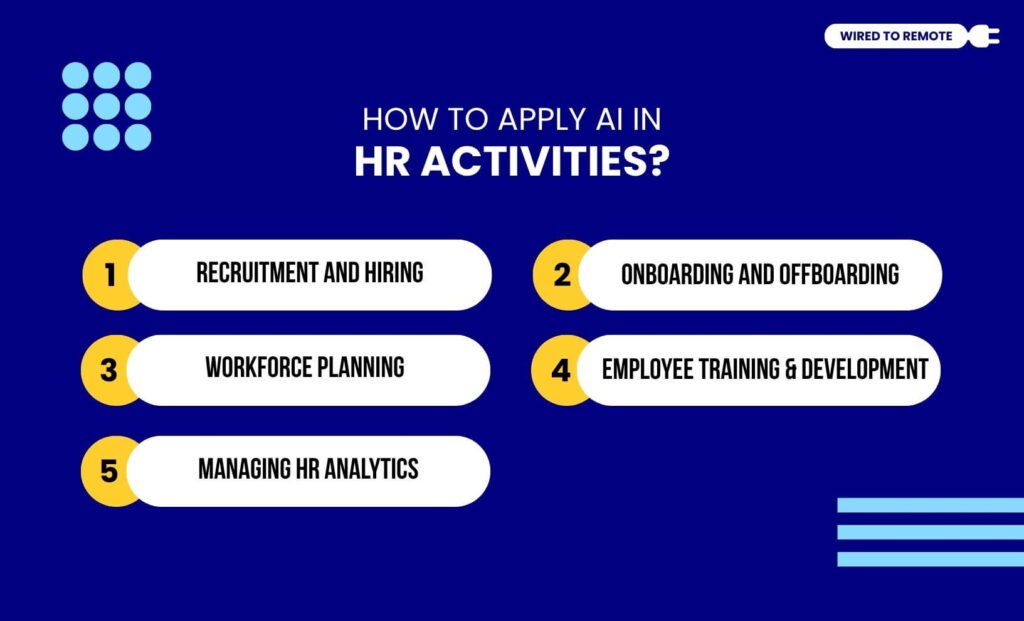
When AI is applied in handling HR activities, it transforms the way HR processes work. That is, it reshapes the workflow by making it smarter, faster, and more efficient.
Mainly, AI can be applied in some specific areas of HR activities — recruitment, employee training, performance evaluation, onboarding, and workforce planning.
1. Recruitment And Hiring
Firstly, AI in remote hiring has significantly improved the talent management process. That is, it helps remote recruiters to screen through thousands of candidate resumes to find the best-fitting one.
Moreover, it can be used for writing job descriptions, creating and automating LinkedIn posts, and offering pre-interview briefings about company culture.
2. Onboarding And Offboarding
As the report from AIHR highlights — “Great employee onboarding can improve retention by 82%”. So, implementing AI in the onboarding process can make it engaging for the candidates.
Moreover, the automation of the offboarding process further ensures that the candidate has a good experience till the end. So, by personalizing the notifications and scheduling exit interviews, AI can further enhance the overall candidate experience.
3. Workforce Planning
AI tools have the capabilities to analyze employee performance, imminent skill gaps within the workforce, and predict employee turnover.
This helps HR managers to better plan out the workforce and create training programs to help the employees upskill themselves. So, AI can help in managing the workforce with efficiency.
4. Employee Training And Development
As the market evolves, employees need to cultivate newer skill sets to stay relevant in the field. So, managers can employ the AI tools to offer customized training and development programs based on the individual needs of the employees.
Moreover, it can analyze their performance and adapt the curriculum based on their learning power and preferences.
5. Managing HR Analytics
Finally, AI can be implemented for managing the HR analytics of the firm. With its advanced analysis capabilities, it can analyze employee performance, engagement, turnover rate, and work culture.
This way, managers can identify the areas within the workforce that need improvement and strategically plan out the HR management. So, it is easier to identify patterns and make informed decisions.
Challenges And Ethical Considerations Of AI In HR
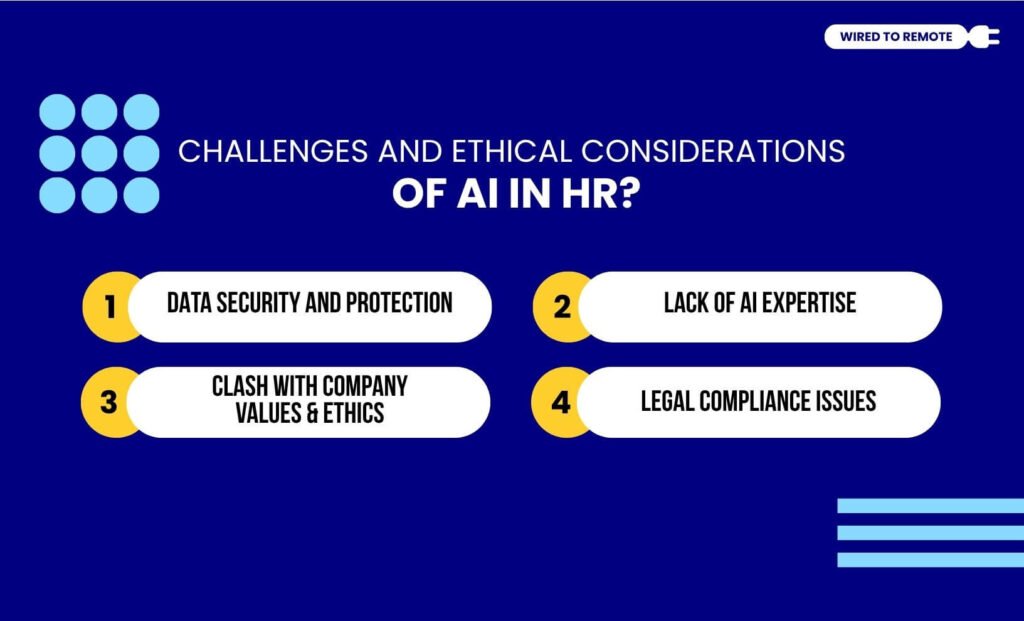
Even though incorporating AI in HR offers ample benefits, it comes with a set of challenges and limitations. Some of these challenges and ethical considerations include—
- Data Security and Protection — Firstly, the HR department holds on to massive datasets containing personal and sensitive employee information. So, implementing AI raises concerns about data security and protection to prevent data breaches.
- Lack of AI Expertise — Moreover, not all employees are skilled to handle AI tools properly. So, there is an imminent lack of expertise within the field. This needs to be overcome with the cultivation of the right skills through training models.
- Clash with Company Values and Ethics — In addition to this, AI models can make decisions that clash with the core values and ethics of the company. So, human supervision is important to ensure that the decisions taken do not ignore the context.
- Legal Compliance Issues — Finally, adopting AI tools in HR can raise certain legal compliance concerns. That is, it can result in data privacy violations, discriminatory results, and other illegal actions in the industry. Leading to compliance lawsuits and penalties.
Best Practices To Implement AI In Human Resources
Implementing AI in HR can be challenging because of certain ethical and legal considerations. So, here are some best practices to implement AI for improved efficiency—
- Mitigating bias in the AI models with diversified training data and human supervision.
- Prioritizing data privacy and protection for sensitive employee information.
- Providing comprehensive and effective training programs to employees.
- Maintaining human supervision for decision-making for critical factors.
The Future Trends Of Artificial Intelligence In Human Resources
Since the current AI models in HR are quite efficient in handling complex datasets and automating routine tasks, the future is promising.
That is, the future AI trends in HR will prioritize hyper-automation of the administrative tasks of the HR department.
So, managers can reduce the workload and focus on other strategic aspects.
Moreover, AI models will eventually enhance diversity and inclusion in talent management based on collaborative intelligence.
So, managers can reduce the bias in the recruitment and talent acquisition. Ensuring the workforce is diversified with multiple talents.
Now, AI in HR can be a budding concept. But pretty soon, it will be normalized in most corporate companies. So, if you are also curious about the transformed HR processes, it’s high time to implement AI to see your firm skyrocket its efficiency.
FAQs
Here are some of the common questions on the incorporation of AI in human resources.
AI in HR refers to the implementation of advanced technologies — machine learning, predictive analysis, and natural language processing — to improve efficiency. Moreover, it helps automate repetitive HR tasks, manage HR processes, and plan out workforce strategies.
Unlike the traditional recruitment process, AI-driven recruitment automates repetitive tasks, schedules interview meetings, screens candidate resumes, and reduces bias in hiring. So, it improves the recruitment process by streamlining workflow and enhancing talent acquisition.
AI implementation in HR can enhance employee engagement in the following ways—
• Personalizing training and development programs based on the individual needs of employees.
• Providing 24/7 HR support through chatbots and virtual assistants.
• Automating routine HR tasks and streamlining workflows.
• Providing real-time employee feedback for insightful reports.
Organizations can ensure that the AI-driven HR decisions are transparent through some of these key practices—
• Clearly communicating how their personal data will be used for HR processes.
• Explaining the background workflows of the AI models in the HR department.
• Regularly auditing and monitoring the AI models to ensure they are compliant, fair, and unbiased.
• Maintaining human oversight on the models for reducing machine bias.
• Involving diversified teams in managing and developing the AI tools in the workforce.
Leave A Comment