

The remote interview process is not a one-sided question-and-answer session with the candidate conducted by the employer.
It is a procedure where both the employer and the applicant clarify their doubts and assess each other before making a big decision.
Specifically, in internal interviews, most employees do not feel the need to ask questions to the hiring manager. Fearing they might sabotage their hiring chances.
But, surprisingly, asking questions to your hiring manager can, in fact, help you to better understand the transition process. Helping you to seamlessly join another department.
With the right questions, you can get an introductory idea about the workload, potential challenges, hierarchical team structure, and their expectations from you.
So, to help you bag the position, I have curated a list of questions to ask at the end of an internal interview.
By breaking them into different categories, I have touched upon all the aspects you need to know before transitioning to a new role. So, what’s the wait for?
Keep reading to ace your next remote internal interview!
What Is An Internal Interview?

Most individuals confuse regular interviews with internal interviews, thinking they are two sides of the same coin. But that’s not true!
Internal interviews are completely different from regular interviews. Starting from their objectives to the hiring process, they do not complement each other.
Unlike the regular interview, where candidates are sourced from outside the company, an internal interview focuses on hiring a person who is working within the firm.
So, the hiring manager sends over the job description within the company portal to let the employees apply for the role.
Usually, this is done for promotional roles or inter-departmental changing roles.
Are Internal Interviews Beneficial For Remote Companies?

In a remote work culture, internal interviews can help fill in roles that require managing projects and meeting deadlines.
For these roles, the company needs someone who knows its policies and internal work processes. And, who can be a better fit than the existing employees?
Moreover, remote companies face one of the biggest drawbacks — workplace miscommunication. So, hiring a new person from outside the company can be challenging.
Also, they might need more time to adapt to the new role with no colleague or coworker helping them out at their desk.
However, an internally interviewed employee can fill in the role faster and more efficiently. It also boosts their job satisfaction and helps in retaining talent within the firm.
What Questions To Ask At The End Of An Internal Interview?
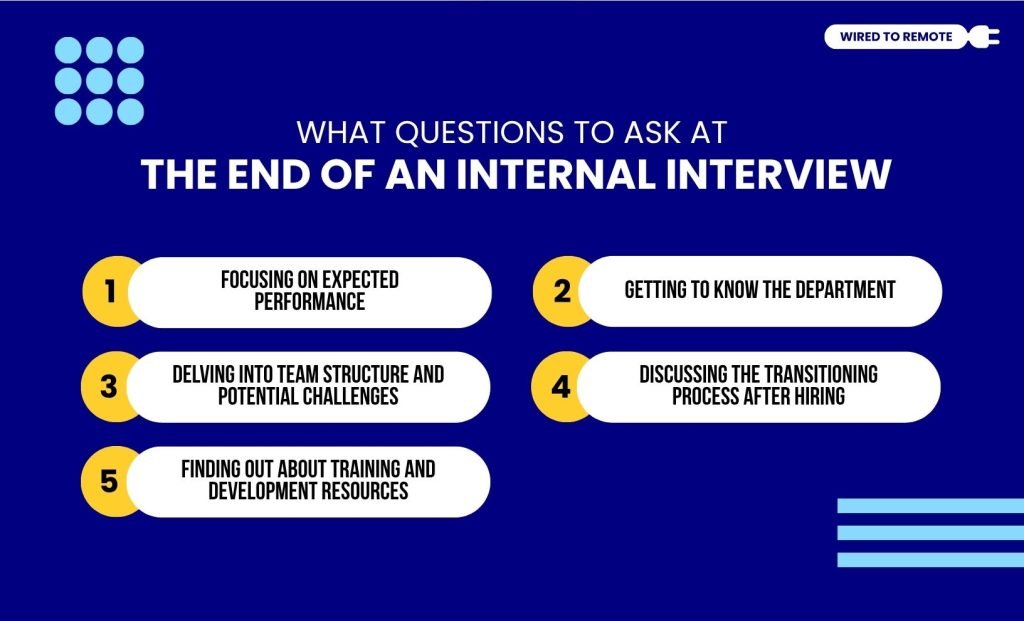
Some of the questions that you can ask your hiring manager at the end of an internal interview include:
1. Focusing On Expected Performance
Firstly, you need to know what the company expects from you when it is offering you a new position.
Asking questions about the roles and responsibilities can help you better understand what you need to do to meet those expectations.
You can ask these to assess their expectations of you:
- What tasks do I need to complete within the first six months of my joining?
- How will my performance be measured in the year?
- What are my immediate roles and responsibilities with the team?
- How will I get reviewed for my work, and how often will I receive the reviews?
Expert Tip: Asking about performance metrics in the first six months shows the hiring manager that you are results-oriented and ready to take immediate ownership of the role.
2. Getting To Know The Department
Just knowing the company policies is not enough. If you need to change your department, you should collect information about the function and importance of the new department.
So, you can ask specific questions about the new department to get familiarized with its work and your position simultaneously. You can ask these:
- What is the core function of this department in the company?
- How do you see the department evolve over the next 5 years?
- What are the future opportunities of this department in the industry?
- How does the department contribute to the overall revenue system of the company?
3. Delving Into Team Structure And Potential Challenges
Just like getting to know the department, you need to know about your team and the potential challenges.
Whether the team strictly follows a hierarchical order or micro-manages tasks can give you a better understanding of the work environment you’ll get.
So, you need to know about the team structure before making your decision. You can ask these questions:
- Can you brief me on the team I will be working with?
- Who will be my close teammates?
- Do I have to report directly to the manager on a daily basis?
- What are the strengths and challenges of this team?
- Will more people join the team in the next six months?
4. Discussing The Transitioning Process After Hiring
One of the crucial aspects of an internal interview is that you will need to transition to a different role. So, make sure you have information on how the transition will happen.
You can ask these to figure out the transition process after you are hired:
- How will my transition look in this role?
- Do you need any more documents to support my suitability for the position?
- How will I be guided into the new role from the current one that I am doing?
- Is there something I need to know before joining the position?
5. Finding Out About Training And Development Resources
Lastly, you must be aware of how you will be trained in the new role or whether the company will provide any development resources to guide you.
This will help you understand how you will be helped to adapt to a new role. And, based on that, you can choose to train externally or learn from the senior workers.
So, you can ask these questions on training and resources:
- What is the training period for the role?
- Will I receive guidance and mentorship before starting my work with the position?
- Who will be responsible for explaining to me my tasks and responsibilities?
Navigating The Social Risk
So many of us wonder whether changing our roles within our company is possible! What an exciting move, right?
But hold on before you go for that meeting, let’s find out how to keep everything going smoothly.
Getting internal interviews is really great for your career; however, it might even get a bit awkward with your current boss.
You surely do not want to jeopardize your relationship with the boss just to grow.
Hence, the best decision is to be open and safe! Here’s how to handle the social part and prepare yourself for acing the conversation:
1. Inform Your Boss In Advance
Discuss with your current supervisor before putting in your application.
Being transparent radically builds trust and prevents them from receiving an email from HR as a surprise!
2. Demonstrate Your Commitment
It’s important that you show the interviewer your concern is the company’s overall growth, not just a quick promotion.
Feeling relaxed and confident after this is going to be a real thing for you.
Also, you will be in great shape when you meet the new manager for an interview for the position we are talking about here.
Now you can bravely come up with the best questions to ask at the close of an internal interview. This will convey that you are ready for this new challenge!
Things To Keep In Mind Before Asking Questions At The End Of The Internal Interview
With a set of questions prepared before the internal interview, you can impress the hiring manager.
Making them see you as a passionate candidate eager to contribute to the development of the company.
However, asking too many questions can backfire on your winning chances. Sabotaging your opportunity to grow within the firm. So, you need to keep a few things in mind.
Firstly, keep your questions short and no more than three. Choose the most essential things you want to know, and then prepare those only.
Secondly, give time in between your questions. Don’t rush the hiring manager to answer all your questions in one breath. Remember, give him space to explain and clarify.
Finally, do not ask too many “me” questions that only focus on your benefits. This will make you seem like a selfish person who is not a team player.
So, adjust your questionnaire by mixing questions from different categories.
Now that you have the complete list of questions to ask at the end of an internal interview, cracking the interview and getting your dream position has become easy.
Remember, with the right questions and the right contexts, you can create a lasting impression on the recruiter.
So, put that fear in the backseat and prepare YOUR questions for the interview!



Leave A Comment