

It is no wonder that Thailand marks its place as one of the best digital nomad destinations.
Now, with its fabulous scenic beauty, vibrant nightlife, and mouth-watering delicacies, it offers the perfect locale for digital nomads.
Turning cultural exploration and earning at the same time into a piece of cake.
Moreover, Thailand has come up with its special Thailand Digital Nomad Visa. Permitting non-immigrants to enjoy this exotic lifestyle while working remotely.
So, if Thailand has been on your tour list, it is high time to make that wish come true by availing its digital nomad visa.
Here, in this blog, I have brought you the ultimate guide on getting the Digital Nomad Visa of Thailand by focusing on—
- Its key benefits and types,
- Eligibility criteria and documents required,
- Process of application, some tips, and more.
So, come dive right in!
What Is The Thailand Digital Nomad Visa?
To explain simply, the Thai Digital Nomad Visa is specifically designed to allow remote workers from across the world to work and stay in Thailand for a long time.
Now, the visa is commonly named as Destination Thailand Visa (DTV). This helps in distinguishing it from the other Thai tourist visas.
Unlike other Thai visas, DTV allows the remote workers or digital nomads to reside in Thailand for a total of 5 years. But the time period is divided into blocks of 180 days.
That is, the workers are allowed to stay for 180 days and then renew the visa for another 180 days. This can be done for up to 5 years.
So, the worker is allowed to enter the country multiple times with the same visa.
Types Of Thailand Visas For Remote Workers
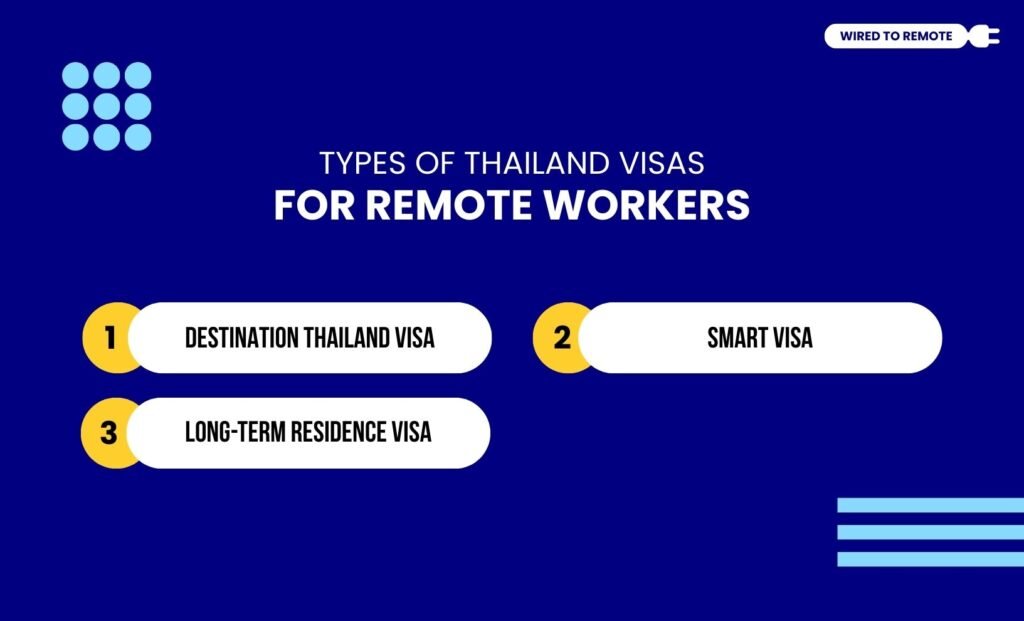
Given that Thailand is a famous tourist spot in Asia, it offers various types of visas. Now, among these, some can be used by remote workers to stay and work remotely—
1. Destination Thailand Visa (DTV)
Firstly, it has the DTV specifically designed for digital nomads. Allowing them to stay for 180 days at a time. But they can extend the visa up to 5 years with multiple visit provisions.
Moreover, the workers are allowed to work for foreign clients and companies. So, they can legally work for other countries outside Thailand, contributing to its economic conditions.
2. Smart Visa
Apart from the DTV, the Smart Visa allows entrepreneurs, tech professionals, and highly qualified individuals to stay and work in Thailand.
But these professionals need to have a higher monthly income and professional qualifications. So, it is easier for these professionals to work for foreign clients.
3. Long-Term Residence Visa (LTR)
Finally, the LTR visa allows diverse workers to seek residency of over 10 years with a high-earning bracket.
So, individuals working in higher positions and seeking to settle in Thailand for the long term can apply for this visa to get an extended stay.
What Are The Benefits Of The Thai Digital Nomad Visa?
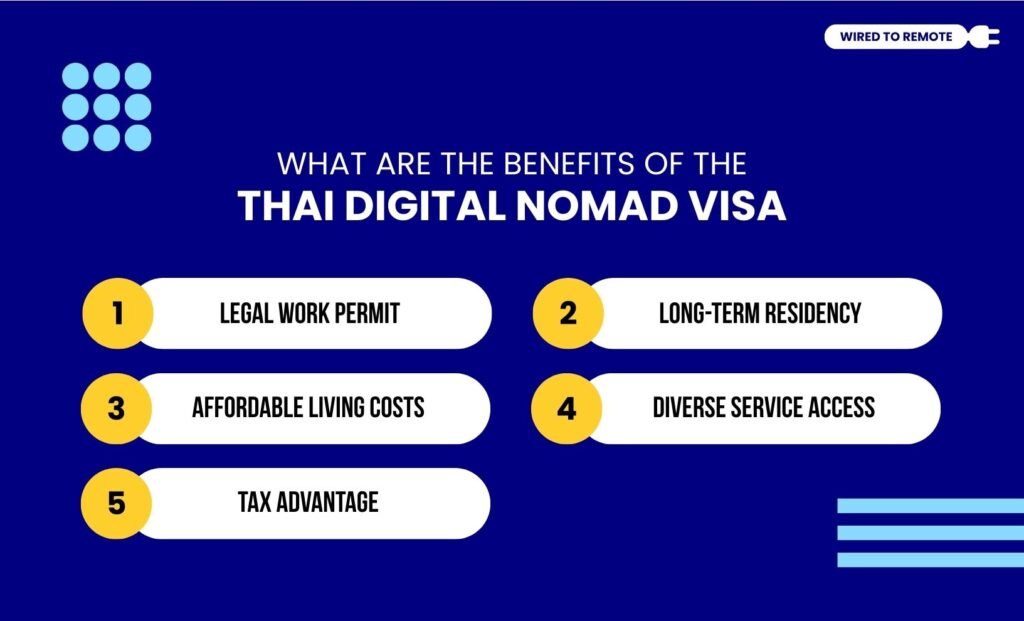
Much of the popularity of Thailand as a digital nomad destination lies in the ample benefits of its digital nomad visas. So, some of these benefits include—
- Legal Work Permit: Firstly, the visa allows the workers to legally work for foreign companies and clients remotely. So, they can earn and enjoy the place at the same time.
- Long-Term Residency: Unlike visas of Japan, Italy, or Colombia, it offers options for long-term residency in the country. So, the workers can stay in the country and get multiple-entry permits.
- Affordable Living Costs: Additionally, the cost of living in Thailand is comparatively lower than in Spain or Germany. So, it is a great place to become a digital nomad.
- Diverse Service Access: Moreover, the visa allows the remote workers to access both civic amenities and healthcare facilities. So, they can access the essential services while staying in a foreign country.
- Tax Advantage: Finally, the short 180-day brackets exempt remote workers from the taxation policies. So, they can enjoy the tax advantages while staying and earning in the country.
What Are The Eligibility Criteria Of The Thailand Digital Nomad Visa?
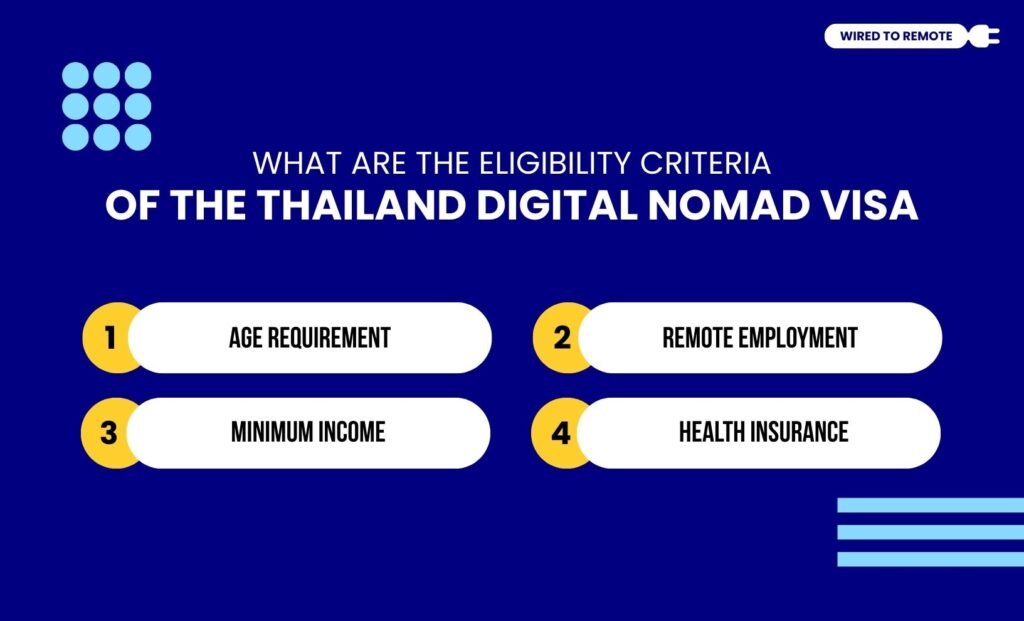
Given that the Visa offers massive benefits, it comes with fixed eligibility criteria. So, here are the major areas of eligibility considered for the DTV—
1. Age Requirement
Firstly, the remote workers or digital nomads need to be above the age of 20 years. So, they are legally adults and hold the potential to work while staying in the country.
2. Remote Employment
Moreover, the workers need to be employed by foreign companies or work remotely with foreign clients. That is, they are not allowed to work with the local companies or clients.
So, entrepreneurs with their own registered businesses and freelancers working for foreign companies are eligible for this visa.
3. Minimum Income
Additionally, they need to earn a minimum amount per month to sustain their lifestyles. That is, the minimum monthly income should be 500,000 THB. So, they can maintain their lifestyle in Thailand easily.
4. Health Insurance
Finally, the workers need to have a proper international health insurance that allows them to cover the medical treatments in the diverse facilities of Thailand.
What Documents Are Required To Apply For The Thailand Digital Nomad Visa?
Now, before applying for the Thailand Digital Nomad Visa, you need to keep the essential documents ready. So, here are some of these essential documents—
- Valid Passport: Firstly, you need to provide a valid passport that has at least two blank pages and a minimum of six months of validity.
- Nationality or Identity Proof: Also, you need to provide official documents to prove your identity and nationality.
- Proof of Income: Additionally, you need to have bank statements, the last three months’ payslips, or other documents to prove your monthly income.
- Remote Employment Documents: Moreover, your employment details should be provided. That is, the contract, client details, and remote work details should be included.
- Proof of Residence: Also, you need to show proof of residency. That is, it can be the utility bills or the lease agreement for the place.
- Health Insurance: Finally, you need to provide the international health insurance documents. This will help in evaluating your eligibility for getting the DTV in Thailand.
How To Apply For The Thailand Digital Nomad Visa?
Generally, applying for the DTV is quite easy. So, here are the steps you need to follow to apply for the Thailand Digital Nomad Visa—
- Firstly, prepare all the required documents and visit the official Ministry of Foreign Affairs site.
- Then, fill out the application form for the Thailand Digital Nomad visa and attach all the documents with the application.
- After that, check the application fees and submit the application form with the payment.
- Finally, you need to wait for 4 to 8 weeks to get a response from the embassy. So, once the visa is approved, you can collect it from the Foreign Affairs office.
Getting visas as Digital Nomads has become easy-peasy. So, what’s stopping you from exploring this dynamic lifestyle?
Take this chance to explore varied nations or cultures without compromising on your remote career.
FAQs
Here, I have brought you some of the common questions that most remote workers look for while applying for the Thai Digital Nomad Visa.
Usually, Thailand provides specific Digital Nomad visas for remote workers and digital nomads to work for foreign companies while staying in Thailand. That is, it does not legally permit a person to work remotely under the tourist visa. So, remote workers might have to pay high penalties — fines, deportation, and blacklisting risks.
Yes, absolutely. Since the DTV is designed for digital nomads working remotely in Thailand, it can be renewed for another 180 days. Moreover, the visa can be extended to a multiple-entry 5-year plan, allowing workers to leave and come back multiple times with the renewed visa.
Generally, the proof of savings is not enough to get approval for the Thailand Digital Nomad Visa. So, the remote worker or digital nomad needs to provide proof of remote employment, client contracts, portfolio, and professional certificates. This way, they can show their working competency and get the approval for the digital nomad visa in a jiffy.
Yes, absolutely. But only your spouse or legal partner, children, and dependent adults can join you with the DTV. But they need to separately apply for the dependent DTV, showing their dependency on you. Also, you need to provide proof of relationship with your family members.



Leave A Comment