
A matrix organization blends two lines of authority within the same company.
Employees report to a functional manager and a project manager at the same time.
Companies adopted this structure to manage complex projects and global teams.
Large firms in technology, consulting, and manufacturing often use it.
The goal is simple.
A matrix organization lets a company share talent across many projects without rebuilding teams each time.
What Is A Matrix Organization?
A matrix organization is a management structure where employees have two reporting relationships.
One manager oversees their department. Another manager oversees the project they work on.
For example, a software engineer may report to the engineering director.
At the same time, the engineer reports to a product manager leading a new app project.
This model became popular in the 1970s.
Large aerospace firms used it to manage complicated programs that required engineers, designers, and financial teams.
The structure helped companies organize people by skill and by project at the same time.
How A Matrix Organization Works?
A matrix organization runs on two parallel chains of command.
Functional managers handle training, hiring, and career development. Project managers handle deadlines, tasks, and project results.
Imagine a marketing specialist working on two product launches. The marketing director guides the employee’s long-term growth.
But the product managers assign daily tasks and track progress.
The employee moves between projects as the company needs support. This flexibility helps companies complete projects faster.
Types Of Matrix Organization Structures:
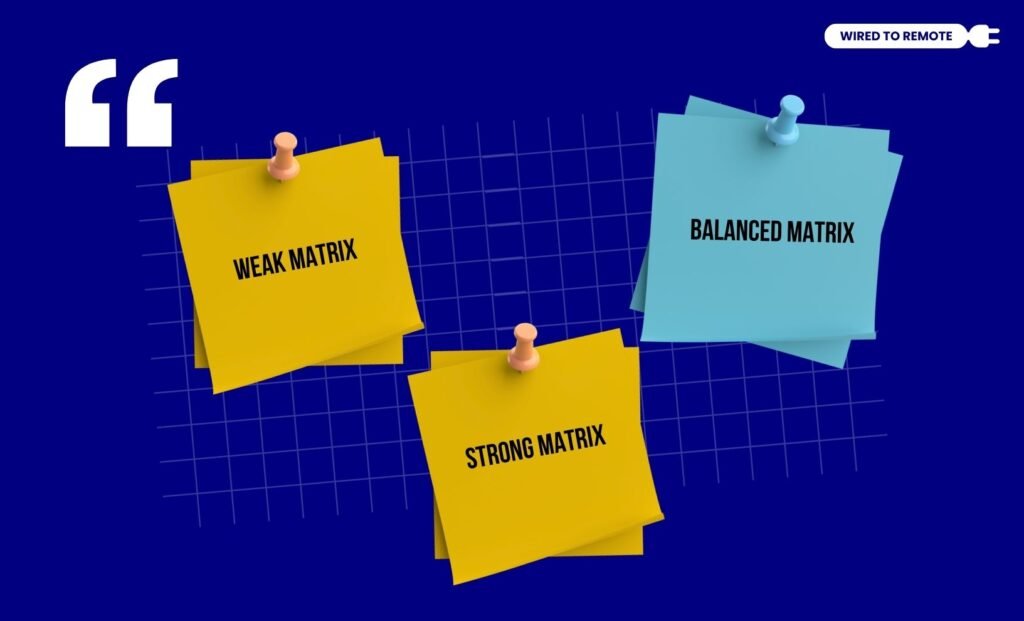
Companies use three common versions of a matrix organization.
1. Weak Matrix:
In a weak matrix, functional managers hold most authority. Project managers act more like coordinators. Moreover, employees still report mainly to their department manager.
2. Balanced Matrix:
In a balanced matrix, power is shared between both managers.
While functional leaders control staffing and skills, project leaders control schedules and deliverables. Also, many modern tech firms use this version.
3. Strong Matrix:
In a strong matrix, project managers have greater authority. They control budgets, timelines, and team decisions. Also, functional managers mainly support training and staffing.
Benefits Of A Matrix Organization:
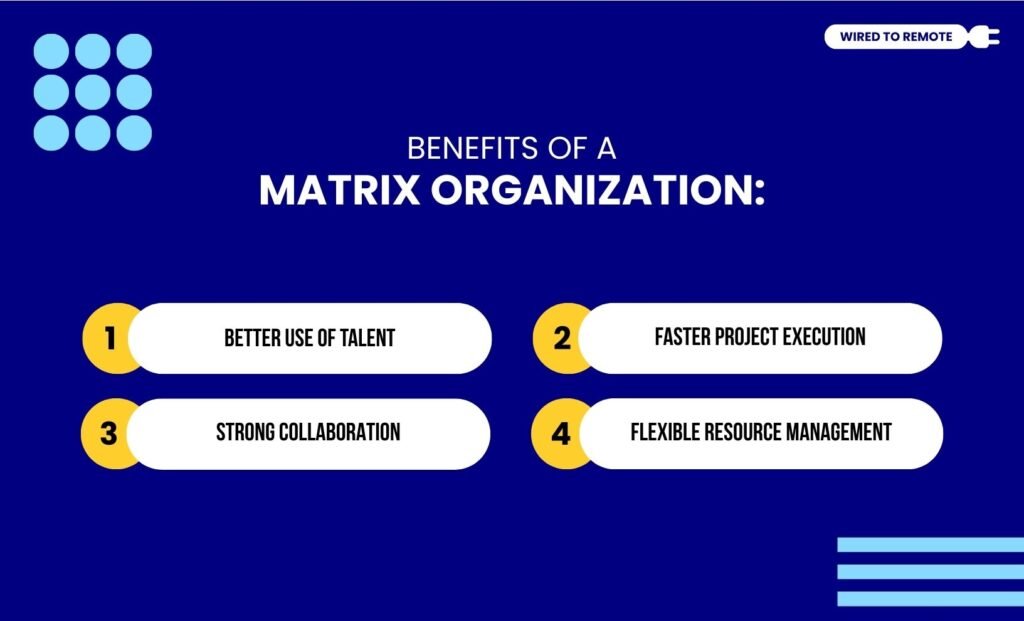
Of course, many companies adopt the matrix organization for several clear advantages.
1. Better Use Of Talent:
Employees can contribute their skills to several projects. Companies avoid hiring new staff for every project.
Personally, I started my career as a social media marketing executive.
But being from a Literature and writing background primarily, writing was a skill I had developed organically growing up.
It comes naturally to me – and it all started with my reporting head asking me to write a blog out of fun four years ago.
Currently, I write for a living and also work on social media projects. And this is only possible within a matrix organization.
2. Faster Project Execution:
Project managers can pull specialists from different departments quickly. Teams start work without long hiring delays.
Obviously, this one’s perhaps the biggest advantage of such an organizational structure.
Because one resource can contribute their skills to multiple projects, the turnaround time automatically goes down, ensuring faster execution.
3. Strong Collaboration:
A matrix structure connects departments that rarely interact. Marketing, engineering, and finance teams often work together.
In my experience, cross-department collaboration is a game-changer – it is not about working with other departments smoothly.
Rather, it is about contributing to the overall big picture – the success of the project. And for success, if strong collaboration across teams is necessary, then be it!
4. Flexible Resource Management:
Companies can shift staff when priorities change. A project that needs urgent help can receive experts within days.
And this makes life so much easier as compared to functional organizational structures, where finding a replacement often takes weeks and even months for senior roles.
Why? Because there is no flexibility in terms of resource management, a little flexibility and adaptability can ensure faster TADs and overall success.
Challenges Of A Matrix Organization:
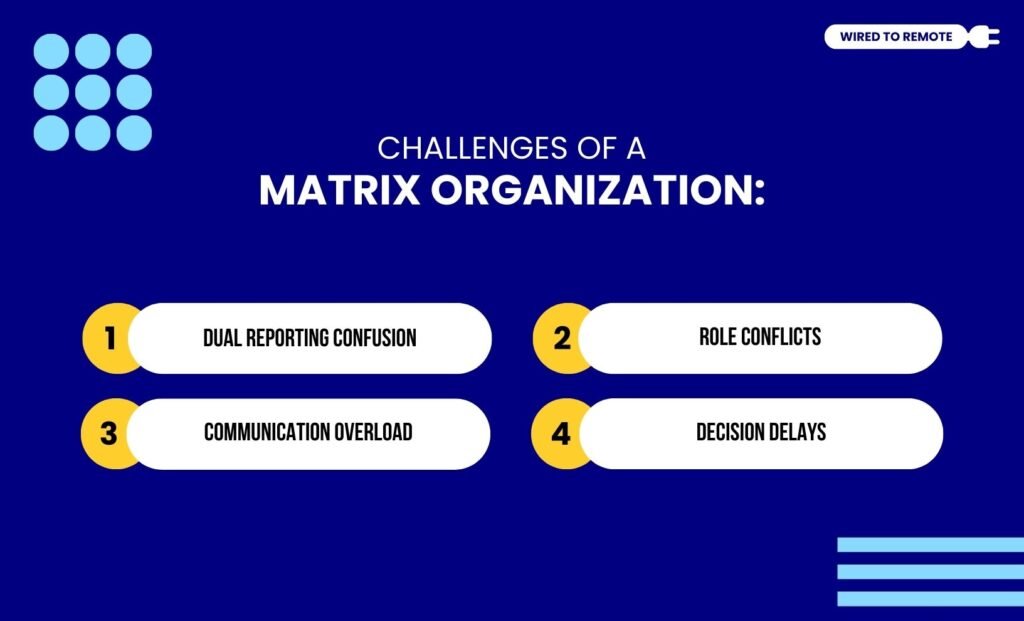
The matrix organization also creates management challenges – no structure is perfect, and the same applies to a matrix organizational structure.
Moreover, not all organizational structures are going to suit you. Personally, I am more suited to functional structures, thanks to clear reporting lines, defined hierarchy, and fixed SOPs.
Apologies for my rigidity, but then there are people who would choose a matrix organizational structure because they don’t care about hierarchy and structures.
And that’s absolutely fine. It’s always best to check out the pros and cons of any structure before you form an opinion.
On that note, let’s check out the challenges associated with a matrix organizational structure.
1. Dual Reporting Confusion:
Employees report to two managers. Sometimes those managers want different outcomes.
And that is where the problem starts – not for the managers, but for the employee reporting to two different people.
Unfortunately, this organizational structure faces issues related to dual reporting confusion.
I think with clear, transparent communication and defined job roles, this can be reduced, though it is easier said than done.
2. Role Conflicts:
A functional manager may push long-term training goals. A project manager may push short-term deadlines.
And this problem stems directly from dual reporting confusion. I mean, it starts with the employee’s confusion and attempts to appease both managers.
In the end, the outcome suffers, leading to conflict with the employee.
Also, nobody wants unnecessary drama at the workplace just because you have two managers who don’t agree with each other – so annoying!
3. Communication Overload:
Employees often attend meetings with two teams. Too many meetings slow down real work.
Again, this problem also stems from the last two issues I’ve highlighted above. First, there’s confusion, then conflict, followed by communication issues and ultimately unnecessary delays.
And if you haven’t faced this in real life, you would never know how annoying it gets.
Either nobody is talking, or they are talking too much, both of which will only distract you from the bigger picture.
4. Decision Delays:
Managers must align before making big decisions. This process can slow projects if communication is weak.
As I’ve been saying constantly, all the challenges of a matrix organization are related to one another. And delays are perhaps the end result of all the issues I’ve pointed above.
Nobody wants unnecessary delays – but then confusion, conflict, and communication issues work together to create delays in operational workflow.
Real-World Example Of A Matrix Organization:
Many global companies use matrix structures to manage large operations. A consulting firm with offices in 30 countries may assign consultants to global clients.
The consultant reports to a regional office manager. But the consultant also reports to the project leader serving that client.
This system helps firms deliver projects that require experts from many regions.
Another example appears in technology companies. Product teams often pull engineers, designers, and analysts from different departments.
The project manager drives the product launch. Department leaders still guide employee development.
When Should Companies Use A Matrix Organization?
A matrix organization works best under certain conditions.
Companies with multiple complex projects benefit the most. Organizations with highly skilled specialists also benefit.
Large global companies often use matrix systems because they share talent across locations.
But small businesses rarely need such complexity.
So, when does a matrix organization truly help a company grow? It works best when projects need many skills and departments must collaborate closely.
Key Takeaways:
The matrix organization blends functional expertise with project leadership. Employees report to two managers and work across multiple teams.
This structure improves flexibility, collaboration, and talent use. But it also demands strong communication and clear role definitions.
When managed well, a matrix organization helps companies deliver complex projects faster while developing employee skills at the same time.



Leave A Comment