

Can a style of leadership based on centralized decision-making and strict control help your organization grow successfully? Well, with autocratic leadership, it just might!
Autocracy has been around for a long, long time, especially in industries where clear direction and quick decision-making are essential.
The only problem? It heavily impacts adaptability and employee engagement.
Having said that, some of the most well-known leaders in history – from political figures to business executives – have depended on this strategy to maintain efficiency and order.
Moreover, while this leadership style is effective in a structured environment, it might not be the right fit for all workplaces.
As a result, understanding the different benefits, drawbacks, and applications in real-world scenarios is vital for decision-makers trying to improve their approach to management.
In this blog, I will explore the key characteristics of autocracy, how it fares compared to other styles of leadership, and real-world examples.
Also, you will see how you can use this leadership style to align with industry demands and the goals of your organization.
Stay tuned.
What Is Autocratic Leadership?
Autocratic leadership is a style of management in which the entire decision-making power rests with a single leader, with no input from other members in the group.
Moreover, an autocratic leader makes any decision solely on the basis of their perspectives and judgment, usually without considering the suggestions or opinions of others.
Such leaders usually enforce strict obedience, expecting the execution of their directives without any dissent.
This style of leadership is famous for its no-nonsense, direct approach to governance and management. Plus, it is highly effective in professional scenarios where any kind of ambiguity is a liability.
While the autocratic style of leadership involves firm and clear direction, it is blended with guidance anf support, encouraging inputs and nurturing a collaborative environment.
Key Characteristics Of Autocratic Leadership:
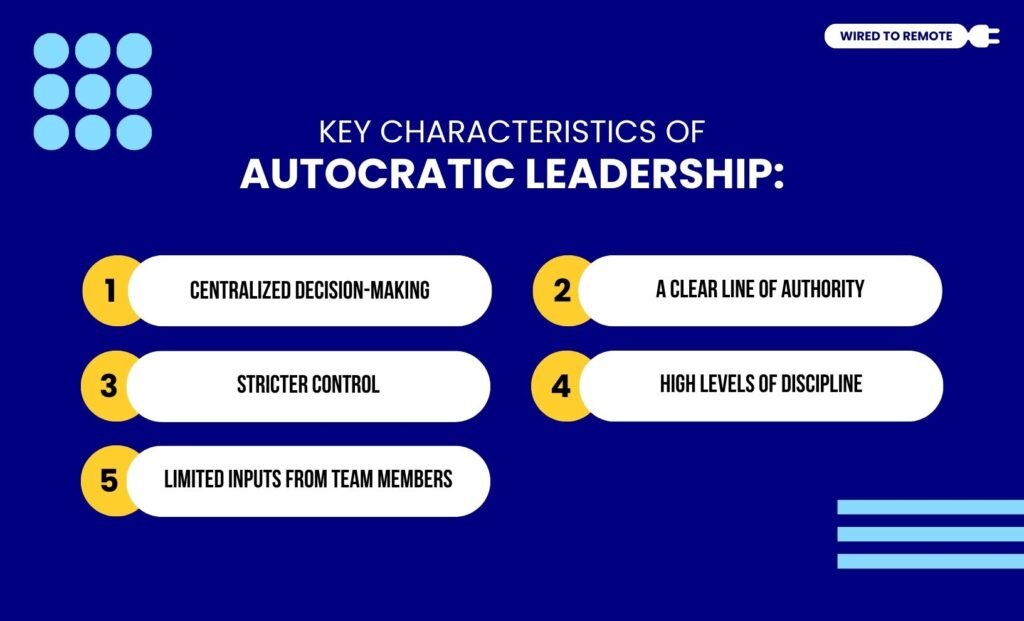
Since authority rests on one leader in this leadership style, you will see the leader has significant decision-making authority and control.
Also, team members and subordinates can only give minimal inputs. In this context, I’ve tried my best to highlight the key characteristics of an autocratic leader:
1. Centralized Decision-Making:
The autocratic leader typically holds all the power to make decisions.
So, they independently make decisions without discussing with others in their teams. No consultation necessary, if you want to decide on anything – sounds oddly powerful, doesn’t it?
2. A Clear Line Of Authority:
Autocratic leaders always establish distinct and clear lines of authority – they are always at the top, with their command flowing downward.
Also, there is complete clarity and transparency about who makes all the decisions – everyone knows who is in charge.
3. Stricter Control:
Autocratic leaders are known for having strict control over all their team members.
Moreover, they monitor the work of their team members closely, dictating how team members should complete their tasks.
This includes how much autonomy or flexibility every team member has at their disposal.
4. High Levels Of Discipline:
Autocratic leadership creates environments with discipline at its core.
In such settings, leaders will expect all team members to strictly adhere to rules and operational workflows.
The point? To reduce errors and boost operational efficiency, particularly in situations where precision is crucial.
5. Limited Inputs From Team Members:
Input or feedback from members in the team is generally kept to a bare minimum.
This is because the focus is primarily always on obedience and implementation, not collaborative issue-solving.
Also, the idea is that too many opinions and ideas might complicate simple tasks – remember, too many cooks spoil the broth.
What Are The Advantages Of Autocratic Leadership?
So, I’ve noted down all the major advantages associated with an autocratic style of leadership:
1. Fast Decision-Making:
The power to make decisions quickly without consulting with anyone is useful, especially in settings that need quick action.
2. Simplicity In Operational Workflow:
For big organizations or ones with complicated hierarchies, an autocratic style of leadership can easily simplify command chains, making it super easy to enforce policies and manage operations.
3. Order And Consistency:
This style of leadership ensures operational workflow is followed consistently, leading to organizational stability and predictable outcomes.
4. Optimal For Daily (And Routine) Tasks:
An autocratic style of leadership thrives in operations where any sort of innovation is less vital than speed and predictability.
What Are The Disadvantages Of Autocratic Leadership?
While an autocratic style of leadership is practical in some situations, it also comes with notable disadvantages that impact team dynamics, morale, and innovation.
1. Suppresses Innovation In Team Members:
Autocratic leaders can easily prevent the development of leadership skills in employees, reducing growth opportunities for meaningful contributions and initiative-taking.
2. Risk of low retention rates:
Employees who think their expertise and opinions are consistently ignored might become dissatisfied.
This can make it difficult for an organization to retain employees, significantly lowering retention rates.
3. Reduces employee morale:
The absence of involvement in the entire decision-making process can end up demotivating employees, reducing their satisfaction with the job.
4. Reduces creativity:
Centralized decision-making doesn’t leave any room for others to come up with anything innovative or contribute creatively.
As a result, it can suppress the creativity of team members, preventing the organization from making the most of diverse perspectives.
Autocratic Leadership Vs Other Styles Of Leadership:
| Leadership Style | Key Characteristic | Decision-Making Process | Focus | Employee Involvement |
|---|---|---|---|---|
| Autocratic Leadership | Centralized control with the leader making all decisions with zero consultation with others. | Leader-centric with zero or minimal team input. | Control and task completion. | Minimal to zero |
| Authoritarian leadership | Much like an autocracy, but harsher, with a strict focus on obedience. | Leader-centric with rigid expectations. | Discipline and adherence to rules. | Minimal to zero |
| Democratic leadership | All about group participation, with the leader taking inputs from everyone. | Collaborative and leader-driven. | Balancing team morale and tasks. | High involvement |
| Participative leadership | Emphasizes collaboration with decisions being taken collectively. | Shared decision-making. | Shared goals and team empowerment. | High involvement |
Real-World Examples Of Autocratic Leadership:
The autocratic style of leadership is prevalent across different sectors. This includes the military and the business world. On that note, I’ve discussed a few famous autocratic leaders:
1. Steve Jobs:
Apple’s co-founder is famous for his autocratic style of leadership and unilateral decision-making, especially about company direction and product design.
His strict sense of control helped to shape Apple’s technological innovation and brand.
When Jobs was developing the OG iphone, he rejected several prototypes that failed to meet these exact standards, sometimes even making decisions that did not align with expert opinions and market research.
Also, his infamous ‘reality distortion field’ strategy was a documented phenomenon in which Jobs used hyperbole, persuasion, and charisma to push his teams beyond perceived limits.
Jobs’ autocratic leadership, paired with his exceptional vision and keen market intuition, clearly demonstrated how Apple innovated, broke through, and grew despite everything.
2. Mary Barra:
General Motors’ CEO, Mary Barra, has always demonstrated an autocratic style of leadership while navigating her company through transformation and major challenges.
In 2014, Barra became CEO, inheriting a huge crisis around ignition switch safety that had led to several fatalities at the time.
Barra had responded with quick, unilateral action, going on to implement a detailed safety review across different product lines. Also, she started directing her company’s response to the issue personally.
Moreover, she controversially decided to recall more than 30 million vehicles and start a compensation fund for victims, in spite of the huge financial cost.
Under Barra’s leadership, General Motors has undergone a major transformation, including a shift towards EV technology and ambitious targets that shocked industry analysts.
3. Elon Musk:
As the head of several companies, Musk is famous for his highly directive, hands-on leadership style.
He independently makes major decisions about the business and sets high expectations fr the employees.
During the early production days at Tesla, Musk was directly controlling the entire manufacturing process.
He went on to implement 24/7 shifts and started personally reviewing engineering changes. Also, he started maintaining strict control over both operational and strategic decisions.
Similarly, for SpaceX, Musk has always insisted on revolutionary approaches and aggressive timelines to rocket design, usually overruling aerospace engineers with experience.
Musk’s leadership has pushed the boundaries of technology, disrupting established industries. However, it has also led to public conflicts with regulators and low employee retention rates.
How To Lead Effectively With Autocratic Leadership?
The autocratic style of leadership comes with its own set of strengths and weaknesses.
As a result, it is essential to find out whether this leadership style aligns with a company’s objectives and culture.
While this leadership style can build clear direction, support decision-making, and drive efficiency, it also limits creativity and reduces employee engagement.
Considering the weaknesses of autocracy, the best leadership style of a company primarily relies on the structure of the company, team dynamics, and industry demands.
Moreover, modern leadership is about adaptability and, more importantly, balancing authority with the skill to mix with employees.
Any leader who can identify when to enforce structure and when to motivate participation will obviously become more successful in managing team dynamics, ultimately achieving success in the long term.
Frequently Asked Questions:
Check out the most frequently asked questions related to autocratic leadership:
Autocracy isn’t good or bad – you can’t really judge like that! It depends entirely on the situation – in some cases, it is highly effective. For example, for handling inexperienced teams, responding to crises, and working in the manufacturing industry. Moreover, it works best when the situation demands quick and decisive action, but it will fail wherever inputs or creativity are essential.
Yes, autocracy can work in a modern workplace. However, the effectiveness of autocracy in the modern workspace is entirely situational – and not applicable universally. It is perfect for high-stakes scenarios, crisis management, healthcare environments, and in the manufacturing landscape.
In an autocracy, the leader solely enjoys the decision-making power – they don’t need to consult with anyone and can decide on anything independently. Once they make a decision, they can go ahead with imposing it, expecting team members to follow through obediently. In contrast, democratic leaders actively involve their team members in the decision-making process.
In order to avoid the many pitfalls of autocracy, including high turnover, stifled innovation, and low morale, leaders need to foster open communication, inclusivity, and trust, while maintaining a clear, decisive direction. Also, the key strategies in this context include delegating responsibility, identifying contributions, and encouraging feedback from the team.



Leave A Comment