Most companies believe they already have a solid employee reward system in place. On paper, it usually looks solid. There are bonuses, incentives, and maybe even a monthly recognition post.
But if you look a little closer, the system often doesn’t land.
Employees don’t feel motivated. The same people keep winning. Others stop trying after a point. And slowly, the whole thing turns into a routine no one takes seriously.
So the real issue is not about having a reward scheme. It’s about whether it actually works in daily work life.
And that is precisely why I am here today – to discuss what a successful employee reward scheme is made of, and more importantly, why so many companies get it wrong.
Stay tuned.
Where Reward Schemes Start Breaking Down?

The biggest problem is timing.
So, when someone puts in extra effort, solves a difficult problem, or helps the team hit a deadline.
But recognition comes much later – sometimes weeks later, and sometimes at the end of a quarter. By then, the moment has passed.
Then there is the issue of clarity. Many systems use vague terms like ‘excellent work’ or ‘strong contribution.’
That sounds good, but it doesn’t guide behavior – people don’t know what to repeat.
Additionally, another common issue is silent favoritism.
Even if managers don’t intend it, patterns start forming. The same employees get noticed again and again, while others start feeling invisible.
At that point, the system stops motivating people. Instead, it starts dividing them.
What Employees Actually Respond To?
It’s easy to assume that money is the main driver. It is important, no doubt. But it’s not the only thing that matters.
In many cases, employees respond faster to simple recognition.
For example, a quick acknowledgment in a team call or a direct message from a manager. Even a short line like “that really helped the team” can have a strong effect.
It feels immediate and real.
Also, there is a growing preference for flexibility. While some employees would choose time off over a small bonus, others might value learning opportunities or visibility within the company.
So the idea that one reward fits all doesn’t hold up anymore.
Different Types Of Rewards (And When To Use Them)
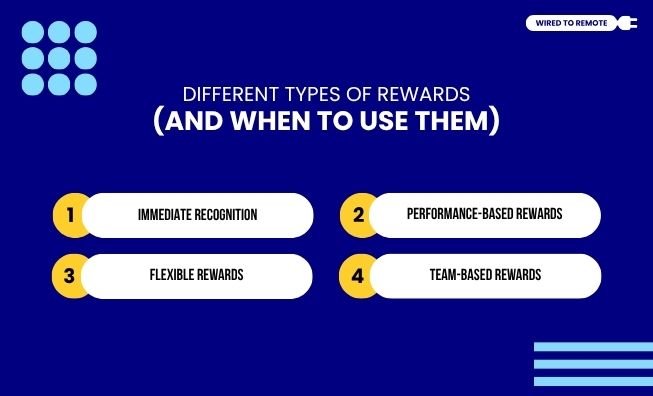
A good employee reward scheme doesn’t rely on just one format. Instead, it mixes different types, depending on the situation.
1. Immediate Recognition:
This is the simplest and most effective form. So, when someone does something well, acknowledge it right away.
Also, don’t overthink the format – it can be public or private, depending on the person. The key is timing and not the format.
2. Performance-Based Rewards:
These work best when outcomes are measurable. Sales is the easiest example. Close deals, earn incentives – the connection is clear.
But in roles where output is less defined, you need to be careful.
Also, if people don’t understand the target, they won’t chase it. As a result, in such cases, clarity and transparency become essential.
3. Flexible Rewards:
This is where many companies are starting to shift. Instead of fixed rewards, they offer options. Employees can choose what they value most.
For example, it could be a bonus, a day off, a course, or even a work-from-home week. This approach makes the system feel more personal.
4. Team-Based Rewards:
Individual rewards can sometimes create quiet competition. That’s not always bad, but it can hurt collaboration over time.
Team rewards balance this out. When a group hits a shared goal, everyone benefits. It builds a sense of collective effort, which is often missing in performance-driven setups.
How To Build An Employee Reward Scheme That Feels Real?
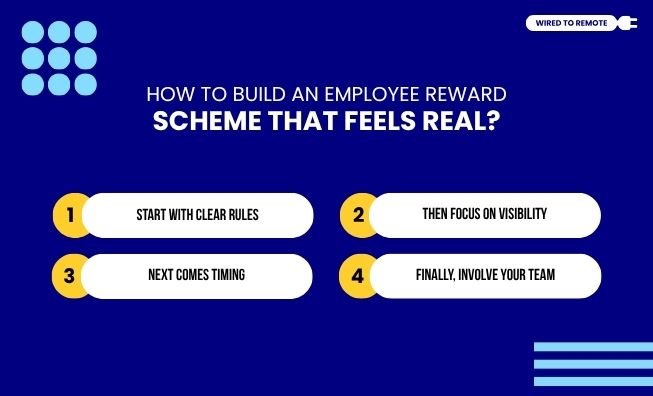
You don’t need a complex framework. In fact, the more complicated it gets, the less people engage with it.
- Start with clear rules: Define what actions or outcomes lead to rewards. Avoid broad language. Also, be specific enough that anyone on the team can understand it.
- Then focus on visibility: Talk about the system often. Mention it in meetings. Moreover, share examples of people earning rewards. This keeps it active in people’s minds.
- Next comes timing: This is where most systems fail. Recognition should feel connected to the action. So, if there’s a long gap, the impact fades.
- Finally, involve your team: Ask them what they value. You might be surprised by the answers. While some may prefer growth opportunities over cash, others might want more flexibility. Also, when people feel heard, they engage more with the system.
A More Realistic Example:
Let’s take a small content or marketing team. Instead of building a heavy reward structure, they try something simple.
Each week, they highlight one or two pieces of work that performed well. Not just in terms of numbers but also in terms of effort.
For measurable success, like high traffic or conversions, they attach a small bonus.
Moreover, for consistent performers, they offer occasional time-based rewards, like a half-day off or a flexible week. Over time, something shifts.
People don’t just focus on finishing tasks. Instead, they start paying attention to quality. They share ideas more openly. Also, they even appreciate each other’s work more.
The system doesn’t feel forced – it becomes part of how the team operates.
Mistakes That Quietly Kill Reward Systems
Some mistakes are easy to spot. Others build slowly.
One common issue is overcomplicating the system. Too many rules, too many categories, too many conditions. The problem? People lose interest.
Another mistake is ignoring mid-level performers. So, if only top performers are rewarded, others stop pushing themselves.
Delays, again, play a big role. As a result, even a good reward loses value if it comes too late. And finally, not updating the system.
So, what worked a year ago may not work now. Teams change. Priorities shift. The reward system should adapt too.
An Employee Reward Scheme Is A Transparent Reflection Of What An Organization Values:
An employee reward scheme is not just a policy or a checklist. Instead, it’s a reflection of what a company values.
So, if done right, it makes people feel seen, appreciated, and motivated to do better work. Also, if done poorly, it becomes background noise.
The difference is not in how much you spend. It’s in how real the system feels to the people it is meant for.



Leave A Comment