- AI in hiring has massively transformed the recruitment process. Making it efficient, fast, and streamlined.
- It improves recruitment by automating administrative tasks, screening potential candidates, and enhancing the candidate experience.
- But it comes with certain unique challenges and ethical considerations— lack of data governance, algorithmic bias, lack of transparency in processes, issues with candidate evaluation, and resistance to adoption.
When AI technology emerged, it massively impacted diverse industries. And the recruitment industry was not left out of the lot.
Unlike other implementations of AI in different sectors, its adoption in the hiring sector has transformed the entire remote recruitment process. Making it more data-driven and efficient.
Moreover, AI recruitment tools provide countless benefits— automating tasks, enhancing employee onboarding, and optimizing workforce planning.
According to the SHRM Labs report, around 35% to 45% remote-first companies have started adopting AI in hiring to simplify the process.
In addition to this, recruiters can use AI to reach a wider talent pool, make bias-free decisions, and predict future hiring trends based on historical data.
So, naturally, they are readily adopting these revolutionary tools.
But implementing these tools is not that simple. That is, it comes with many challenges and ethical issues. So, it is better to know the challenges and their overcoming strategies.
In this blog, I am going to delve into exactly that. That is, by highlighting the diverse aspects of AI in hiring, I am going to focus on—
- How AI revolutionized remote hiring,
- Its key benefits and best practices,
- AI hiring challenges, and more.
So, come dive right into it!
How Is AI Transforming Remote And Global Hiring?
Adoption of AI in recruitment has transformed how remote and global hiring used to work. So, by automating repetitive hiring tasks, AI allows remote recruiters to focus on high-value activities.
Moreover, AI in remote hiring helps with assessing a large pool of talent. That is, it eliminates the tedious process of manually screening candidates with automated recruitment solutions.
According to the World Economic Forum report—
Approximately 88% of companies already use some form of AI for initial candidate screening. Despite widespread adoption, skepticism persists regarding AI’s effectiveness in recruitment. This is understandable given that traditional AI systems still largely rely on self-reported candidate information, making them susceptible to inaccuracies.
In addition to this, the AI tools screen the resumes to analyze the skills, relevant experience, and the candidate’s behavioral traits. That is, only potential candidates are shortlisted.
Along with sourcing and screening candidates, AI HR technology also schedules the initial interview rounds. So, the best-fitting candidate can be filtered out of the huge lot of applications in a jiffy.
So, in remote or global hiring, an AI-integrated recruitment process provides data-driven candidate screening. Making the process efficient and less biased.
Key Benefits Of AI-Powered Hiring Systems
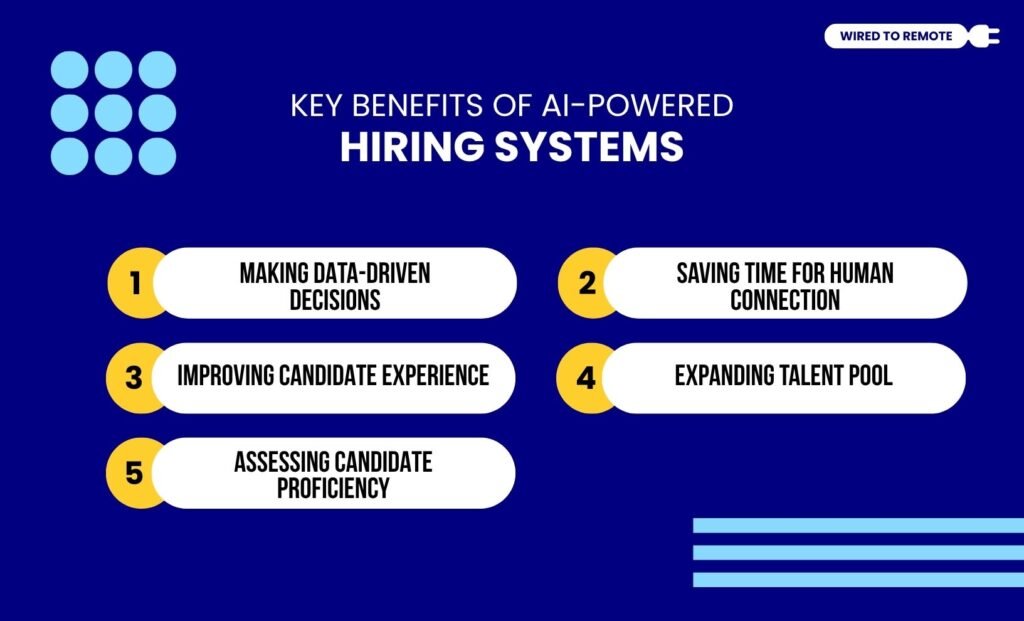
Some of the key benefits of adopting the AI-powered hiring systems include—
1. Making Data-Driven Decisions
Firstly, the data-driven insights from the AI-powered recruitment tools help remote hiring managers to make better decisions. So, they can build personalized recruitment strategies, hire the right candidates, and improve their talent pipeline.
2. Saving Time For Human Connection
Moreover, with automated hiring processes, remote recruiters save time, which they can use for performing other high-value tasks like building human connections. So, remote recruiters can focus more on human-centric activities to improve the quality of hiring.
3. Improving Candidate Experience
In addition to this, the AI tools help improve the overall candidate experience on the hiring platforms. So, by streamlining the process, it maintains the candidate touchpoints while engaging them in the application for the role.
4. Expanding Talent Pool
Unlike traditional hiring, AI-powered recruitment reaches a wider and more diverse talent pool to find the best-fitting candidate. So, the tools can help identify active or passive candidates based on their skills, experience, and backgrounds.
5. Assessing Candidate Proficiency
Finally, the AI hiring tools help with evaluating the candidates’ proficiency with efficiency. So, recruiters no longer need to manually screen, evaluate their proficiency, or match candidates across the job requirements. All this can be done by the AI tools.
Challenges Of AI In Remote Recruitment
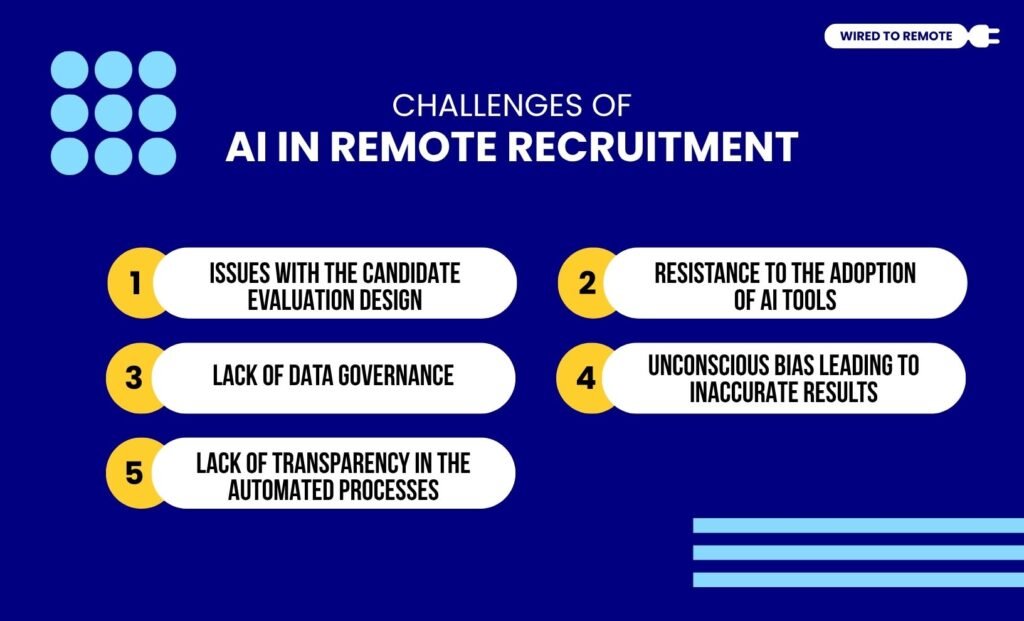
Even though AI in hiring improves efficiency, proper decision-making, and broader talent pool access, there are some challenges with its adoption, which include—
1. Issues With The Candidate Evaluation Design
Firstly, the candidate evaluation design acts as the foundation for filtering out the potential candidates from a huge list of applicants. So, when there are issues with the design, the candidate assessment is highly affected.
That is, if the questions on the assessment are not able to gauge the proficiency of the candidate. Then, recruiters might end up shortlisting the wrong candidates for the role.
2. Resistance To The Adoption Of AI Tools
Even though AI is readily adopted by most companies, some firms are still reluctant to integrate AI into their recruitment process. So, the resistance to adoption can affect the streamlining of the entire process.
3. Lack Of Data Governance
In addition to this, the lack of data governance policies for the AI tools makes their implementation challenging. Given that the HR department handles a huge amount of sensitive candidate data, having a proper data governance policy is important.
According to the report from TechTarget—
Most organizations’ data policies and procedures don’t have AI governance embedded into them because it’s a new thing.
4. Unconscious Bias Leading To Inaccurate Results
Even though AI potentially eliminates human bias, it brings in a different kind of mechanical bias. That is, it eliminates the resumes of candidates that do not match the job description.
And, this can lead to losing a potential candidate with a not-so-good resume. So, using the automation of the AI tools blindly can impact the hiring process.
5. Lack Of Transparency In The Automated Processes
Most AI hiring tools do not show the workings behind the automated processes. That is, these do not provide a clear explanation of how they filtered the candidates.
Moreover, the lack of transparency can make it difficult to determine where the bias is happening. So, recruiters cannot ensure a fair and compliant recruitment process.
How To Overcome These Challenges?
Even if AI in hiring comes with some unique challenges, recruiters can easily overcome them with the right measures. So, here are some measures—
- Firstly, remote recruiters need to regularly audit and supervise how the AI tools are screening candidates to ensure there are no issues.
- Moreover, the AI tools should be implemented strategically so that the process is neither completely reliant on AI nor on humans.
- In addition to this, remote companies should incorporate robust data security systems to ethically and legally use the candidate data.
- Finally, constant training should be provided to the HR professionals to increase their proficiency in handling the tools properly.
According to the Deel report on how AI in hiring should work—
It is now less about changing the way people work. Instead, AI enables people to forget all the boring administrative tasks they were forced to do and let AI take over so they can focus on creating great relationships with other human beings.
Best Practices For Using AI In Hiring Processes
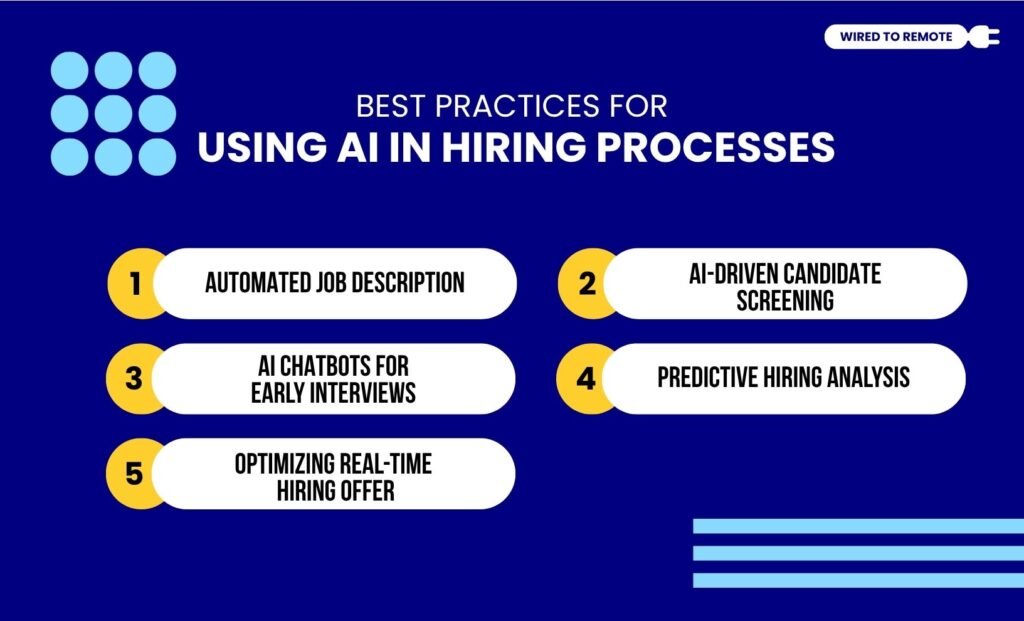
Since implementing AI in the recruitment process can improve efficiency and hiring decision-making, here are some best practices to adopt it—
- Automated Job Description: By using Gen AI, remote recruiters can easily create job descriptions before posting them. So, they can tailor the job description for the specific roles and personalize the screening process.
- AI-Driven Candidate Screening: Also, the AI tools can be used for efficient candidate resume screening. So, the tools can match the candidate’s profile with the job requirements and filter the ones with the right skills, qualifications, and experience.
- AI Chatbots For Early Interviews: To handle the initial interviews, recruiters can use the AI chatbots. So, these bots can conduct the pre-screening assessments, schedule interviews, and handle the candidate interactions.
- Predictive Hiring Analysis: Additionally, the AI tools can be used for analyzing the historical hiring data to predict future trends. So, the recruiters can strategize and modify their recruitment process based on the predictive insights.
- Optimizing Real-Time Hiring Offer: Finally, the AI tools can help with crafting the perfect offer letter that satisfies both the candidate and the recruiter’s interests. So, they can make faster hiring decisions with the right candidates.
Ethical Considerations And Expert Insights On AI-Driven Recruitment
As AI is slowly becoming more and more popular among the best recruitment agencies, certain ethical considerations have emerged.
So, to ensure that ethical AI hiring is carefully used for fair practices, here are some of these considerations—
1. Eliminating Bias With Diversity In Training Data
Since AI recruitment models can give biased results, it is essential to train the models with diverse historical data. This way, the biased responses can be easily mitigated. So, the models will no longer recommend candidates with biased screening.
2. Providing Data Privacy And Security
Generally, the HR department holds onto a massive amount of sensitive candidate data. That is, ethical concerns arise with how this data is processed and stored by the company.
So, by incorporating robust data protection systems, remote companies can provide the necessary data privacy and security. Moreover, transparently stating how they use the candidate data can also resolve this ethical concern.
3. Promoting AI Algorithmic Transparency
Given that most AI tools do not show the algorithmic procedure for the candidate recommendations, this leads to an ethical concern about how the hiring decisions are made.
So, recruiters need to use transparent AI models that clearly show how the candidates are sourced, screened, and recommended. This way, the ethical issues can be avoided.
Expert Opinions On Safe AI Hiring Practices
According to the hiring expert’s opinion on Taylor Hopkinson about the responsible use of AI in recruitment—
AI could revolutionize recruitment practices, but it’s crucial to approach its implementation with caution and responsibility… by embracing ethical AI and human-centric approaches, we can ensure that AI serves as a tool for positive change in the recruitment industry.
Moreover, another HR manager comments on LinkedIn about AI in hiring—
In the rapidly evolving landscape of AI-driven HR processes, ethical considerations are paramount to ensuring fairness, transparency, and trust. Organizations must actively engage with these considerations, implementing robust strategies to address bias, protect data privacy, and enhance transparency.
Additionally, Professor Karim Lakhani, teaching AI Essentials for Business, in a report on Harvard Business School, comments—
The extent to which, as these firms drive this immense scale, scope, and learning, there are all kinds of really important ethical considerations that need to be part of the management, the leadership philosophy from the get-go.
What Are The Future AI Recruitment Trends?
Apparently speaking, the future of AI in hiring is quite promising. With emerging trends like AI-driven job portals and HR models, the entire hiring process anticipates much transformation.
Firstly, AI-powered job platforms can essentially match the candidates with their best-fitted job openings. So, reducing the application process time and finding potential candidates faster.
Moreover, the continuous innovation in AI HR technology can optimize the hiring workflow and mitigate biases further. So, remote recruiters can find the best-fitting talent with more efficiency.
Things To Keep In Mind With AI In Hiring
Given that AI in hiring can literally bring in the futuristic recruitment models for remote organizations, they are being readily adopted around the world.
But simply implementing AI in HR processes is not enough. So, here are some key considerations to make while using AI recruitment models—
- Choosing a transparent and efficient model to provide refined recruitment strategies, reduce bias, and enhance candidate experience.
- Monitoring the AI tools with proper human supervision to identify challenges and mitigate them at the earliest.
- Using proper data security measures to avoid mishandling the sensitive candidate data.
Now, with AI evolving, embracing its powered recruitment solutions is no longer a choice. But a necessity. So, improve your recruitment process by employing the best-fitted AI model today!
FAQs
Here are some common questions about AI in hiring that remote recruiters can check.
AI technology’s incorporation in the recruitment industry massively improves the entire hiring process. That is, the AI-driven recruitment tools automate resume screening, candidate sourcing, interview scheduling, and conducting real-time communication.
Moreover, they offer personalized recruiting strategies and data-based predictions. So, recruiters can make faster hiring decisions with more efficiency.
Even though AI recruitment provides many benefits, it comes with a lot of unique risks. Some of these risks of using AI include—
• Algorithmic biases based on historical data
• Non-transparent hiring procedures with AI models
• Issues with data privacy and security
• Lack of human connection in the hiring process
• Technical issues with incorporating the AI technology.
Honestly speaking, AI has the potential to eliminate bias in hiring, but with certain challenges. That is, AI can reduce human bias and favoritism.
But if it is not trained with diverse historical data, it can make biased candidate recommendations. So, based on the dataset used for the model, it can give biased or unbiased results.
Generally, AI hiring platforms use machine learning and natural language processing (NLP) to streamline the entire recruitment process.
That is, they automate the repetitive tasks, customize strategies, and optimize the hiring workflow. So, the remote recruiters can source and hire potential candidates more efficiently.
Since the hiring processes are long and take time, the AI models help with enhancing the candidate experience by providing time-to-time updates on their application process.
Moreover, they offer instant communication through chatbots, schedule interviews, and reduce bias by evaluating candidates on their merit.
Even though AI offers diverse innovative features, it cannot replace human recruiters. Moreover, AI is designed to enhance the recruitment process by automating processes and providing unbiased recommendations.
But without the monitoring of the human recruiters, it faces certain difficulties. So, only combining both human recruiters and AI hiring tools can improve the overall recruitment efficiency.
Given that small businesses lack funding for digital transformation, they can use simple but scalable AI hiring tools. That is, they can implement AI to screen the candidates, schedule interviews, and enhance the candidate experience with the chatbots.
Also, they can use Gen AI to create job descriptions and real-time offer letters for hiring the right candidates. And, as the businesses expand, the tools can be scaled accordingly.
Some of the safety measures for using AI recruitment processes include—
• Diversifying the training data to avoid unconscious bias
• Using tarnsaparent algorithmic AI models
• Regularly monitoring and auditing the AI tools
• Providing data security and privacy for managing sensitive candidate data.

Leave A Comment