
Being a digital nomad is not easy. You need to travel the world while juggling your project deadlines. Shifting life from the comfortable office chair to the adventurous world.
And, sometimes finding affordable accommodations in some of the best destinations for digital nomads can be tricky.
But with the prebooking system of modern travel apps, it has become easy to choose a roof over your head right from your phone.
Among the many apps available, Airbnb and Booking.com have taken the internet by storm. Offering a unique and wide variety of staying options to travelers.
But the real question is— “Which one is perfect for digital nomads?”
Well, no need to look any further, your remote buddy’s got your back. In this Airbnb vs Booking.com blog, I will be discussing the diverse aspects of both the apps to highlight—
- Their key differences,
- Customer support provisions,
- Tips to choose the right platform, and more.
So, come dive right in!
Airbnb vs Booking.com: Key Differences
Before knowing their differences, do you know how these travel apps exactly work?
For instance, Airbnb and Booking.com both provide affordable staying options for short-term rental guests. But the platforms for each app are built differently.
That is, Airbnb is a guest-host centric model, while Booking is more of a hotel-centric model.
So, Airbnb provides personal stays, designed spaces, and opportunities to build connections between hosts and their guests.
On the other hand, Booking provides faster, efficient, and commercialized staying options for travelers. So, in a way, it works like a third-party hotel booking portal.
Naturally, since they are built differently, they share a variety of dissimilarities. Some of these include—
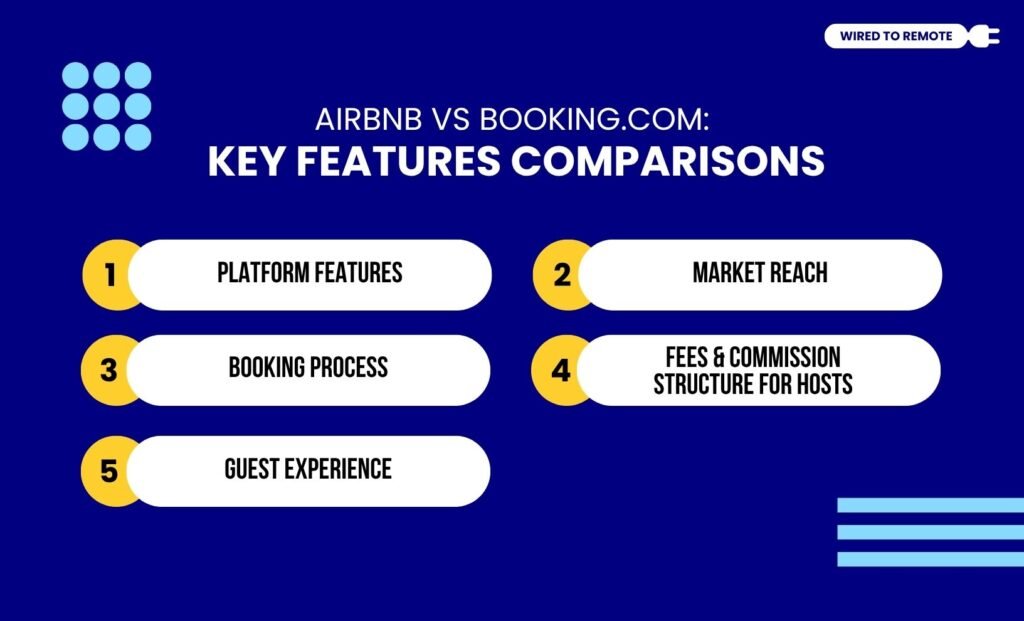
1. Platform Features
Even though Airbnb and Booking are travel apps, their platform designs are different. For instance, Airbnb’s design is more guest-focused.
So, it highlights authenticity, local experiences, unique properties, and flexible staying options for nomads.
But on the contrary, Booking is more host-centric. So, it covers businesses, commercial stays, traveler convenience, and hotel accessibility.
Moreover, hosts have less flexibility and control with Booking, while Airbnb allows anyone to offer their place for rental guests.
So, hosts follow a standardized process to list their places on Booking.
In addition to this, Airbnb’s listing covers unique places, homestays, apartments, and vacay houses.
But Booking offers only hotels, rental apartments, and traditional vacation places. Making it difficult for digital nomads to find affordable accommodation.
According to the report from Host Away on comparing these two apps—
Airbnb is known for its personality-packed stays. Alongside apartments and homes, you’ll find treehouses, castles, windmills, and more in its “OMG!” category. You can book an entire place — or share a room to save on cost. Booking.com leans more traditional. While it started with hotels, it now includes homes, apartments, resorts, and tiny houses, too. It doesn’t spotlight quirky stays like Airbnb, but it does offer travel extras like flights, car rentals, and bundled bookings.
2. Market Reach
As the platforms offer different types of lodging options, their customer base also varies.
Mainly, Airbnb is a preferred choice for young travelers and experience-driven nomads, who are constantly on the lookout for unique but affordable places to stay.
On the contrary, Booking is massively accessed by older generations, global travelers, and families. Helping them find a traditional apartment or hotel with room services.
Moreover, most Airbnb customers prefer longer stay options with unique experiences. But Booking customers choose short-term fixed-staying places.
As the report from Host Away points out—
Airbnb tends to attract younger, experience-driven travelers — especially Millennials and Gen Z. These guests often travel solo or with friends and are drawn to properties that feel unique, personal, or local. They’re looking for charm, character, and storytelling. Booking.com guests are more varied in age and travel type. Families, mature travelers, and business tourists make up a large portion of its audience. They’re often seeking straightforward accommodations with predictable service.
3. Booking Process
Since Airbnb’s primary focus is to build relations between hosts and guests, its booking process involves direct communication.
So, the guests can literally contact and book the place through communication.
But Booking has a hotel-centric approach, which makes the booking process platform-mediated.
So, users need to follow the standardized booking process on the platform without having any direct communication with the host.
In addition to this, both platform collects booking payments from the guests. But Airbnb pays the host after check-in, while Booking pays the host instantly.
4. Fees And Commission Structure For Hosts
Similar to most travel apps, both Airbnb and Booking charge their hosts for providing staying services.
For Airbnb, the fee and commission structure is a split setup. That is, the host and the guests pay service charges separately.
Now, the service charge for hosts starts from 3% of the price. And, that for the guests ranges around 14% of the total costs.
But Booking collects only host commissions. That is, no guests need to pay a single dime for their booking. But the hosts are charged around 14% – 15% per reservation.
As the report from uplisting points out about the two apps—
Airbnb’s model shifts more of the cost to the guest, which lets you stay competitive on nightly rates without giving up too much revenue. On Booking.com, the full commission comes out of your side, so you’ll need to build it into your pricing.
5. Guest Experience
Finally, the guest experience also differs. As Airbnb is guest-focused, it provides a detailed host profile of the guest reviews, descriptions, and unique local experiences.
Helping travelers choose a place after envisioning the details.
But Booking has a straightforward stance when it comes to guest experience. That is, it provides a detailed list of the key properties for a place — amenities and room services.
So, based on the kind of details you want to know before choosing a place, you can either find your nomadic resort through Airbnb or Booking.
Is There Customer Support For Airbnb And Booking.com?
Yes, absolutely. Both Airbnb and Booking provide a 24/7 customer support system.
While guests can find community-focused and query-resolving support from the Airbnb system. From Booking, they get a more efficient support that resolves issues quickly.
In addition to this, both the customer support actively help out travelers to easily book their accommodation. So, for digital nomadism, that’s more like a boon in disguise.
Tips To Choose Between Airbnb And Booking.com
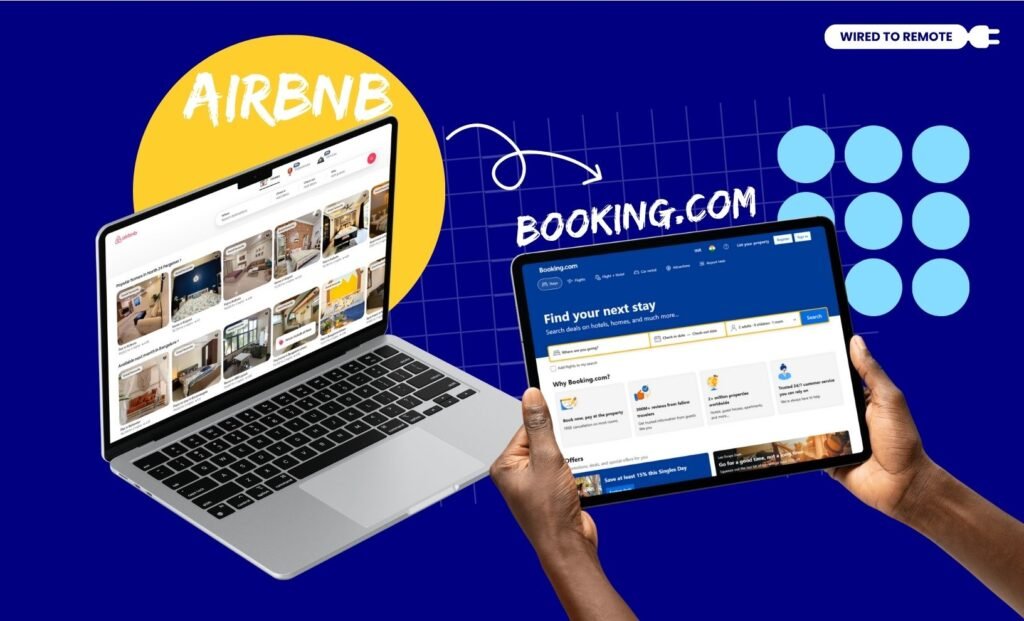
Now, the dilemma around Airbnb vs Booking.com is not gonna end soon. Where Airbnb rocks, Booking fails, and vice versa. So, there is no single winner of this battle.
But knowing which one will help you find better accommodations in your next digital nomad country is crucial. So, here are some tips to choose between them—
- Deciding on the kind of place you want to stay — if you want something unique, try Airbnb. But if you want a simple apartment, switch to Booking.
- Calculating the budget for your stay — if you want luxurious places with ample amenities, Booking will be perfect. Otherwise, go with Airbnb.
So, based on the kind of place and budget you have, you can make the choice between the two apps. And, if you are a digital nomad who hasn’t tried either of them yet, what are you waiting for?
Go ahead and plan your next nomadic accommodation with either unique Airbnbs or traditional Booking resorts.
FAQs
Here are some of the common questions most users look for while choosing between Airbnb and Booking.com.
Yes, absolutely. As a host with a property, you can easily list your place on both Airbnb as well as Booking. This way, you can gain a wider exposure to all kinds of travelers. And, this will also help you get more guests. But to manage both of them simultaneously, you need to keep a channel manager or digital tool.
The Superhost status on Airbnb actually comes with a lot of benefits. No wonder everyone is trying to achieve one. Some of its primary benefits include—
• Enhanced online visibility
• Higher booking rates
• Opportunity to grow your business sustainably
• Attracting more guests with an assured badge of quality
• Access to exclusive rewards
• Control over the premium pricing.
Since both are different platforms, they have different cancellation policies. For instance, Airbnb offers both flexible and strict guidelines based on the choice of the host. But Booking has a more flexible option with many zero-cancellation-charge policies. So, based on the host’s decision, the cancellation policies differ.



Leave A Comment