

Today’s topic: How to stay focused when working remotely?
I’ve been working remotely for 7 years now. And while I have had my share of ups and downs, figuring out how to stay focused when working remotely has been the biggest problem I’ve solved in the past couple of years.
So, if you are embarrassed about getting distracted once in a while (or all the freaking time), fear not! You are not the only one.
TSheets did a survey recently on remote workers and their fair share of distractions. Here’s what they discovered:

• 66% of remote workers in the survey said they get distracted often while working from home.
• In the same study, 25% of remote workers cited household chores as a significant distraction.
The survey indicated that distractions are common among remote workers, negatively impacting their productivity.
When you are working from home, staying focused can be challenging. I am an Instagram addict – and my phone would lure me from work every 30 minutes. I would tell myself to check my phone once, just to break the monotony. But eventually, I would be lying in bed, scrolling on Instagram for hours, all work forgotten.
And while my phone was my biggest distraction, it could be something else for you – a new show on Netflix, a good nap, a pantry full of junk food, or even laundry.
Moreover, it is so EASY to get distracted when you are working remotely – there is nobody to hold you responsible. It is highly possible that you are reading this blog at a time when you should be getting some work done.
(But don’t disappear – reading this is better than scrolling on social media.)
Thankfully, I have figured out the secret – learn how to stay focused when working remotely with a few easy strategies that you can implement today.
Stay tuned.
How To Stay Focused When Working Remotely?
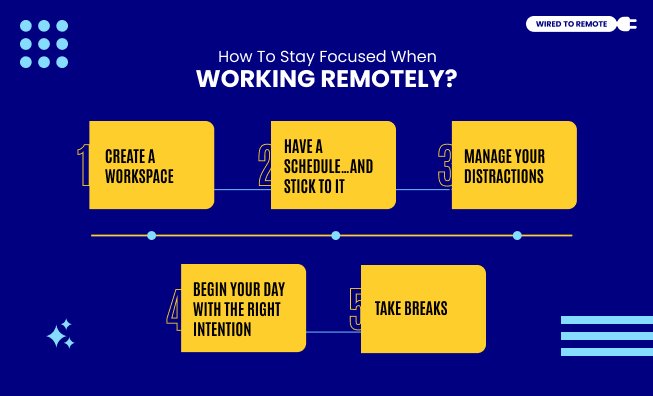
Here are some of the things that you can do to increase your productivity an stay focused as a remote worker:
- Create a workspace.
- Have a schedule.
- Manage your distractions.
- Begin your day with the right intention.
- Take breaks.
Let’s take a better look at them:
1. Create A Workspace:
When I started, I worked from bed. It was a disaster. Your brain associates your bed with sleep and scrolling.
Instead, you must create a physical boundary. You need a dedicated workspace to trigger a “work mode” mental state.
Specifically, your workspace doesn’t need to be a corner office. It can be a kitchen nook or a folding table in the living room.
The key is intentionality.
If you have roommates or family, avoid common areas. You cannot focus if someone is making a sandwich three feet away.
HR Insight: If you manage a team, encourage them to audit their home setups. A desk isn’t a luxury; it’s an ergonomic necessity.
- Declutter: Keep the surface clean to keep the mind clear.
- Lighting: Natural light boosts mood and focus.
- Ergonomics: Keep your laptop at eye level. Your neck will thank you.
2. Have A Schedule…And Stick To It:
Working remotely gives you the luxury of choosing your work hours. In that case, it is always best to align your work hours with the time of the day when you are most productive.
Moreover, it is easy to create a schedule – the real difficulty lies in maintaining the same schedule. So, I started structuring my day like I would at an office. I made a schedule with work hours – during my work hours, I would try to finish my designated work.
Once my ‘office hours’ end, I will not check my work emails or interact with clients. Similarly, during my work hours, I would refrain from doing household chores or meeting friends for coffee.
Ways to manage time and create a schedule:

• Pomodoro Method: In this method, you will have to work for 25 minutes, followed by a 5-minute break. After four ‘Pomodoros,’ you can take a long break of 20 to 30 minutes.
• Eisenhower Box: In this method, you will have to use a two-by-two grid to prioritize assigned tasks by importance and urgency. Based on a task’s priority in the grid, it gets scheduled.
• Eating The Frog: In this method, you must identify the most crucial task of the day - the one you are most likely to procrastinate on - and finish it first.
• Time Blocking: In this method, you have to divide the day into time blocks allocated to specific tasks. You have to finish the tasks within the allocated time.
If you create a daily schedule and follow it, your brain will learn when to work and relax. Additionally, creating a schedule with your daily tasks will ensure you have plenty of time to focus on priorities.
Adding time management to this mix will help to boost your focus, preventing you from feeling burnt out.
3. Manage Your Distractions:
The question of the hour is – how to stay focused when working remotely.
The real issue, my friends, happens to be the never-ending list of distractions we all encounter regularly. From your phone lying beside you like a ticking time bomb to household chores; we are spread thin trying to focus.
How to manage distractions?

• Use time management and productivity tools.
• Remove your smartphone and other gadgets from around you if it’s too distracting for you.
• Set clear boundaries in your personal and professional life.
• Use alarms and notifications on your desktop to divide your day into slots allocated to specific tasks.
While it is impossible to control external factors at times, there are certain things you can do to handle these distractions. One method that always works for me is setting boundaries in my professional and personal life.
For instance, my parents know that I’m working between 10 am to 7 pm – during this time, they don’t disturb me unless it is an absolute emergency that needs my immediate attention.
4. Begin Your Day With The Right Intention:
Another way to retain your focus during work hours is to start your day with the right intention. It is best to devise a morning routine, make it a habit, and, most importantly, be consistent.
Doing the same things every morning as a routine comes with multiple benefits:

• It makes your mind aware of the start of the day.
• It helps you focus on tasks you must complete by the end of the day.
• A routine helps you to do more work, preventing you from getting overwhelmed.
Moreover, there are several ways to come up with a morning routine. It might be simple and specific highlighting activities like dressing up, sitting at your desk, listening to a podcast, and listing your tasks. Or it could be something casual, like sitting at your favorite cafe and reading the morning newspaper.
Whatever routine you create, you must be consistent about practicing the same – it can increase your focus and productivity.
5. Take Breaks:
While taking breaks might sound counterproductive, the truth is regular breaks will boost your productivity, helping you stay focused.
If you take short breaks and go on a walk for fresh air or munch on some snacks, your focus will improve once you get back to work. Moreover, if you are not a fan of short breaks and find them incredibly distracting, you can schedule longer breaks for doing yoga or going to the gym.
Ideas For Break Activities:

• Meditate.
• Listen to some music.
• Stretch and move around.
• Do a few deep breathing exercises.
• Eat a few healthy snacks.
• Doodle or just daydream.
• Step outside and walk around.
It is so easy to get wrapped up in an interesting project and forget all about breaks – but understand that breaks are ideal for your well-being and health.
Sitting for an extended period of time is not healthy – your blood flow slows down, muscles get tightened, and you get more prone to injuries. Getting up and moving around counteracts these adverse effects.
In addition, breaks also boost your concentration. So, it is best to schedule regular breaks during your work hours. Just remember that when it is time to hit pause, pick activities that will relax your mind, allowing you to move around, breathe deeply, and effectively ‘zone out.’
The Digital Nomad Tech Stack: High-Tech Tools For Radical Focus
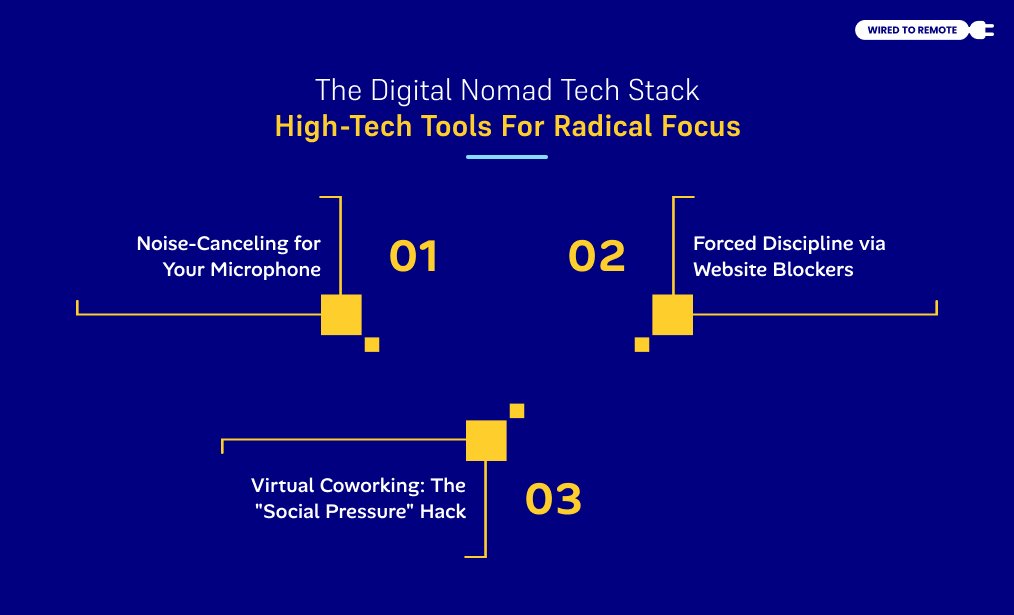
When your “office” changes every week, you cannot rely on willpower alone. You need a digital fortress.
As a nomad, your environment is unpredictable – think loud cafes in Medellín or spotty Wi-Fi in Bali.
To maintain a professional edge, I recommend building a “Focus Tech Stack” that automates discipline.
Noise-Canceling for Your Microphone
Physical noise-canceling headphones protect your ears, but what about your clients? If you are taking a meeting in a bustling environment, use Krisp.ai.
This AI-powered tool removes background noise – crying babies, barking dogs, or espresso machines – from both ends of the call.
Consequently, you sound like you are in a quiet boardroom, even if you are at a beach club.
Forced Discipline via Website Blockers
Let’s be honest: when work gets hard, Instagram feels easy.
Instead of fighting the urge, use Cold Turkey or Freedom. These aren’t just “reminders.” Rather, they are hard lockers.
You can set them to block social media, news sites, or even the entire internet for specific blocks of time. Thus, you eliminate the “choice” to procrastinate, forcing your brain to settle into deep work.
Virtual Coworking: The “Social Pressure” Hack
The biggest downside of remote work is the lack of “social mirroring.” When you see others working, like in a co-working space, you work. I use Focusmate or Flow Club to replicate this.
You book a 50-minute session and work on camera with a partner. Moreover, the accountability of a stranger watching you work – and checking in on your goals – virtually eliminates the temptation to pick up your phone.
Know How To Stay Focused When Working Remotely And Get Work Done!
Now, you know how to stay focused when working remotely.
The thing is, we have all struggled with focus while working remotely. It does not matter if it is your first day working remotely or your hundredth day. I mentioned in the very beginning how I had struggled for years before I could come up with a routine that worked for me.
So, think about it and begin with the smallest changes. Soon, you will be able to witness how these changes are impacting your focus and overall productivity.
The idea is to learn how to stay focused when working remotely – what works for YOU? What keeps you focused, and what distracts you? Figure that out and start improving your productivity today!


Leave A Comment