The topic of the day: Online assessment in remote hiring.
You see, hiring for remote roles isn’t just a challenge. It is a complete strategy shift. We have watched countless managers hunt for “perfect” resumes.
They find a candidate with an Ivy League degree and a decade of experience. Then, they hire them. Within a month, the wheels fall off.
Why?
Because that candidate couldn’t handle a Slack-driven workflow. They struggled with asynchronous communication. They lacked the self-discipline to work without a boss watching over their shoulder.
Let’s face it – the traditional hiring model is broken for the digital age.
We rely too much on “pedigree” and not enough on “proof.” This is where online assessments change the game. Experts view these tools as the “secret weapon” for the modern recruiter.
They allow you to stop guessing. They allow you to start measuring.
What Makes A Great Resume?
Resumes are marketing brochures. They tell curated stories. Often, those stories don’t match reality.
A candidate might list “Expert in Python” or “Master Communicator.” But what does that mean in a remote context?
In my experience, a resume rarely reveals if someone can troubleshoot a server at 3:00 AM without guidance. It doesn’t show if they can write a clear, concise project update that prevents a meeting.
Consequently, relying on resumes alone leads to a massive waste of time. You spend weeks sifting through hundreds of applicants. You base your initial decisions on guesswork.
Instead, assessments help you dig deeper immediately. They cut through the “fluff.” They reveal technical expertise. Most importantly, they highlight remote-ready traits like adaptability and self-discipline.
A LinkedIn study recently found that 76% of hiring managers now prefer assessments. They want to focus purely on skills. I agree with them. (Source: LinkedIn Hiring Statistics)
When you move the “test” to the front of the funnel, you change the power dynamic. You stop looking for a “good interview” and start looking for a “good worker.”
Understanding The Toolkit: What Are Online Assessments In Remote Hiring?
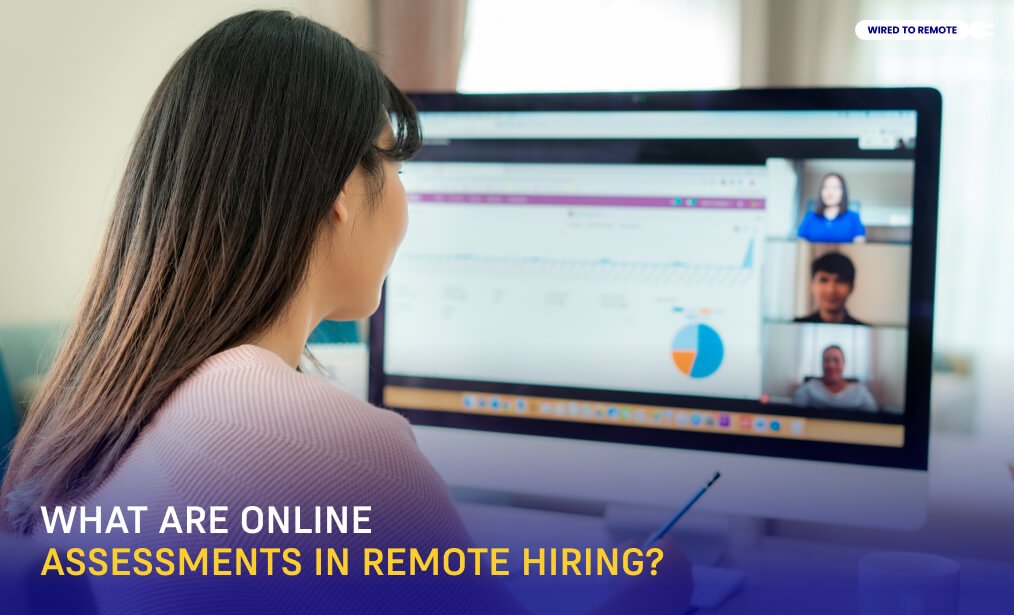
I view online assessment as a deep-dive diagnostic tool. They aren’t just “multiple-choice quizzes.” They are simulations of the job itself.
For example, if you are hiring a developer, you don’t care about their GPA. You care about their code. You use a coding challenge, and watch how they solve a bug. And you would check if they leave clear comments for their teammates.
Furthermore, for a project manager, you would use a situational judgment test. In that case, you want to see how they handle a missed deadline in a different time zone.
The data supports this “evidence-based” approach.
Mercer found that 74% of companies using these tools make better hiring decisions. They aren’t just hiring faster. Rather, they are hiring people who stay longer. (Source: Mercer’s 2025 Global Talent Trends Study)
These tests measure the “Big Three” of remote work:
- Technical Proficiency: Can they actually do the task?
- Cognitive Ability: Can they solve new problems without a manual?
- Soft Skills: Can they communicate effectively in a text-heavy environment?
Speed As A Competitive Advantage
In the remote world, speed is everything.
If you find a great candidate in the Philippines or Poland, you aren’t the only one looking at them. The best talent gets hired in days, not weeks.
However, traditional hiring is slow. It involves endless screening calls and “getting to know you” chats.
Similarly, Talent Board research shows that assessments improve “time-to-hire” by 36%. By automating the first hurdle, you filter out unqualified candidates instantly. (Source: inFeedo)
You don’t waste thirty minutes on a phone call with someone who can’t actually use your software.
Thus, you spend your valuable energy interviewing only the top 5%. These are the people who have already proven they can do the work.
Remote-first pioneers like Zapier and GitLab have mastered this. They don’t have “hiring seasons.” They have “hiring systems.”
Basically, they use automated tests to keep their pipeline moving 24/7. This allows them to snag top-tier talent while their competitors are still reading cover letters.
The Fairness Factor: Leveling The Global Playing Field
One of my favorite things about assessments is how they promote equity. Traditional hiring is riddled with unconscious bias.
We tend to hire people who look like us or went to the same schools. As a result, we miss out on incredible talent from non-traditional backgrounds.
Online assessment doesn’t care about your zip code. They don’t care about your age or your gender. They only care about your output.
Consequently, you discover “hidden gems.” You might find a self-taught designer in a small village who outperforms a big-agency veteran.
By ignoring the “pedigree” and focusing on the “product,” you build a more innovative and diverse team.
A Win-Win For The Candidate
We often talk about the employer’s benefits. But what about the candidate? I believe assessments actually improve the candidate experience.
First, they reduce “interview anxiety.” Not everyone is a great talker. Some of the best remote workers are introverts who shine when they are “in the zone.” Assessments let them prove their worth through action.
Moreover, it provides clarity. A well-designed test acts as a “realistic job preview.” If a candidate struggles with the assessment, they realize the role might not be right for them.
It is much better to find this out during a two-hour test than two months into a new job. Candidates feel more confident knowing they earned the role based on their performance, not their personality.
The Ripple Effect On Company Culture
The impact of a bad hire is magnified in a remote setup. One person who can’t manage their time can stall an entire team.
One poor communicator can cause “Slack-fatigue” for everyone else. Additionally, firing someone remotely is a logistical and emotional nightmare.
By using assessments, you protect your culture. You ensure that every new hire meets a high “remote-readiness” bar. This leads to higher retention rates. It leads to higher morale.
When everyone on the team knows that their colleagues were vetted for actual skill, trust increases. And trust is the primary currency of remote work.
Who Specifically Needs To Adopt Online Assessment?
Experts are of the opinion that every remote company should use assessments. However, it is an absolute “must-have” for these five groups:
- Remote-First Teams: You can’t rely on “office vibes.” You need verified digital proof.
- Agile Startups: You are moving at 100 mph. You cannot afford a “bad hire” that drains your limited resources.
- Customer Support Centers: You must verify written empathy. You need to see how they handle a “hostile” chat before they touch a real client.
- Tech & Engineering: Skills change every six months. A degree from 2015 doesn’t mean they know today’s frameworks.
- DEI-Focused Leaders: If you want to move past “lip service” on diversity, you must use objective hiring tools.
How HR Teams Can Implement Online Assessments
Transitioning to an assessment-first model requires more than just buying software; it requires a shift in your hiring DNA.
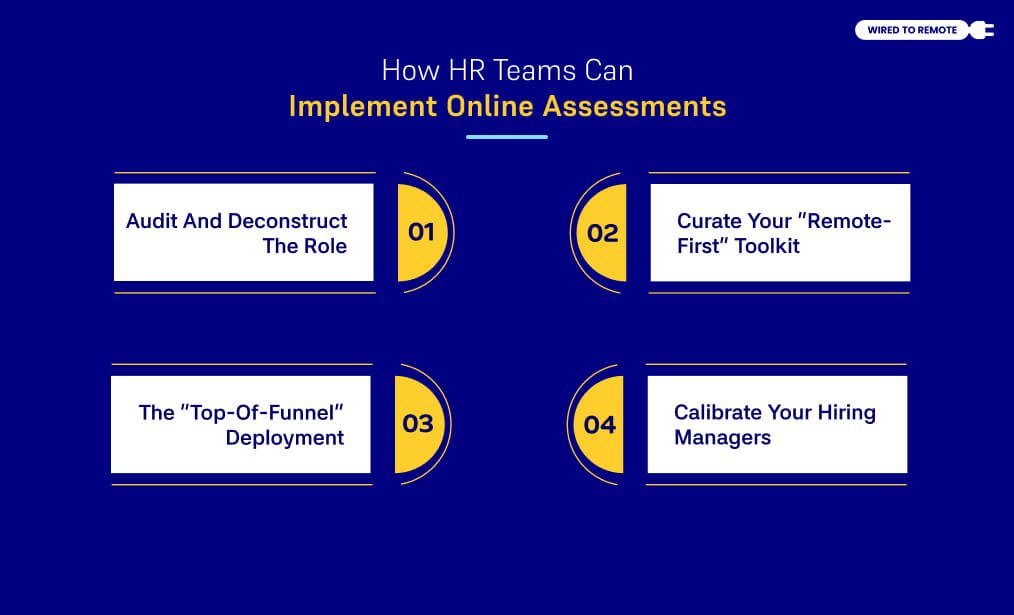
To move from “pedigree-obsessed” to “skills-verified,” most experts recommend following this four-step implementation framework.
1. Audit And Deconstruct The Role
Before you test, you must define.
Look at your current job descriptions. Are you asking for “five years of experience,” or are you asking for the ability to manage a cross-functional project in Jira?
Consequently, you must deconstruct every role into core competencies. For remote positions, prioritize “unsupervised problem-solving” and “written clarity” over traditional academic credentials.
2. Curate Your “Remote-First” Toolkit
Not all tools are equal. You need a platform that aligns with your specific niche. For example, here’s what you should keep in mind:
- Technical Talent: Use platforms like HackerEarth to run real-world coding simulations.
- General Skills: Tools like TestGorilla or HackerRank offer pre-built tests for everything from SEO to critical thinking.
- Culture Fit: Use Mercer Mettl to gauge psychometric traits like resilience and adaptability.
3. The “Top-Of-Funnel” Deployment
To maximize efficiency, place your assessment as early as possible.
Instead of reviewing 500 resumes, invite all qualified applicants to a 30-minute “core skills” test. This ensures that the candidates reaching your desk have already proven their value.
Thus, you eliminate “resume fluffing” before it wastes a single minute of your recruitment team’s time.
4. Calibrate Your Hiring Managers
The final hurdle is internal “pedigree bias.” You must train your managers to trust the data over the “Ivy League” name on a resume.
Ultimately, an HR team’s success depends on getting buy-in from leadership. Show them that a high assessment score is a better predictor of long-term retention than a prestigious former employer.
Is Online Assessment The End Of The Resume Era?
We are entering a new era of employment. The “Great Remote Experiment” proved that where you work doesn’t matter.
Now, we are realizing that where you learned doesn’t matter either. Only what you can do matters.
Online assessment is the bridge to this future. They make the hiring process faster. They make it smarter. And they make it fair.
Ultimately, if you want to build a world-class remote workforce, you have to let go of the resume. You have to let the skills lead the way.

Leave A Comment