

As the craze for the digital nomad lifestyle is on the rise, countries are opening doors to these remote workers with a special visa permit.
And, Portugal is not out of the rat race. That is, like Japan, Colombia, Italy, or Spain, Portugal has introduced its digital nomad visa, or the D8 Visa.
Now, Portugal has long been a part of the best digital nomad destinations. Offering the perfect locale for high cultural exploration, natural resorts, and a growing expat community.
So, the launch of the Portugal Digital Nomad Visa has boosted its position in the list. Making it one of the top ten choices for digital nomads.
Now, if you have been eyeing Portugal to kickstart your digital nomad journey, your remote buddy is here with the ultimate guide.
In this blog, I have brought everything you need to know about the D8 visa in one place by focusing on—
- Its basic provisions and benefits,
- Eligibility criteria and document requirements,
- Steps of the application process, some tips, and more.
So, come dive right in!
What Is The Portugal Digital Nomad Visa?
First things first, Portugal offers two types of visas for digital nomads— Temporary visa and Residency visa (D8 Visa).
Now, the Temporary visa is designed to allow remote workers from around the world to stay for a short period, make multiple visits, and work for foreign entities.
Moreover, the visa typically lasts for 1 year. Allowing the visa holder to renew it for a maximum of 5 times within the year.
But D8 is more of a Residency visa. That is, it allows remote workers to stay for a long time and even provides the opportunity for permanent residency and citizenship.
That is, the D8 visa initially allows the worker a 4-month permit, which can be extended to a 2-year residence permit. Additionally, this visa can be renewed for 3 more years.
So, the remote worker gets an overall 5 years of stay permit in Portugal.
Key Benefits Of The Portugal Digital Nomad Visa
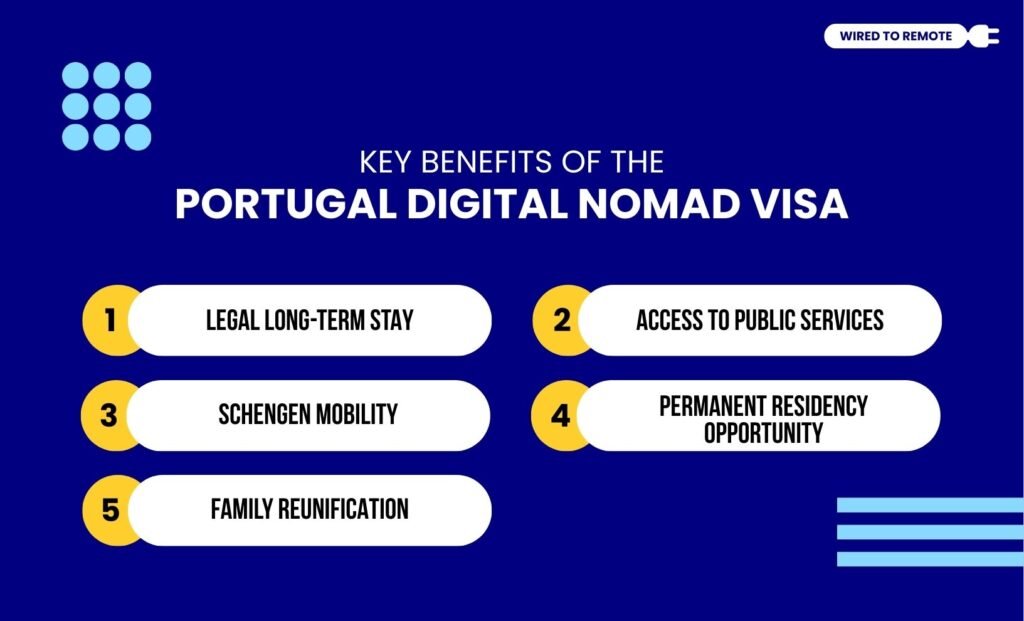
Unlike other visas, the Portugal visa is popular for its diverse benefits. So, some of these benefits include—
1. Legal Long-Term Stay
Firstly, it provides the remote worker with a longer stay permit. That is, it allows the worker to stay and work for overseas companies and clients for a overall of 5 years.
2. Access To Public Services
Moreover, the visa allows the remote workers to access the public services of Portugal. That is, they can easily get civic amenities, hospital facilities, and other civic needs without paying an extra dollar.
3. Schengen Mobility
Additionally, it allows non-EU residents the travel opportunity for the Schengen areas for 90 to 180 days. So, they can explore European culture in this region completely visa-free.
4. Permanent Residency Opportunity
Moreover, it provides the opportunity for remote workers to seek permanent residency or future citizenship. So, if they want to settle down in Portugal, the D8 visa offers a direct pathway.
5. Family Reunification
Finally, it allows the remote employee to bring their immediate family members. That is, the workers can bring their spouse or legal partner, children, and any dependent adults with the visa.
What Are The Eligibility Criteria Of The Portuguese Digital Nomad Visa?
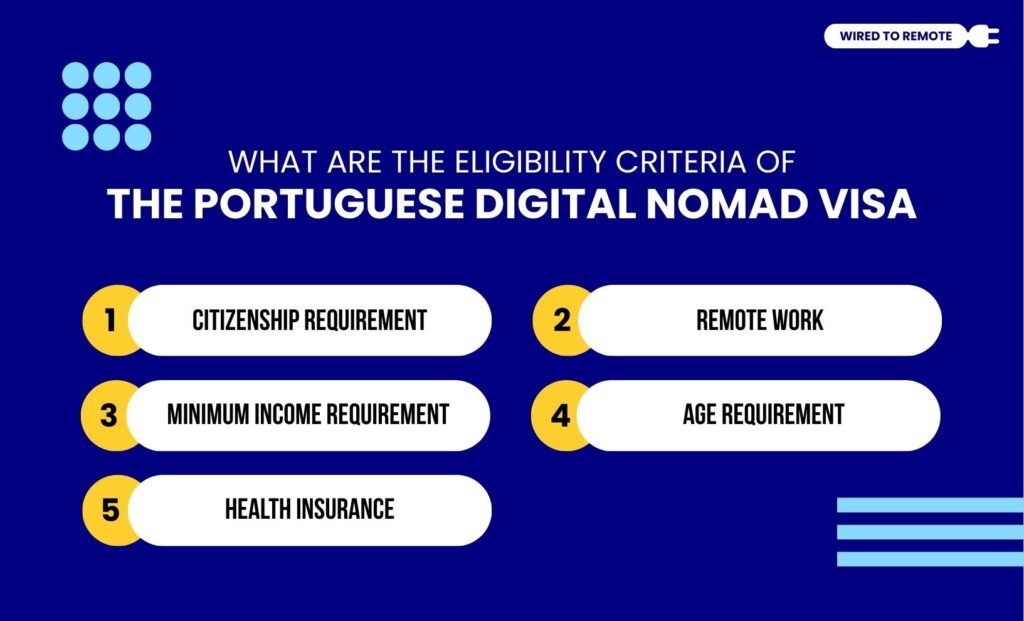
Given that the D8 visa is designed for non-EU/EEA residents, it has fixed eligibility criteria. So, here are the eligibility criteria for the visa application—
1. Citizenship Requirement
Firstly, the remote workers need to be from non-EU/EEA countries. That is, they should not belong to or hold the citizenship of any European country.
2. Remote Work
Moreover, the remote workers are allowed to work specifically for foreign companies and overseas clients. So, they can either freelance, work full-time, or even work on projects for foreign clients.
3. Minimum Income Requirement
In addition to this, to sustain their livelihood in Portugal, the remote employees need to earn the benchmark monthly income. That is, they need to earn at least €3,480 per month, the minimum wage in Portugal.
4. Age Requirement
Also, the visa applicant should not be a minor. That is, the remote worker should be above the age of 18 years to apply for the permit and visa provisions.
5. Health Insurance
Finally, the visa applicant should have international health insurance. So, the health insurance can cover their medical treatments, emergencies, and hospitalization charges.
What Are The Document Requirements For The Portugal Digital Nomad Visa?

Now, before applying for the Portugal digital nomad visa, you need to keep the essential documents prepared. So, here are the document requirements for the visa application—
- Valid Passport: Firstly, the workers need to provide a valid passport with at least 6 months of validity.
- Age and Nationality Proof: Moreover, they need to provide official documents for their nationality and age proof, like the birth certificate or government-issued identity.
- Monthly Income Proof: Additionally, they need to provide the monthly payslips, bank statements, or transaction history for the last 3 months as income proof.
- Local Accommodation Proof: Also, they need to provide the lease agreement, land registry certificate, or hotel bookings to show the accommodation proof.
- Remote Work Documents: Additionally, they need to provide the employment documents, client contracts, and foreign deals for remote work.
- Health Insurance: Moreover, they should provide the health insurance documents that cover at least €30,000 for most of the Portuguese medical facilities.
- Clean Criminal Record: Finally, they have to provide a clean criminal record with no criminal convictions or 12-month sentences.
How To Apply For The Portugal Digital Nomad Visa?
Now, like the massive benefits, the application process for the Portuguese D8 visa is quite easy. So, here are the steps to complete the application—
- Firstly, prepare the essential documents and check your eligibility based on the criteria provided.
- Then, either visit the Ministry of Foreign Affairs office or go to the Portugal Visa portal (VFS Global) to collect the application form.
- After that, fill out the application with your personal details and attach the essential documents.
- Then, you need to get an appointment with the VFS Global to submit your application form, fees, and documents.
- After that, you need to wait for the processing of the application for about 2 to 4 weeks. Also, you can track the progress in the VFS Global portal.
- Finally, once you get the approval, collect the visa from the office and set out on your journey to Portugal as a digital nomad.
Remember, choosing the right place is the key to living a fulfilled digital nomad lifestyle. Portugal offers one of the best destinations with the perfect combo of digitalization and culture.
So, what’s the wait for? Take this chance to explore high-end European culture while earning from your laptop by opting for the Portuguese D8 visa today!
FAQs
Here are some of the common questions around the Portuguese digital nomad visa that most remote workers look for.
Yes, but it is conditional. That is, the Portugal digital nomad visa allows remote workers to primarily work for foreign clients and companies. But they can also freelance for Portuguese companies or local entities. Also, their family members are allowed to work for the local companies or clients.
Yes, absolutely. Since the Portuguese digital nomad visa is a permit for long-term stay, it allows the remote workers to extend their initial 2-year stay period up to 3 more years. So, they get to stay for an overall 5-year period with the visa. Additionally, the visa provides the opportunity for permanent residency and citizenship.
The Portugal temporary visa and residency visa share many dissimilarities. For instance, the temporary visa allows the remote workers to stay for a short period, typically for a year, and make multiple visits. But the residency visa or digital nomad visa allows the remote workers to stay for longer periods, typically 2 years, which can be extended for 3 more years. Moreover, it can be used for future permanent residency.
Yes, but only if you are a tax resident. That is, if your stay extends over the period of 183 days in Portugal, you will need to pay the Portuguese income taxes even for your externally sourced monthly income. So, you will be charged taxes based irrespective of the source of your income— local or global.



Leave A Comment