

It is no news that remote work is always paired with unproductiveness. But in the post-pandemic world, it has turned the equation 180 degrees — boosting productivity and workforce efficiency.
That is, in a remote work setup, employees get flexibility and the perfect work-life balance.
Also, the remote setup offers a distraction-free space and a comfortable environment. Allowing employees to work with motivation and concentration.
Now, witnessing this higher trajectory of productivity, companies are taking measures to shift to a hybrid or remote model. Encouraging workers to ditch the office chair and choose their comfort work zone.
But the main question is — “Why does remote work lead to higher productivity?”
Well, that’s exactly what I am going to delve into in this blog. Here, I will explore the diverse nuances of remote work productivity by highlighting—
- How remote work transformed productivity,
- Reasons for its higher productivity,
- Conditions and challenges that affect productivity, and more.
So, come dive right in!
How Remote Work Transformed Productivity?
First things first, remote work culture has massively impacted the corporate world.
That is, it has changed the entire anatomy of traditional company cultures with workers joining from diverse locations, choosing flexible timings, and bringing diverse ideas to the table.
So, naturally, this change in the work mode and culture has marked its impact on productivity.
1. Popularity Of Remote Work
Even though remote work is often associated with unproductivity, after the COVID-19 pandemic, it slowly started gaining traction.
As employees realize how remote work allows them to save time in daily commutes and balance personal life and professional life without breaking a sweat, they readily choose it over regular office work.
So, with the workforce inclining towards a new work mode, companies started to shift their work culture. Investing in a remote or hybrid model to bring in talent from around the world.
2. Productivity Gains With Remote Work
Remote work has shown rapid improvement in focus time, performance of employees, and work completion time. But this improvement is not static. That is, it varies from sector to sector.
As the report from the Bureau of Labor Statistics highlights— “The fourth-ranked industry in terms of the rise in remote work—funds, trusts, and other financial vehicles—grew by 10.0 percent in the pandemic, but declined by 0.2 percent in the 2007–19 period. Thus, only some high-productive industries during the pandemic were also highly productive before the pandemic. Nevertheless, many industries that experienced a large increase in remote work also had higher-than-average TFP growth pre-pandemic.”
Why Does Remote Work Lead To Higher Productivity?
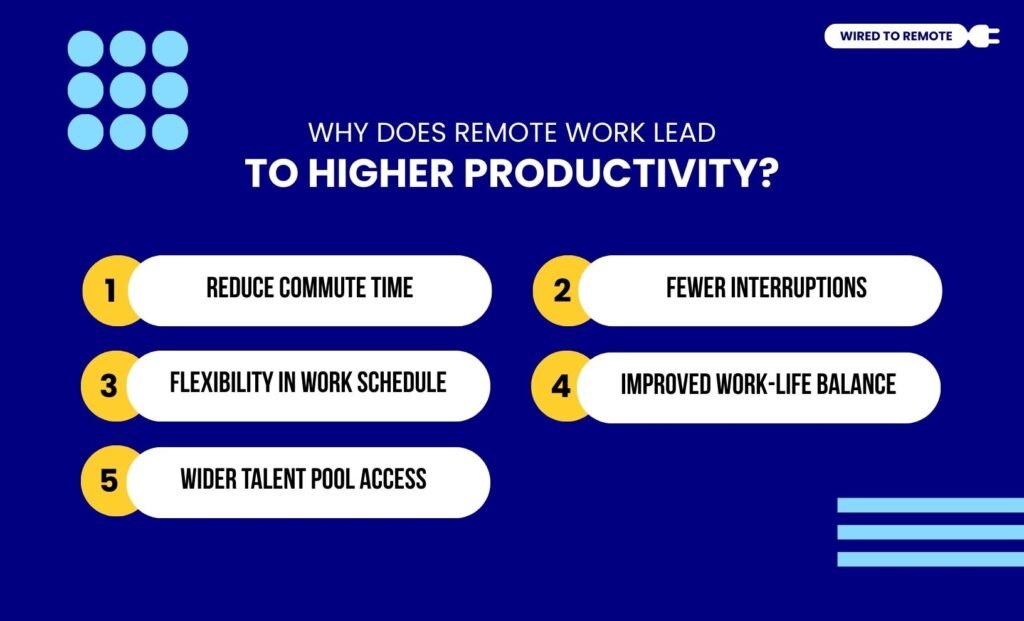
Now, there are countless reasons behind the improved productivity offered by remote work. And knowing them can help understand how to implement this new work mode for maximum productivity. So, here are the major reasons—
1. Reduce Commute Time
Firstly, remote work can be done from anywhere. That is, employees can clock in from any location — be it their home, a cafe, a resort, or a quiet balcony amidst nature.
And, this flexibility of place can reduce the commuting time by tenfold. Allowing workers to give more time to work and personal life than travelling to the office.
So, more work gets done within the same timeframe, boosting the team’s productivity.
2. Fewer Interruptions
Additionally, the office is a place filled with diverse departments. And, working next to a chaotic department can hinder focus and concentration for work. Delaying the work completion time.
But in remote work, employees can choose a quiet space to work peacefully. So, they get to perform their best in an optimized environment with a focused mind.
This way, the work is often completed before the deadlines knock on the door.
3. Flexibility In Work Schedule
Moreover, offices have a fixed schedule, compelling employees to come and leave the office at specific hours. But not all employees can get the work done within a fixed timeframe.
Then, in a remote work setup, employees get the autonomy to manage their work schedule, project timings, and work hours.
So, they can work when they have the right space and time, without forcing themselves. And, this gives them motivation to work and take on responsibilities.
That is, they can balance their work with their personal life.
According to the report of FlexJobs— “86% of professionals said they think a flexible or telecommuting job would help them save money— while the same percentage of people said it would also allow them to reduce stress. Meanwhile, 97% said a job with flexibility would have a huge improvement or positive impact on their overall quality of life.”
4. Improved Work-Life Balance
In addition to this, remote work cuts off office politics and work stress. Allowing employees to work in a comfortable and healthy environment.
Also, with the flexibility of the work schedule, workers enjoy the perfect work-life balance. That is, they can give enough time to work and still handle personal errands.
And this work-life balance keeps them motivated and relaxed. So, they perform their best in any kind of work. Boosting the productivity of the team.
As the article from FlexJobs points out— “It is estimated that on average, 60% or less of work time is spent productively. Many of the reasons for loss of ambition during office hours include interruptions from colleagues, the stress of commuting, and office politics.”
5. Wider Talent Pool Access
Finally, remote work gets access to global talent. That is, they can hire the best candidates from across the world to clock in from any location and handle the work.
Now, with a fine employee in team, the work gets done faster without any flaws. And, this saves time to look into other projects.
So, naturally, the companies can see a boost in productivity and improvement in the overall workforce efficiency.
Conditions For Higher Productivity In Remote Work
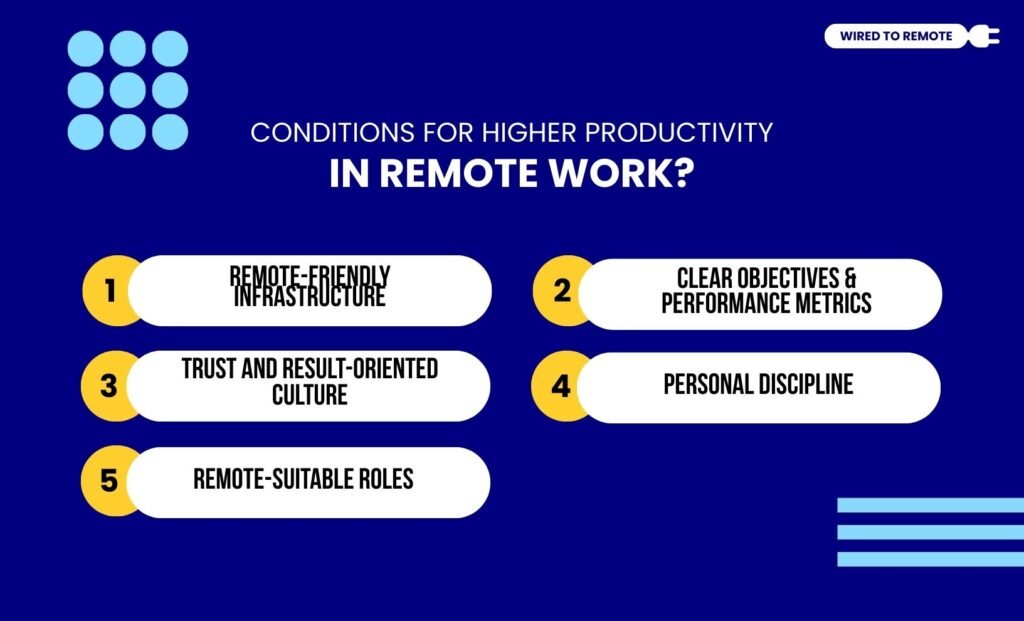
Even though remote work boosts productivity, it requires certain conditions to improve the efficiency of the team. Some of these conditions include—
- Remote-Friendly Infrastructure — Firstly, workers should have a proper home office setup to work productively. That is, they should have a designated workspace with all the essential items.
- Clear Objectives and Performance Metrics — Moreover, remote workers should be given clear objectives and key performance metrics to track their progress and productivity.
- Trust and Result-Oriented Culture — Additionally, companies need to offer a trustworthy and result-oriented work culture for remote employees to handle work without the stress of micromanagement.
- Personal Discipline — Also, the employees need to have self-discipline to stay motivated and focused while working in a remote setup. So, even when the pressure rises, they can actively perform their role.
- Remote-Suitable Roles — Finally, remote work cannot boost productivity for non-remote roles. That is, the work should be remote-suitable to see a spike in productivity.
Common Challenges That Prevent Productivity In Remote Work
Unlike the traditional work model, the remote work model faces some unique challenges that might hinder productivity. Some of these challenges include—
- Lack of a reliable and spontaneous communication system hinders collaboration in remote work.
- Feeling exhausted or burnt out with overworking due to no fixed work hours and work schedule.
- Lack of high-end technology and equipment at home that are suitable for remote work.
- The chaotic environment at home that distract workers or hinders productivity.
- Lack of employee training and managerial processes for handling remote work without any issues.
Tips To Boost Productivity Levels In Remote Work

Since productivity completely depends on how you concentrate and stay motivated in remote work, here are some tips to not let the ball drop in productivity—
- Creating a dedicated workspace with zero distractions.
- Following a daily routine to avoid overworking or mismanaging your time.
- Using the project tracking tools to track progress through Kanban boards and time tracking tools.
- Maintaining communication with the other team members and managers to get the work done on time.
- Blocking timeframes with complex tasks that need to be handled with concentration at the beginning of the day.
Now, with the right system, anyone can improve productivity in a remote setup. So, employ the perfect work model to see the sudden spike in remote work productivity and efficiency.
FAQs
Here are some of the common questions about the increased productivity within a remote work setup.
No, not always. Generally, studies show that remote work increases productivity. But in reality, productivity in remote work massively depends on a variety of factors. So, it cannot be claimed that remote work always increases productivity.
Mostly jobs that have fewer physical dependencies and are more digitally inclined witnessed a massive boost in their productivity with remote work. That is, job roles that revolve around knowledge-based, digital tasks, and handling projects through online platforms see a rise in productivity. But job roles that require the physical presence of employees have not been entirely productive in a remote setup.
Generally, it is vital to work in an optimized workspace to stay concentrated and get the work done right on time. So, even if you are working from home, it is crucial to reduce any distractions or interruptions to boost productivity.
Some of the ways to reduce the distractions at home include—
• Keeping the work area clutter-free and organized.
• Choosing a quiet space at home to work.
• Investing in ergonomic furniture to work comfortably.
• Communicating with other teammates through communication channels.
• Choosing a distraction-free timeframe to work.
Since in a remote work setup, workers clock in from diverse locations, it is hard to measure their productivity directly. So, companies need to incorporate effective tools and performance metrics to measure remote productivity effectively. That is, they need to track the task progress, collect daily reports, and evaluate the engagement. This way, they can measure the productivity of the team.
Yes, absolutely. Unlike a fully remote team, a hybrid setup offers both work flexibility and team connection. So, workers get to choose their work timing while connecting with others from the workplace through communication channels and in-person meetings. But this completely depends on the job role and the work culture of the company. So, based on the job role, it can be more productive with a hybrid setup over a fully remote one.



Leave A Comment