

In the last few years, the corporate world witnessed the growing popularity of remote working options.
Most employees prefer the remote work culture because of its flexible nature. They enjoy the work-life-balance and flexibility of locations that remote working provides.
Even though there are a lot of advantages and benefits of remote working culture, there are certain challenges associated with it that cannot be ignored.
Enter communication challenges.
Remote work productivity hinges entirely on communication architecture. While location flexibility increases employee satisfaction, geographical distribution removes critical non-verbal physical cues.
Without deliberate communication frameworks, digital teams face fragmented information silos and a high risk of project misalignment.
Why Communication Challenges Arise in Remote Work?

Key Point:
Remote communication challenges arise primarily from three systemic factors: the loss of non-verbal physical cues, asynchronous delays across disparate time zones, and fragmented tool stacks that create information silos.
The most common reason for communication challenges in remote work is the absence of face-to-face communication. In remote work, employees hardly get the opportunity to meet their teammates in the real world.
As most people in remote work environments work from different locations, it is difficult for them to meet with one another for communication. Moreover, their absence in face-to-face communication often causes miscommunication and misinterpretation of information.
Additionally, some organizations provide remote working options for different time zones. This can further extend the communication gap among colleagues residing in different time zones.
Among the numerous reasons, these are some of the most common causes for major communication challenges in remote work.
5 Major Communication Challenges in Remote Work
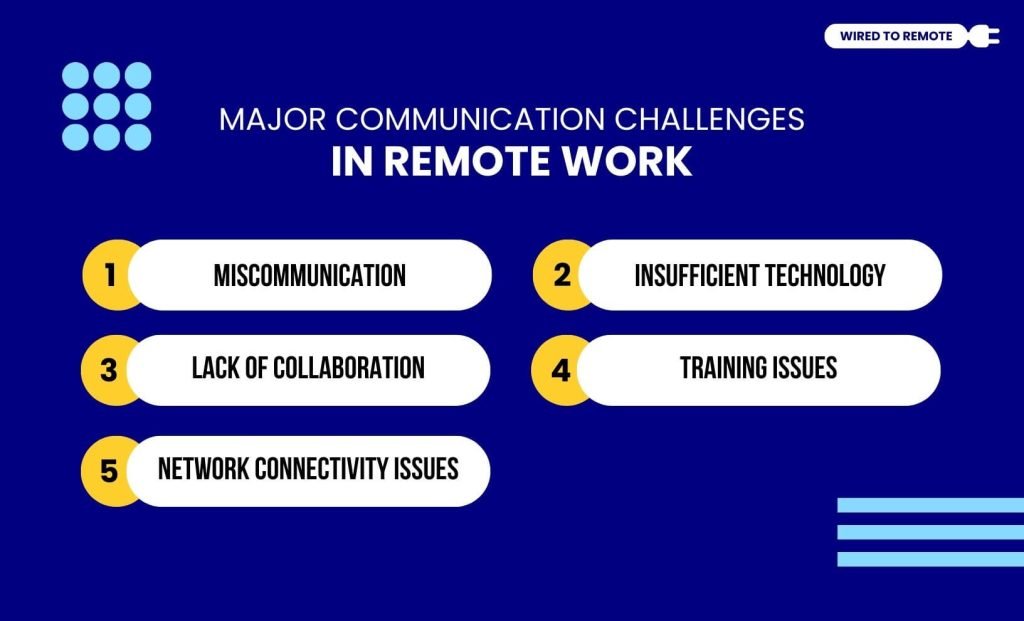
A Remote work setting allows the employees to work from anywhere they desire. So, having a good communication system among them is necessary. Moreover, with the growing popularity of remote work, you should be aware of these major communication challenges.
Some of these communication challenges are:
1. Miscommunication
One of the major communication challenges in remote work culture is miscommunication among employees.
Traditionally, workers used to physically meet up with the individual at their desk to communicate information and issues at work.
However, with remote work, everyone is located in different places. So, having conversations with your colleagues gets limited to either text messaging or phone calls.
Even when employees try to communicate through text messages, emails, or phone calls, there are various instances of miscommunication. Take, for instance, when an employee sends an email or text message to another, the tone of their text is hardly conveyed.
Additionally, miscommunication can also happen due to misinterpretation of the sent texts and emails. This happens when individuals misread some texts and end up taking wrong actions based on them.
This puts the entire organization in jeopardy and affects its performance.
2. Insufficient Technology
When workers are working remotely, they need good technology to communicate effectively with the teams. However, with insufficient technological equipment, remote working can become extremely difficult.
As you know, the entire working process of remote work culture primarily depends on having reliable technology. So, in case the organization fails to provide proper technology for communication, the teams might face miscommunication issues.
Moreover, poorly performing technology can interfere with the functions and operational processes of the firms.
For instance, good technology will help employees to establish better communication, share files and have virtual meetings.
In these meetings, they can discuss the various issues related to work and find possible solutions faster. Leading to better performance of the company.
3. Lack of Collaboration
Another major communication challenge in remote work is the lack of collaborative spirit among the team members.
In a company, workers from diverse teams and departments need to collaborate to find creative and innovative solutions to problems.
Moreover, collaboration among diverse workers from the organization helps in building team bonding and team spirit.
However, in a remote setting, workers don’t get to meet face-to-face. This makes them have less trust in others as well as accountability issues.
Additionally, cross-group collaboration with external experts is affected by limited communication options.
The employees cannot communicate with external expert professionals, which affects fostering meaningful relationships and cultivating innovative ideas.
This affects the overall innovation and growth of the organization.
4. Training Issues
Apart from the above challenges, organizations may face communication issues due to the lack of technological knowledge of employees. Sometimes, when organizations introduce advanced technologies for workplace communication, they need to consider the workers’ ability to use them.
If the enterprise introduces communication technology with complicated features, the employees won’t be able to follow through with them. Moreover, the workers need to be given proper training and guidance for understanding and using the different technologies for communication.
Additionally, without training, the workers fail to utilize the tools and features of this advanced technology, causing more chaos and confusion. This can affect the workplace culture and employee productivity of the organization.
5. Network Connectivity Issues
Another major communication challenge is poor network connection and low-quality connectivity in phone calls and video meetings.
As you know, remote work primarily relies on network connection for workplace communication. So, when there are issues with the network connectivity or poor quality of connection, the video meetings can lag, and phone calls can abruptly drop.
These can affect the communication flow and disrupt the smooth processing of the operations. Moreover, low network connectivity reduces employee productivity and efficiency, as they fail to communicate information properly.
Overall, the functioning is disrupted, and workplace communication is interrupted with network issues.
Solutions for Communication Challenges in Remote Work Culture
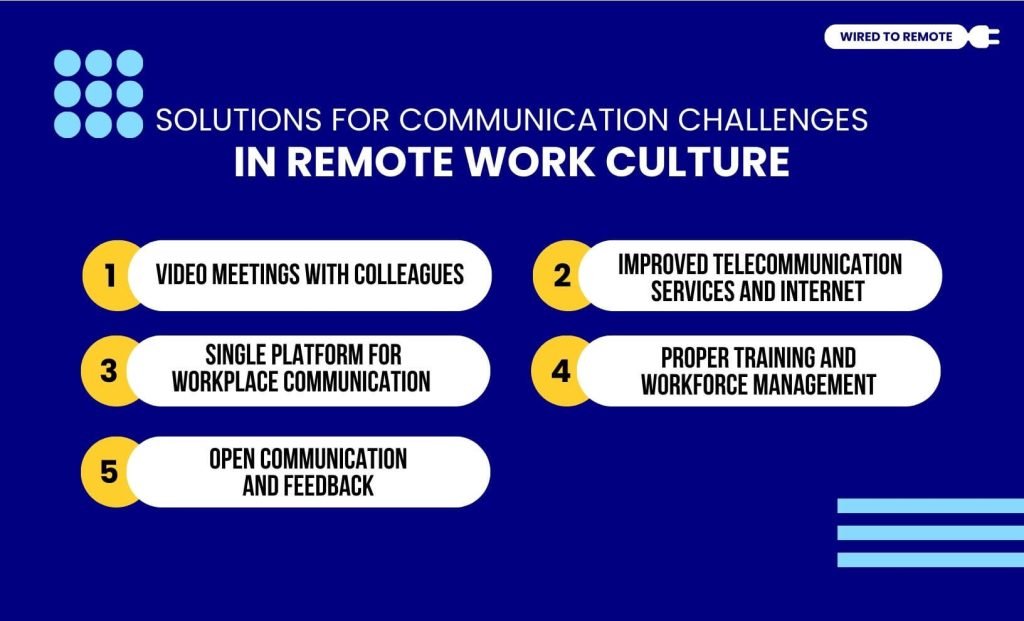
In order to successfully run the organization in a remote culture, you can adopt innovative solutions for communication challenges. These solutions can help you to mitigate the issues and help your employees to foster better engagement.
Some of the innovative solutions for these communication challenges include:
1. Video Meetings with Colleagues
The most efficient way to mitigate major communication challenges is by introducing video meetings or virtual meetings. When the organization incorporates various services and technologies that support video meetings, it helps employees to communicate better.
With the provision of video meetings, workers can easily sit for virtual face-to-face meetings to discuss issues and doubts. This face-to-face virtual environment effectively prevents any miscommunication or misinterpretation of messages.
Moreover, if there is any doubt or query regarding work, employees can openly communicate and clarify them in the video meetings.
2. Improved Telecommunication Services and Internet
Another solution to communication challenges is the incorporation of good telecommunication services. As remote working employees have limited communication options, having a good telecom service and fast internet can prevent network issues.
Moreover, if the organization has updated telecom services, it can ensure the smooth flow of information and messages among remote workers.
For instance, if the company witnesses poor connection, it needs to upgrade its phone system and WAN model to improve its network connectivity.
Once the network connection is improved, lagging in video meetings and droppings in phone calls will subsequently reduce. Additionally, employees will be able to establish better communication among themselves.
3. Single Platform for Workplace Communication
There are countless apps and online platforms available with video meeting services. However, using too many platforms for their services can confuse the workers. So, the organization needs to focus on a single platform for supporting workplace communication.
For this, the company can choose a single app that supports most of the major communication functions. This app should be able to provide a shared space for sharing important files as well as having virtual meetings.
Some of the most common apps used by organizations for workplace communication are Google Meet, Zoom, and Microsoft Teams. These apps provide a shared space, called the drive, for employees to share files and virtual meeting platforms.
This incorporation of a single app for all workplace communication essentially saves the organization from confusion and miscommunication.
Here are some of the best communication tools for remote teams:
| Tool Category | Recommended Software | Primary Use Case | Communication Type |
|---|---|---|---|
| Daily Operations | Slack, Microsoft Teams | Quick alignment, urgent pings, social watercoolers | Synchronous / Near-Sync |
| Project Tracking | Asana, Jira, Monday.com | Task delegation, timeline tracking, status updates | Asynchronous |
| Knowledge Base | Notion, Confluence | Standard Operating Procedures (SOPs), company wikis | Asynchronous |
| Contextual Video | Loom, Zoom | Complex walkthroughs (Loom), live brainstorming (Zoom) | Hybrid |
4. Proper Training and Workforce Management
Another solution for fighting communication challenges in remote work is to introduce training models and programs for employees. This will guide the workers in utilizing advanced technologies for communication with maximum efficiency.
Once they receive the training, the workers will be able to understand the features of the communication tools. Additionally, they will be able to decide how to utilize the technology for better communication.
Moreover, the management of the workforce can be incorporated to ensure the smooth flow of information within the organization.
When the company divides the workforce into smaller teams with team leaders, the information easily flows from the top management to the lower levels.
5. Open Communication and Feedback
It is absolutely essential to ensure open communication in remote work to avoid workplace issues.
When employees openly communicate their opinions and issues with teammates and leaders, they can solve them efficiently.
Moreover, open communication helps workers to collaboratively identify creative solutions for the problems. This can further guarantee the building of team bonding and reliance on team members.
Additionally, feedback with constructive criticisms from the employees can help in improving communication and work culture.
When an employee gives their insightful feedback to the management, they can investigate the issue and improve.
This can evidently contribute to growth and organizational efficiency.
Build A Written Documentation Culture
Move company knowledge out of ephemeral chat histories and into an accessible internal wiki. Every core workflow, technical setup, and policy must be documented in writing.
- Actionable Step: Adopt a “if it is not documented, it does not exist” policy. Train employees to build, tag, and update standard internal procedures continuously. This streamlines onboarding and guarantees that information remains highly accessible across all operational levels
Tackle Communication Challenges In Remote Work With Strategy!
In a remote working culture, communication and collaboration among employees can be difficult and challenging.
However, with proper communicative measures and technological solutions, these communication challenges can be easily mitigated.
Now that you have read about the major communication challenges, you know how they affect the smooth operations of the company.
So, it is absolutely necessary to eliminate them to ensure team bonding and collaboration. Furthermore, good communication among remote workers can effectively contribute to overall organizational performance, efficiency, and growth.



Leave A Comment