

A work policy is meant to keep the employees and employers in check to prevent them from misusing their positions.
Even in a remote setup, a work policy helps outline the company’s expectations for the workers in detail. Avoiding misunderstanding in the virtual workspace.
Now, just as remote work is different from traditional office work, the policy creation process is also different. That is, a work policy for managing remote teams includes different components compared to the 9-to-5 model.
But the question is— “How to create a remote work policy that attracts and retains talent from around the world?”
Well, your remote buddy’s here to save the day. In this blog, I am going to explore the diverse aspects of remote work policies, highlighting—
- Its fundamentals and relevance,
- Key components to consider,
- Step-by-step guide to develop it, troubleshooting methods, and more.
So, come dive right in!
What Is A Remote Work Policy? — Understanding The Fundamentals
First things first, a remote work policy is slightly different than a traditional office work policy. That is, it establishes the specific guidelines for remote workers in a company.
So, it includes telecommuting policies, work-from-home frameworks, work schedules, and many more details about how the company works.
This way, it allows the employees to be aware of the expectations of the company. So, they can comply with the policy and avoid facing issues or causing trouble.
Key Components To Include In A Remote Work Policy
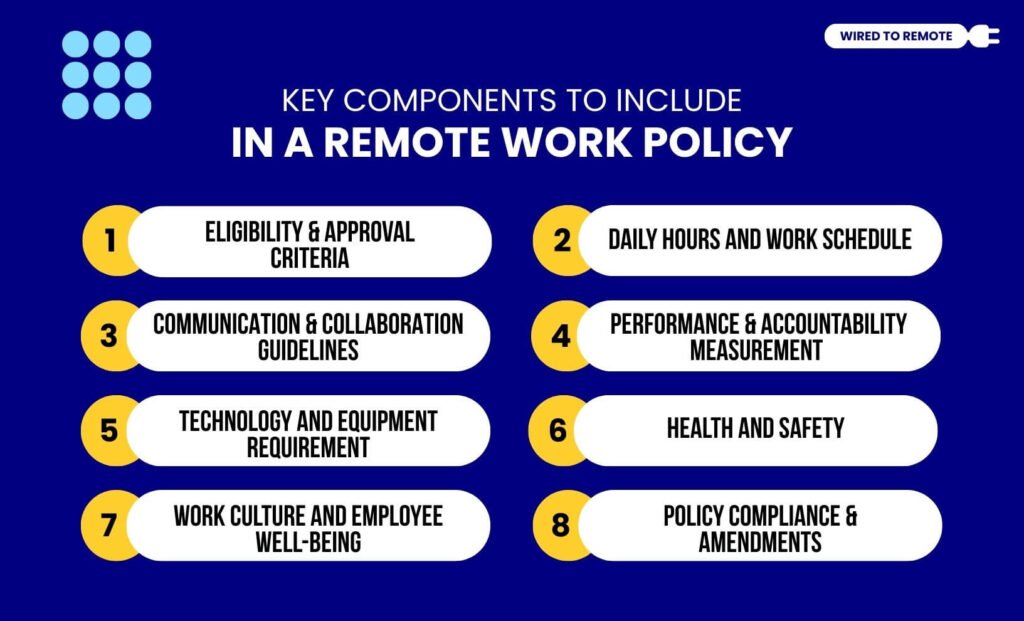
Since the remote work policy is not exactly like traditional work policies, its components are also different. So, here are the major components—
1. Eligibility And Approval Criteria
Firstly, it includes the eligibility and approval criteria for workers. That is, it mentions the roles and responsibilities for remote workers.
Also, it consists of the conditions for job suitability and performance measurement. So, employees are aware of their roles and work.
Moreover, it includes the process details of applications. That is, it highlights how the employees are supposed to request and get approval for leaves, incentives, and others.
2. Daily Hours And Work Schedule
Apart from the details of job roles, the work policy specifically details the daily work hours and schedule for the work.
Since remote work is flexible, specifying the work schedule and hours can help employees understand the total hours and work timings expected from them.
3. Communication And Collaboration Guidelines
In addition to this, the remote work policy should also specify the communication and collaboration requirements. Since miscommunication is a major remote work challenge, it should be addressed with proper policies.
This way, employees can have an idea about how they are supposed to communicate within the team. Also, they can be aware of the frequency of meetings for cross-department collaborations.
4. Performance And Accountability Measurement
Moreover, the policy should accurately consist of the details about how the performance of the employees will be assessed.
That is, it should clearly provide the measurement metrics, regular check-ins, and feedback loops details. Making it easier for employees to know how they will be evaluated.
5. Technology And Equipment Requirement
Additionally, the equipment and technology requirements listing is crucial in a remote work policy.
Since remote work solely relies on the virtual platforms and high-end equipment, mentioning the ones required for the job role can keep the employees aligned with the company’s expectations.
Moreover, the data security protocols can also be listed for better data protection management in the remote setup.
This way, they can comply with the industry standards of data protection.
6. Health And Safety
Although it is optional, the health and safety of the employees in a remote setup are also essential.
So, companies can keep ergonomic setups as mandatory requirements for ensuring the workers are taking care of their health while working remotely.
7. Work Culture And Employee Well-being
Even though the work culture in a remote setup is completely virtual, having a workplace policy is not too much.
Rather, this shows that the company values employee well-being.
So, having a proper record of how the employees are supposed to behave at work or communicate can help support employee well-being.
8. Policy Compliance And Amendments
Finally, the policy should adhere to the changing amendments and additions to the labor laws of the industry.
Moreover, companies need to highlight how any violation of the policy will be handled.
This way, they can ensure that the employees and the employers do not misuse their powers. Making the workplace efficient and productive.
How To Create A Remote Work Policy? — A Step-by-Step Guide
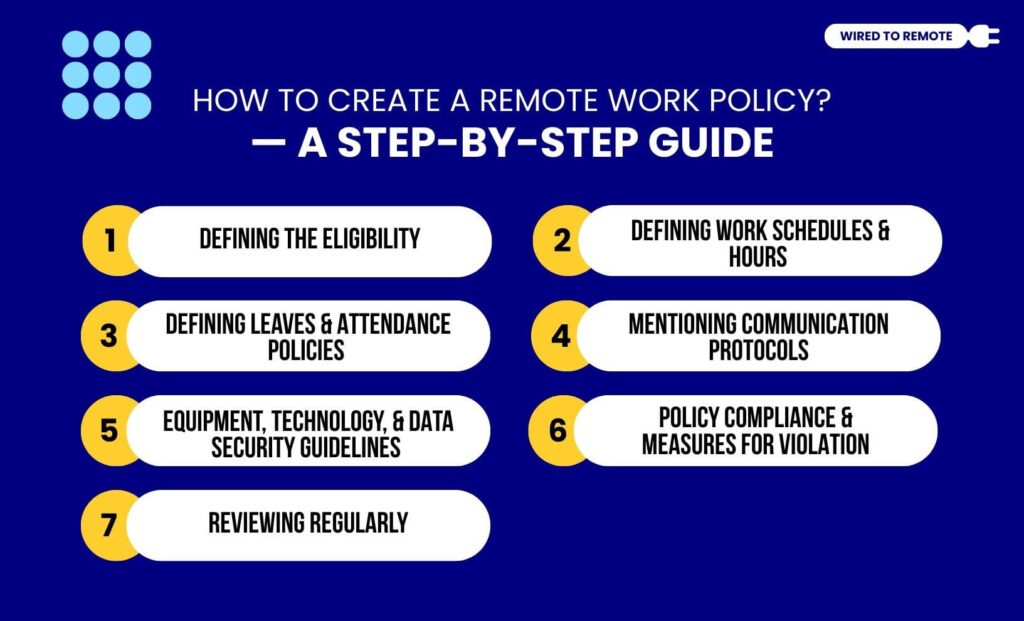
Now, knowing the components of the remote work policy clear what should be included in the policies. So, here are the steps for creating a successful remote work policy—
- Defining The Eligibility
Firstly, you need to understand the requirements of the job role and develop the eligibility for the employees. This way, you can ensure the suitability of the employees in the remote setup.
- Defining Work Schedules And Hours
Moreover, your policy should include defined work schedules and expected hours. So, the workers are aware of the timings to be available for work and spend time in the virtual work mode.
- Defining Leaves And Attendance Policies
Additionally, you need to specify the type and total number of leaves the employees get in a year. Also, how the attendance will be evaluated should be listed in the policy.
- Mentioning Communication Protocols
Apart from these, you need to specify the communication tools and collaboration models for the team. So, the remote workers know how to reach out to their teammates, higher authorities, and management when they need it.
- Equipment, Technology, And Data Security Guidelines
Also, the exact technology, equipment, and data security protocols followed by the company should be mentioned. This way, your employees can have an idea about what they need to get started with remote work.
- Policy Compliance And Measures For Violation
Along with these, you need to include the exact protocols for violating the policies. This will keep the employees and the upper management in check for abiding by the essential rules and regulations.
- Reviewing Regularly
Finally, after creating the work policy, review it by the stakeholders and amend it to ensure all are in support of the policies. Then, regularly review and update the policies to ensure you are adhering to the industry standards.
Troubleshooting Common Challenges Of Remote Work Policy
Even though remote work poilcy provides ample benefits, creating it can be challenging. So, here is how to troubleshoot these challenges effectively—
- Clearly mentioning the data security protocols and communication systems can help ensure that the employees are aware of how the work is done.
- Defining the mitigation strategies properly can help create the standards for processing the policies in the teams.
- Setting the expectations about work hours and deliverables can help balance out the flexibility with accountability of the remote team.
Now, creating a proper remote work policy can help provide the right guidelines to the employees. Making remote work easier to manage while adhering to industry standards.
So, with this guide, create the best remote work policy today to attract and retain global talent in your team!
FAQs
Now, here I have brought you some common questions around the remote work policy creation that most employers look for.
Since a good remote work policy offers countless benefits, it is implemented by most remote companies. So, some of these benefits include—
• Accessing a wide pool of talent from across the globe.
• Enhancing the productivity of the workforce.
• Ensuring the balance in work and personal life is maintained.
• Building trust and having transparency between employees and employers.
• Improving workforce management for a remote work setup.
Generally, work policies should be reviewed yearly to ensure that the policy is compliant with the legal rules and regulations in the remote industry. Moreover, you can review the policy whenever there is a change in the business models or new labor laws are added. This way, you can ensure that the policy complies with the change in the work culture or the industry standards.
If you want to ensure that your remote work policy complies with the labor laws, you need to hire a Compliance officer. They can look through the policy and review areas that need to consider legal requirements. Also, regularly reviewing the policy against any updates in the labor laws can help stay compliant with the major labor laws in the industry.



Leave A Comment