
Today’s hot topic: how to become a digital nomad?
Imagine: you are sitting by the beach, the gentle lull of ocean waves, or the quiet buzz of a cafe playing background music. I am literally sitting at a beautiful barista miles away from home (and my office), penning this down.
I can proudly say I am a digital nomad – No, I don’t go to the neighborhood cafe to write blogs and get my daily work done. Rather, I am a digital nomad – I travel, and the work I do while traveling pays for my trips.
Life is certainly a thrill – you might be working from your home on Monday night, and by Wednesday, you could be sitting by the beach, logging into work. It does sound exciting, doesn’t it?
To cut a long story short, digital nomads are typically people who work from different locations, but virtually. And this lifestyle could easily be yours – a life that blends the boundaries between travel, passion, and work.
So, whether you want to work part-time or full-time, as a freelancer or an employee, let’s walk into the world of digital nomads – and find out if you can find the right balance between your professional and personal goals.
Stay tuned!
What Is A Digital Nomad?
A digital nomad is someone who is location-independent and relies on technology to do their everyday work while living a nomadic life. Digital nomads usually work remotely, relying mostly on telecommunication instead of attending the office physically.
Moreover, this lifestyle has become possible through different innovations, including affordable internet connectivity, content management software, and other tools. Additionally, the rising popularity of the gig economy has played a vital role as well.
Where Did It All Start?
‘Digital Nomad’ is a term that was first coined in 1997 by David Manners and Tsugio Makimoto in their book, The Digital Nomad.
This book talked about inventing an all-powerful – not to mention, singular – communication device that would let employees literally work from home and anywhere else. Of course, the 2020 Pandemic made everything possible – from working from home to working on the go, anything is possible in 2025.
And the data is in complete favor! As per MBO Partner’s 2o2o study, 10.9 million digital nomads were residing in the United States. The same study also reported that 19 million Americans are considering becoming a digital nomad.
Interestingly, digital nomads are mostly young people who are working in the knowledge economy – in industries like consulting, tutoring, media, writing, IT, design, and marketing.
Moreover, these nomads are either remote employees or know how to outsource resources. Also, it is vital to note that while most freelancers and telecommuters are sort of nomads, the term is specifically used for people traveling while working.
How To Become A Digital Nomad? Pros And Cons!

Before I explain how to become a digital nomad, let’s briefly look at the major advantages and disadvantages of this eccentric way of living.
| Pros | Cons |
|---|---|
| 1. Experience cultural diversity | 1. Problems with internet connectivity |
| 2. Work from literally anywhere. | 2. Feelings of isolation. |
| 3. Create a global brand. | 3. Unstable income. |
| 4. Less stressful working environment. | 4. Complications with taxes. |
| 5. Global network. | 5. Issues with time zones. |
| 6. Simple way of living. | 6. Issues related to work permits and Visa regulations |
How To Become A Digital Nomad? A Step-By-Step Guide
Starting your life as a digital nomad might sound exciting – but chances are you are not exactly sure where to start.
So, I’m here to help you figure out how to become a digital nomad – with my step-by-step guide for a smooth transition into your new life.
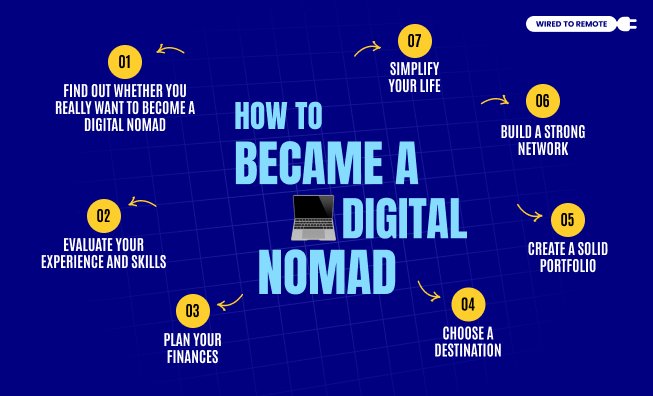
1. Find Out Whether You REALLY Want To Become A Digital Nomad:
Yes – this is the most important thing that you need to ask yourself. Do you REALLY want to become a digital nomad? It is one thing to sit and daydream about working by the sea, another to work remotely from the comfort
Here’s a reality check you need: it is possible that your idea of traveling might be sculpted by your experiences of vacationing. So, understand that becoming a digital nomad is not some sort of perpetual holiday.
Moreover, working as a digital nomad means going beyond the typical 9-to-5 jobs – it demands both flexibility and resilience. So, be honest about your skills as a digital nomad and ask yourself:
- Can I show productivity while I’m moving?
- Can I trade my stable life for adventure?
- Am I ready to deal with challenges such as finding a dependable internet connection when I am traveling?
2. Evaluate Your Experience And Skills:
The next important thing is: audit your experience and skills. Even if you want to become a digital nomad, do you have the skills or experience for this lifestyle?
If you want to work remotely, you need some basic skills that include meeting deadlines, managing tasks, and collaborating with a team across different time zones.
So, to thrive and become successful, you will have to go beyond completing a task – you will have to learn how to grow in a decentralized office.
In addition, great communication in this case is a non-negotiable skill set. Your team is not sitting across the hall – you are miles away, probably in different time zones.
So, every text counts. And being tech-savvy? That is basic! So, ensure that you can deal with a video call glitch as smoothly as booking your flight tickets.
3. Plan Your Finances:
Obviously, if you are wondering how to become a digital nomad, then you are also thinking: how much does a digital nomad earn? It is a fact that transitioning into a new life will need a meticulous financial structure.
Moreover, your digital nomad’s salary includes different factors, such as whether you will maintain housing expenses back home. Also, you will have to itemize your projected budget: meals, lodging, commute, and internet connectivity.
In addition, you will have to find out where your money is actually coming from – ensure you have entirely analyzed the salary of a remote worker or a digital nomad in your field.
Also, you must do your research well and come up with a financial plan that is solid and sustainable. Just remember: your financial plan needs to be realistic, not optimistic.
4. Choose A Destination:
Randomly picking a place to go might sound exciting – but is it a good move? I don’t think so! While the world is your oyster as a digital nomad, every corner of your workspace is not ideal for productivity. You have to think about living expenses, Wi-Fi strength, and your lifestyle.
In Chiang Mai, for example, average monthly costs border around $1,200 with fast Wi-Fi (100 Mbps). Now, if you compare that to Lisbon, where nomad visas last up to a year and co-living spaces cost $1,500 monthly, you will certainly know which locations will serve you best.
So, prioritize the location by choosing what actually matters the most to you. After all, you have to define your boundaries.
Is it the cultural experiences, affordability, or the fast internet? Not every beautiful destination will offer you great connectivity or a thrifty lifestyle.
You have to weigh the advantages and disadvantages of the same: a tranquil beach life or a bustling city life? Each life has its drawbacks and appeal.
5. Create A Solid Portfolio:
When you cannot meet people in person, your portfolio becomes your business card. So, you need a solid portfolio that highlights what you are good at – the best of you. Feature projects that show your skills and align with your career goals.
Remember: your motto here should always be quality – not quantity. So, just a few projects that stand out can make a much bigger impact as compared to a huge volume of average work.
Moreover, you can also think about boosting your portfolio with personal or freelance projects that highlight your expertise and ethics.
The idea is to create a dynamic portfolio that you can keep updating with growing experience. Most importantly, your portfolio should put the spotlight on your best and your latest work.
Don’t forget to ask your mentor or a friend to review your portfolio for an external perspective on the same.
6. Build A Strong Network:
Your professional network is everything – it will lead you to the best job opportunities. The plan is simple: be active on platforms such as LinkedIn, join like-minded communities, and always interact with others. You can share jobs, discuss opportunities, and exchange tips.
It is best to begin at a local level, before going global. Moreover, if possible, try to be a part of workshops, conferences, and events that are happening in your industry. The idea here is to build a network and support system that is flexible, like your nomadic lifestyle.
Even if you are working from a remote location, put in the effort to attend networking events online and work from coworking spaces.
Never underestimate the impact of virtual events – you can trade expertise or collaborate on projects with fellow digital nomads. You never know when these contacts will come in handy – your network is invaluable. The faster you realize that the better for your new career!
7. Simplify Your Life:
Figuring out how to become a digital nomad starts with simplicity. You can begin by decluttering – physically and digitally. So, ask yourself – what are the things you really need to lead a comfortable and productive life?
Focus on trimming down your belongings to the basic essentials – cloud-based options to work, a convenient tech setup, and a minimal wardrobe.
You don’t know when natural disasters, health concerns, unemployment, or political unrest might demand a quick getaway. As a result, every item you carry must have a defined purpose.
Remember, it is not about being mobile and packing light – it is a shift in mindset. So, when you choose to declutter, it is not a type of deprivation. Rather, it is about creating space for a new life, new adventures, and experiences.
Moreover, with such a lifestyle, you finally get the freedom to focus on two things that matter the most – your passion for travel and your work.
What Fields Are Most Adaptable For Digital Nomads?
Fields like development, tech, marketing, business, support services, and creative jobs are perhaps the most adaptable options. Moreover, within these options, popular job roles include web development, software development, content creation, virtual assistance, social media management, and graphic design.
Below, I’ve shared a breakdown of the average income for popular digital nomad job roles:
| Career Option | Average Annual Income (Approx.) |
|---|---|
| Software Engineer | $130,000+ |
| Cybersecurity Analyst | $90,000 to $150,000+ |
| Data Scientist | $70,000–$130,000+ |
| Machine Learning Engineer | $100,000–$160,000+ |
| UX/UI Designer | $65,000–$100,000 |
| Project Manager | $98,580 |
| Web Developer | $92,750 |
| Digital Marketing Specialist | $55,000–$90,000 |
| SEO Professional | $50,000–$85,000+ |
| Copywriter/Content Writer | $50,000–$70,000+ |
| Graphic Designer | $58,910 |
| Social Media Manager | $61,042 |
| Virtual Assistant | $35,000–$55,000+ |
| Data Entry Specialist | $37,790 |
| Customer Service Representative | $30,000–$50,000+ |
| Freelancer Writer | $20,000–$35,000+ |
Research, Apply, And Become A Digital Nomad!
Now that you have a step-by-step guide on how to become a digital nomad, what are you waiting for? Once you follow all the steps I have mentioned above, the final step is to find the right remote job options.
When you start looking for jobs, opt for organizations that will not only let you work remotely but also celebrate the same.
Look for companies that have a work culture that will align with your lifestyle. You will flourish well in work environments that celebrate a nomadic lifestyle and have a distributed team.
If you are just starting, chances are it will take you some time before you can nail it – Rome wasn’t built in a day, and as a digital nomad newbie, you should be ready to put in the hard work and commitment that such a lifestyle demands.
Till then, all the best!
Frequently Asked Questions:
Check out the most frequently asked questions about becoming a digital nomad:
Uruguay, the Netherlands, and Spain are usually cited as the top countries for a digital nomad to pursue a career, as per data published in September 2025. Apart from these three names, other names include Portugal, Canada, and the UAE – all of which are famous for a combination of different factors like visa options, infrastructure, and the quality of life.
Yes, you will definitely need a visa for working remotely in a different country, much like working in an office in a foreign country. The specific visa will depend on the particular country and your exact situation. This also includes work authorization, local laws, and even immigration requirements.
For knowledge, it is better to be aware that working remotely is a gray area legally and is usually not allowed.
Additional Reading:



Leave A Comment