

Communication in remote work is integral. But against asynchronous work schedules, constant meetings can delay the overall efficiency of the teams.
That’s why asynchronous communication is becoming the go-to for remote or hybrid work models.
Now, this revolutionary approach to workplace communication allows employees to share information and updates.
But keeps the distracting meetings and instant responses off the table. Ensuring concentration and efficiency of the workforce.
Moreover, this communication system ensures that all the employees are on the same page with the projects, with proper documentation, irrespective of their location.
So, if you are still curious about why remote teams are choosing it, I have got you covered.
In this article, I will delve into the diverse aspects of asynchronous communication in remote teams, focusing on—
- Its difference from synchronous communication,
- Pros and cons of asynchronously communicating,
- How to implement it, when to use it, and more.
So, come dive right in!
What Is Asynchronous Communication?

Now, coming straight to the point. Asynchronous communication refers to the communication approach that enables users to communicate at different times.
That is, they do not interact in real-time. Rather, they take a slow-paced communication system that prioritizes communicating at one’s own time.
Since remote team members work from diverse locations with different time zones, binding them in a synchronous communication can affect their work-life balance.
So, in asynchronous communication, the sender and the receiver communicate at their own times through messaging, emails, and posts.
This way, the employees can maintain their work-life balance and prioritize the complex work instead of attending the meetings in real-time.
Asynchronous vs. Synchronous Communication — Key Differences
As two different communication approaches, the difference between synchronous and asynchronous communication includes —
| Synchronous Communication | Asynchronous Communication |
|---|---|
| 1. Allows users to interact in real-time, where the participants communicate immediately. | 1. Enables users to communicate at their own time with zero encouragement for instant responses. |
| 2. Offers instant feedback, low flexibility in response time, and less wait time. | 2. Offers a flexible and inclusive model for the diversely located remote employees. |
| 3. Best suited for discussing urgent issues and complex matters. | 3. Best suited for non-urgent updates, cross-time zone collaborations, and documentations. |
Why Are Remote Teams Choosing Asynchronous Communication?
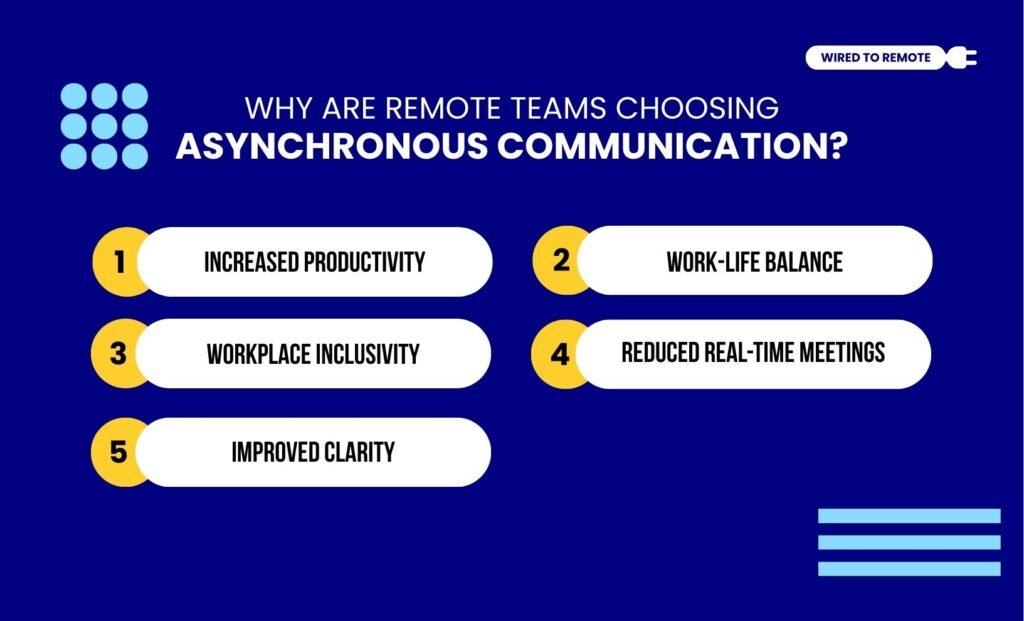
Unlike synchronous communication, remote teams are readily choosing asynchronous communication. But some of the core reasons behind this choice include—
- Increased Productivity: Firstly, this modern approach to communication increases productivity within the team by removing unnecessary meetings.
- Work-Life Balance: Moreover, it allows employees to enjoy a proper work-life balance with no urgency in response times.
- Workplace Inclusivity: Additionally, this communication model includes all kinds of employees, from diverse locations, to keep them in the loop with the updates.
- Reduced Real-Time Meetings: Also, it reduced the need for real-time calls or video meetings significantly, so employees can concentrate on work.
- Improved Clarity: Finally, its documentation provides clarity and future references regarding various projects and workflow models.
Pros And Cons Of Asynchronous Communication
Given that asynchronous communication offers countless benefits, it is being readily adopted in remote teams. But it also comes with certain challenges.
So, here is a clear breakdown of the pros and cons of this revolutionary communication—
| Pros | Cons |
|---|---|
| 1. Reduces interruptions and distractions, so employees can focus on complex tasks. | 1. Not suitable for urgent matter discussions. |
| 2. Removes the need to have coordinated meetings in a remote setup. | 2. Risk of misunderstanding due to a lack of tone and body language. |
| 3. Encourages written messaging, updates, and documentations over real-time video meetings. | 3. Can potentially delay the decision-making process. |
How To Implement Asynchronous Communication In Remote Teams?
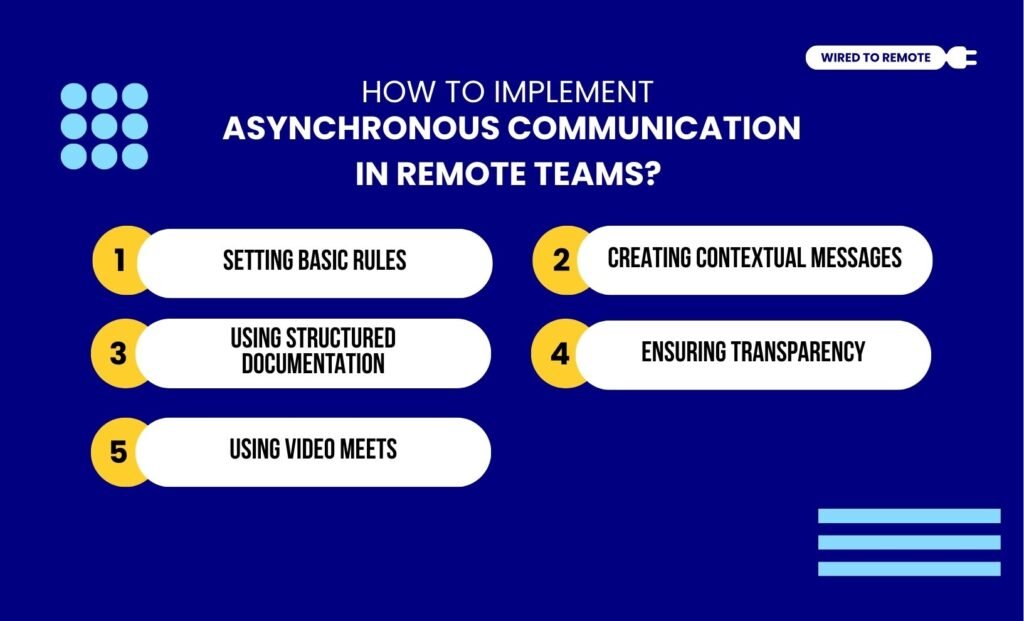
Now, implementing asynchronous communication in remote teams is quite easy. But the only thing is that you need to follow the steps properly.
So, here is a step-by-step guide on incorporating the new communication system within the remote team—
1. Setting Basic Rules
Firstly, employees and employers need to know the exact response time in the workplace communication system. So, set clear response time expectations for the team to follow.
In addition to this, decide on the type of communication channels the team will use. So, there is less confusion in sharing information, documentation, and other updates.
2. Creating Contextual Messages
Moreover, the messages sent over these communication channels should be contextual. That is, it should contain all the information, precise details, and a proper description.
So, it is easier for the receiver to understand the context before responding to it. This way, you can reduce miscommunication through the written communication channels.
3. Using Structured Documentation
In addition to this, you need to use structured documentation to keep a record of workplace communication.
That is, maintain a specific order for meeting summaries, decision logs, and the shared calendars for project timelines. This will help in reducing the confusion with diverse structures.
4. Ensuring Transparency
Along with this, the employer and the employees should ensure that there is transparency in sharing the project statuses.
This will help in maintaining the workplace communication’s transparency and showcase the clear contribution of the employees. So, there is no possibility of miscommunication.
5. Using Video Meets
Finally, employees can use video meetings and voice calls to discuss urgent matters, instead of waiting for the messages to be checked.
Moreover, the video meetings can provide a clear tone and clarity to the messages. So, employees can share the information, ideas, and updates right on time.
When To Use Asynchronous Communication In Remote Teams?
Given that asynchronous communication helps remote teams in sharing updates and information without immediacy in the response time, it is suitable for a few scenarios, like—
- Detailing the updates on the project progress.
- Documenting communication in the workplace.
- Discussing matters that have zero urgency.
- Sending feedback on the company culture and work satisfaction.
Now, asynchronous communication is nothing new.
But in the remote setup, it has revolutionized the entire workplace communication. Prioritizing work efficiency over distracting meetings.
So, choose the right mix of communication approaches for your remote team to skyrocket productivity without losing the workplace connection!
FAQs
Here are some of the common questions around the incorporation of asynchronous communication systems in remote teams.
Yes, absolutely. Unlike synchronous communication, which compels the remote teams to respond immediately, asynchronous communication does not encourage back-and-forth responses.
So, it comes with a slower pace of communication, where the remote members respond at their own time. Focusing more on overall efficiency and higher work quality.
Given that asynchronous work focuses more on overall efficiency and quality, it has the potential to curb the need for frequent remote meetings.
That is, it can reduce constant meetings on updates regarding the daily workflows and project progress.
This way, employees can share information, provide insightful input, and focus on deep work without getting distracted by continuous meetings.
Generally, the key to maintaining team cohesion with asynchronous communication is focusing on transparency, structured messaging, and social connection in virtual spaces.
That is, teams should prioritize intentional communication over immediate responses.
So, they need to determine the communication protocols, foster clarity, encourage social connection, and improve employee morale. This can help maintain team cohesion.



Leave A Comment