

Most companies say they value teamwork, but only a few invest in it the right way.
You will see them planning one-off activities, taking photos, and moving on. Then they wonder why nothing changes.
Corporate team building is not an event; it is a system. So, if you treat it like a checkbox, it will fail.
And that is precisely why I’m here today – to break corporate team building for you.
More importantly, I want to focus on what actually works and why most companies fail to build teams that last.
Stay tuned.
What Corporate Team Building Really Means?

Corporate team building is not about games or outings. Instead, it is about how people work together every day.
A strong team has three things:
- Clear roles.
- Open communication.
- Trust under pressure.
And you cannot build these in a single afternoon. But the right activities can start the process.
What Good Team Building Looks Like?
Good team building feels natural, not forced. Moreover, it connects to real work, offering employees a real reason to care.
And I agree! I’ve spent nearly a decade in corporate, and I started very young, climbing my way to the position of a content manager a few years back.
For me, team building has been at the core of my leadership strategy – and let me tell you, it always works, if you do it right.
Understand that your team is not stupid – they will see right through most lies you will say to get work done.
Instead, I focus on transparency and honesty. I have never lied to my team about the work on our plates.
Also, when I make decisions, I try to involve the senior members by having one-on-one meetings about future plans.
Just plain honesty, communication, and empathy can make things super easy at work, especially if you are working with a big team with people from diverse backgrounds.
As a result, I’ve drawn on three aspects to highlight what good corporate team building looks like:
- Improve how people communicate.
- Build trust through shared effort.
- Help teams solve problems together.
Also, understand that if you don’t see any of these three aspects, it is just entertainment.
Why Most Corporate Team Building Efforts Fail?
Companies often make the same mistakes – and if you have worked in more than one company, you already know that.
- They choose activities that are fun but useless.
- They force participation without context.
- Also, they ignore what happens after the activity ends.
But the truth is, a trust fall will not fix poor leadership. Moreover, an off-site will not solve unclear goals.
Like I was saying, people see through this. And once they understand, you are just doing it for show, they disengage.
Corporate Team Building Activities That Actually Work:
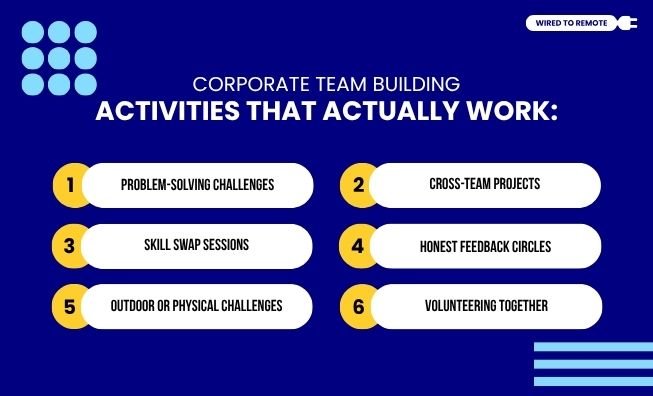
So, here are activities that go beyond surface-level fun.
1. Problem-Solving Challenges:
Give teams a real or simulated problem. Then, set a time limit. Also, keep your resources limited. This forces people to think, listen, and adapt.
On that note, here are some examples:
- Escape room-style challenges.
- Business case simulations.
- Crisis management exercises.
Why will these activities work? Because they mirror real stress.
2. Cross-Team Projects:
Most teams work in silos. The problem? This creates friction.
So, you have to break that pattern. Create short projects with people from different departments.
Also, give them a shared goal and clear ownership.
This builds respect and reduces miscommunication later.
3. Skill Swap Sessions:
Everyone has something to teach – why not use that?
So, just ask team members to run short sessions on their skills. It could be work-related or personal.
This does two things:
- Builds confidence.
- Creates appreciation for each other’s strengths.
Also, it makes learning feel less formal.
4. Honest Feedback Circles:
This is uncomfortable but powerful. And I abide by this since honesty and transparency are at the core of my leadership strategy.
For this to work out, create a safe space for structured feedback. Moreover, ensure you are setting clear rules. Also, keep things respectful and specific.
Focus on:
- What works?
- What needs to improve?
When done right, this builds trust faster than any game.
5. Outdoor Or Physical Challenges:
Physical activities change team dynamics. You will see people step out of their usual roles.
Also, leaders emerge in different ways – as someone you don’t expect to lead suddenly emerges as a strategic leader who leads from the front.
On that note, here are some examples:
- Trekking.
- Sports tournaments.
- Adventure courses.
In addition, these work best when followed by reflection.
6. Volunteering Together:
Working for a shared cause shifts perspective. And not just that, it also removes hierarchy for a while. Moreover, it builds a sense of purpose within teams.
As a result, if you plan to do volunteering, choose something meaningful. Not just a photo opportunity.
How to Make These Activities Actually Work?

The activity itself is only half the job. Yep! You can’t organize corporate team building activities and not follow up later – that’s where most companies go wrong.
You will see companies organize team-building events, motivate employees to participate, and post videos of team bonding on LinkedIn.
But how many companies actually end up building good teams? Not many. Do you know why? What you do before and after matters more.
Before The Activity:
So, here’s what you need to do before any team-building activity:
- Set a clear goal.
- Tell people why this matters.
Also, understand that if there is no purpose, people will not engage.
During The Activity:
Observe how people behave.
- Who speaks?
- Who stays silent?
- Also, who takes control?
This is where the real insight lies.
After The Activity:
As I was saying, this is where most companies fail. As a result, it is crucial that you connect the experience to real work.
So, ask simple questions:
- What did we learn?
- What should we change?
- Also, what will we do differently next week?
If you skip this step, the activity is wasted.
The Role Of Leadership In Corporate Team Building:
No activity can fix poor leadership. So, if managers do not listen, teams will not open up.
Similarly, if leaders avoid accountability, trust will not grow.
As a result, corporate team building starts at the top, and leaders must:
- Show vulnerability.
- Accept feedback.
- Act on what they hear.
Without this, everything else is surface-level. Moreover, a simple way to think about it is to think of team building like fitness.
You cannot work out once and expect results. Moreover, you need consistency. Small efforts, repeated over time, create change.
In addition, understand that most teams do not need more activities. They need better intent.
As a result, the focus should be less on planning the perfect event. Instead, the focus should be more on what a team actually needs.
Start small. Stay consistent. And treat team building as part of work, not a break from it.


Leave A Comment