Team dynamics is an intangible factor with a huge impact on the tangible performance reports of the employees.
It decides how the employees in a team stick to a common goal, interact with each other, and work together.
Moreover, when the team dynamics are positive, everyone has a clear role to play, and the communication is more transparent as there is psychological security.
On the other hand, when the team dynamics are negative, there will be poor performance and conflicts, leading to missed deadlines.
Furthermore, in a remote working environment, positive team dynamics are built on asynchronous workflows, flexibility, and planned communication. There also needs to be efficient self-management.
Hi, in today’s blog, I will talk about what team dynamics are, how they matter and impact employee retention and engagement, how to shape team dynamics, how to improve them, and more.
Moreover, I will focus more on virtual coworking or remote working throughout the discussion.
What Are Team Dynamics?
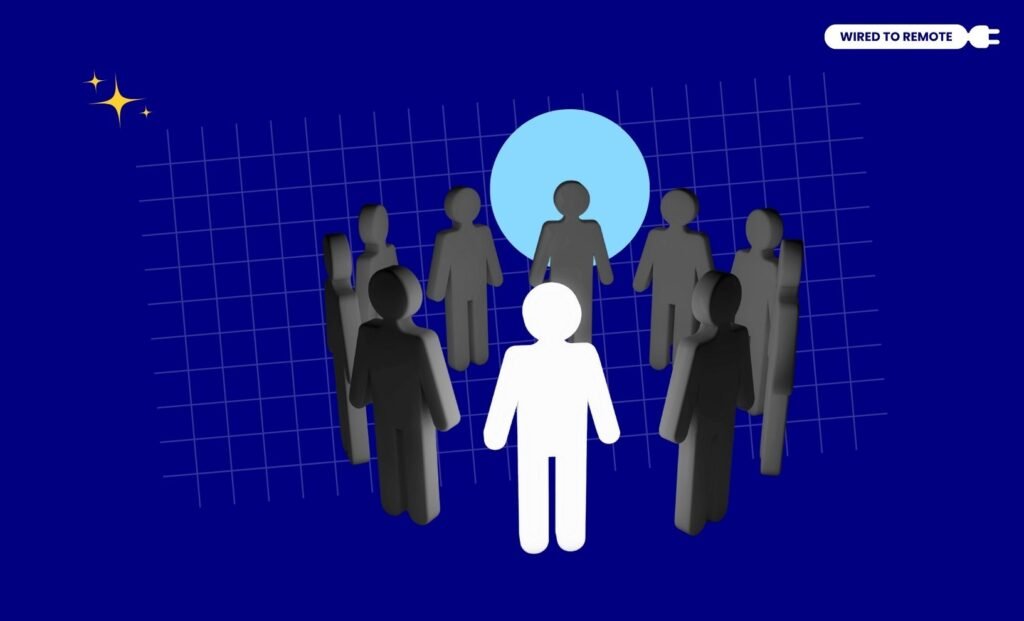
You have a team and a common goal to achieve. Now, team dynamics are the factors such as inter-personal interactions and the style of working.
These factors determine the performance of an individual and the team.
Furthermore, these are invisible factors that improve team engagement, foster trust, and cooperation for achieving the shared goals.
For remote workers or digital nomads, there is a lot of digital collaboration and intentional communication to combat alienation and improve team dynamics. This supportive culture helps to improve the productivity of remote workers.
Moreover, building positive team dynamics can be an important remote work policy to retain top talent.
Virtual hangout times, regular check-ins on the work progress, and employee appreciation are some key strategies to make the team dynamics positive in a remote working environment.
Are Team Dynamics And Group Dynamics The Same?
Though used interchangeably, team dynamics and group dynamics are not the same. The primary difference is the absence of a common or shared goal in group dynamics.
Here is a brief comparison.
| Team Dynamics | Group Dynamics |
|---|---|
| • A Structured Group • People Work toward a Common Goal • Effective Collaboration | • Spontaneous and Informal • No Common Goal is Present • Free to Act on One’s Own Accord |
Why Do Team Dynamics Matter In A Remote-Working Environment?
When you are working from the same space, positive team dynamics improve the productivity and performance of the team.
Furthermore, with psychological security, everyone can be creative enough and confident to express different ideas about problem-solving. Thus, everyone will feel important throughout the decision-making process.
Moreover, with positive team dynamics, everyone has a shared goal to achieve. Thus, on a bigger scale, there is a better alignment with the organizational goal.
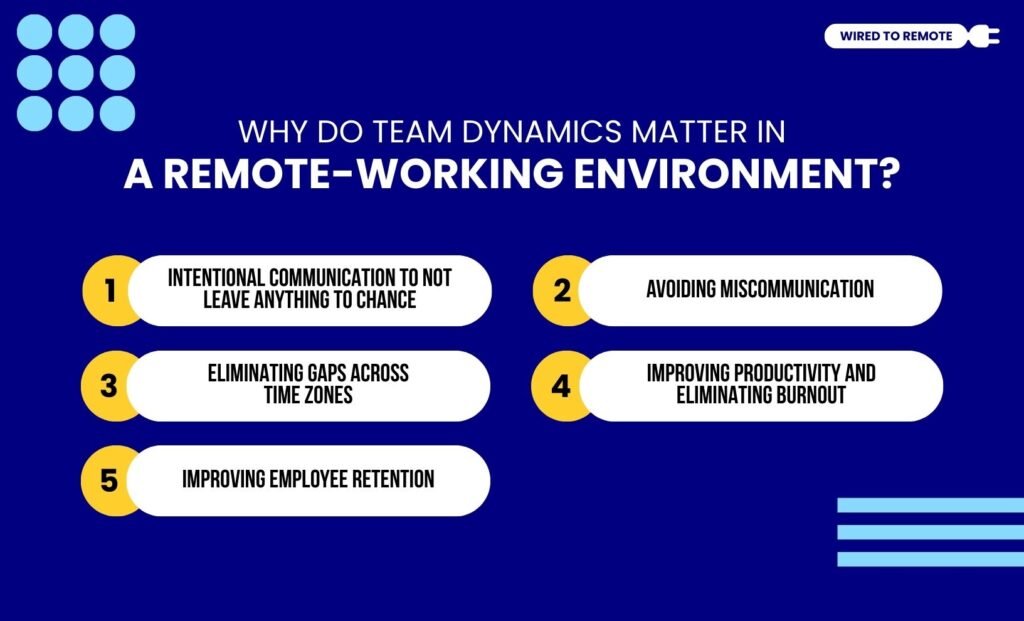
Having said that, the role of team dynamics is even more specific for remote employees.
1. Intentional Communication To Not Leave Anything To Chance
When everyone is working in an office, it is easy to overcome those conflicts with water cooler moments.
However, when you are working remotely, you have to be more deliberate in building communication and resolving those disputes.
Moreover, making efforts to build camaraderie or eliminate disputes is a sign of positive team dynamics.
It means that from discussing common goals to clearing out misunderstandings, you don’t want to leave anything to chance.
Typical watersign things!
2. Avoiding Miscommunication
Written communication can sometimes lead to miscommunication.
However, when the team dynamics are strong, and you exchange non-verbal cues in video calls or virtual meetings, team members can easily avoid the frustrations of duplicate work and working in silos.
Moreover, asynchronous communication in a remote working environment eliminates the disturbance often created by real-time communication, especially when someone is doing research-intensive work.
3. Eliminating Gaps Across Time Zones
Remote team members belong to different cultures and time zones.
However, when the team dynamics are strong, there will be better management of the workflow by following an asynchronous method.
Also, when the team dynamics are positive, the team members are aware of the time window they are expected to be present.
4. Improving Productivity And Eliminating Burnout
Workflows become more seamless in the presence of positive team dynamics.
Furthermore, with concise standard operating procedures (SOPs), everyone working from different parts of the world has a shared goal and an objective step-by-step process to follow.
Thus, everyone shoulders the workload equally, and nobody feels overworked. This is an excellent scenario for avoiding burnout.
5. Improving Employee Retention
“Extended remote work was associated with anxiety, depression, isolation, reduced job satisfaction, and productivity losses stemming from a lack of technical and emotional support.”
This extract from the “Loneliness and Isolation in the Era of Telework: A Comprehensive Review of Challenges for Organizational Success Report” shows how remote employees feel alienated or lonely.
However, with planned virtual games for team meetings, breaks, talk sessions, or team bonding activities, isolation can be avoided. You can even share funny memes to make the atmosphere lighter.
Moreover, these activities also help in better employee engagement and retention.
What Are The Key Elements That Shape Team Dynamics?
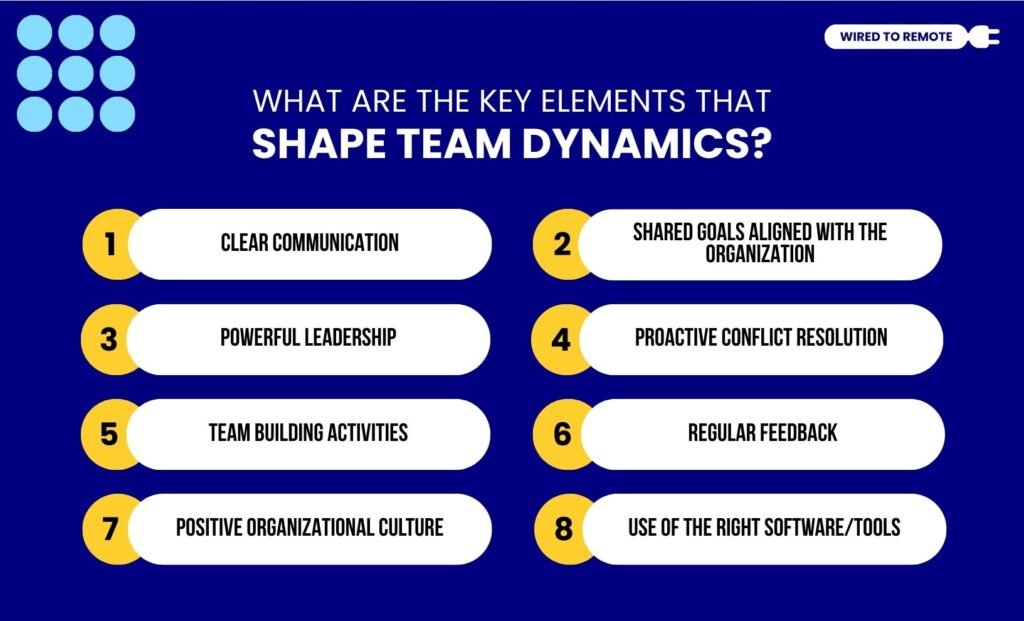
You can only optimize the potential of an individual when the team dynamics are positive.
Furthermore, with positive team dynamics, the mindset of every individual becomes optimistic. So, hurdles, bottlenecks, or any demon you name! The team can combat everything.
So, here are the key elements that build team dynamics.
1. Clear Communication
Clear communication is never a one-way process, be it inside a conference room or through video conferences.
Moreover, once the leader communicates the ideas and goals, everyone needs to actively listen and confidently speak up about their ideas and take on the things discussed.
2. Shared Goals Aligned With The Organization
Suppose the shared goal of your team is to earn $50000 for a particular quarter. Now, everyone will know what role they have to play to achieve that goal.
Thus, reaching the goal becomes easier, and of course, there is a sense of accomplishment when the goal is achieved.
3. Powerful Leadership
“45% of people say lack of trust in leadership is the biggest issue impacting their work performance!” – Tolero Solutions.
Now, powerful leadership is not just about giving orders or propelling the team toward the completion of a task.
A leader needs to create a supportive work environment where everyone is assigned tasks according to their strengths.
Furthermore, the leader must be more empathetic and, instead of shifting blame, should show accountability and proactively work toward resolving the issues.
4. Proactive Conflict Resolution
There is no pointing fingers when the team dynamics are positive. Also, the focus is more on finding practical solutions.
Furthermore, it is about creating an atmosphere where everyone takes feedback positively, and conflicts are resolved before getting escalated.
5. Team Building Activities
Social gatherings outside work are great for in-office employees to bond. However, in a remote environment, you can have a fun quiz session or just a virtual coffee break together.
These simple acts help eliminate stress and boost engagement.
6. Regular Feedback
Regular and constructive feedback helps everyone to identify the hiccups, and it’s not like hauling up one or penalizing one for their faults.
It is more like a process of identifying gaps. The check-in meetings I conduct every Friday are a classic example of a regular feedback culture.
The objective is simple. Identify the problems early and don’t sit on them. It is the first step toward eliminating inefficiency or poor performance.
7. Positive Organizational Culture
If an organization encourages collaboration, transparent communication, and employee appreciation, building positive team dynamics becomes easier.
Built In, a popular community of tech companies and startups, mentioned in their 2021 report that 15% of job seekers refused a job because they did not like the company culture.
That is why having a positive company culture, without frequent conflicts and disengagement is so important in building healthy team dynamics.
8. Use Of The Right Software/Tools
You need the right balance of synchronous and asynchronous communication tools. When you are working on a time-sensitive project, you can use synchronous communication tools such as Microsoft Teams or Google Hangouts.
Furthermore, for asynchronous communication and workflow, you can use Slack conversations, Asana, and Trello.
What Is The Role Of Leadership In Shaping Team Dynamics?
The role of leadership in shaping team dynamics starts with building trust and psychological safety. Thus, everyone in the team becomes an active listener, they are open to feedback, and they want to contribute their creative ideas in resolving problems.
Furthermore, when the leader of a team has emotional intelligence, they can understand the differences in emotions and keep things inclusive, and no emotion is labelled as invalid.
Moreover, the leader sets the norms, expectations, and behavioral guidelines for the entire team.
What Are The Common Types Of Team Dynamics?
There are two types of team dynamics, positive and negative. Here is a brief comparison.
| Positive or Healthy Team Dynamics | Negative or Unhealthy Team Dynamics |
|---|---|
| • Collaborative and Supportive Teams • High Trust Environment • Shared Accountability • Inclusive Decision Making • Trustworthy and Secure Environment | • Avoiding Conflicts Making the Disputes Even • More Serious • Unresolved Tensions • Power Dominance • Imbalanced Participation of Team Members • Weak Communication |
How Team Dynamics Evolve Over Time?
According to Tuckman’s model, there are five stages of evolution for team dynamics.
| Team Dynamics: Five Stages of Evolution | Details |
|---|---|
| Forming | Initial Orientation |
| Storming | Conflict and Negotiation |
| Norming | Establishing Norms and Cohesion |
| Performing | Efficient Collaboration |
| Adjourning | Project End or Team Restructuring |
How Teams Move Or Get Stuck Through The Evolution Of Team Dynamics?
Understanding the key dynamics and pitfalls helps us to have a clear picture about how teams get stuck through the evolution of various stages of team dynamics.
| Stages | Key Team Dynamics | Common Pitfall |
|---|---|---|
| Forming | AnxiousPoliteSetting Boundaries | Lack of Clear Goals or Job Roles |
| Storming | ConflictsPower StrugglesFrustration | Silent, Unresolved Conflicts |
| Norming | CohesionClear RolesCooperation | Fear of Conflict and Change |
| Performing | InterdependenceHigh Efficiency | ComplacencyRegression due to Change |
| Adjourning | DisbandingReflecting on Success | Emotional Disengagement Lack of Closure |
Open communication, active leadership, addressing conflicts openly, and having a shared goal help to move forward through the stages of evolution in team dynamics.
What Are The Practical Ways To Improve Team Dynamics?
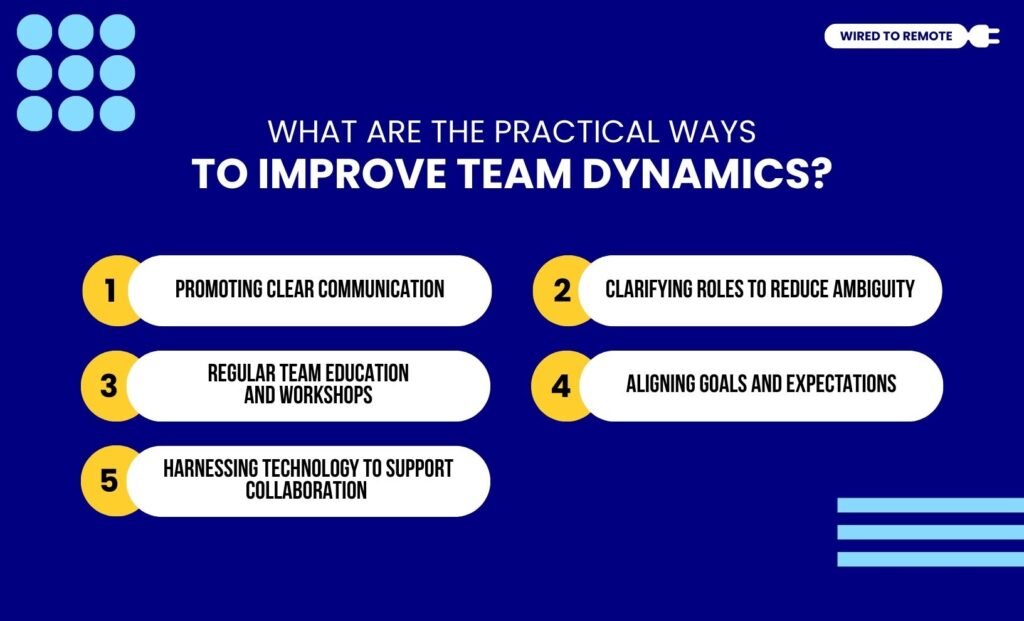
Aligning goals, behavioral training, and the use of technology are some practical ways to improve team dynamics.
1. Promoting Clear Communication
No dispute remains unresolved when the leadership encourages clear communication. Everyone is an active listener if the team dynamics are positive.
Furthermore, team members feel confident to share their ideas about creative problem-solving.
2. Clarifying Roles To Reduce Ambiguity
When you clarify the job roles, each member in the team understands their job roles and what is expected of them.
Furthermore, the roles must be assigned according to the right skill sets.
3. Regular Team Education And Workshops
Behavioral awareness training helps to improve communication, manage stress, and be more receptive to constructive feedback.
William Moulton Marston’s DISC or Dominance, Influence, Steadiness, and Conscientiousness, and the MBTI personality tests are some powerful methods for team education and workshops.
4. Aligning Goals And Expectations
You can translate the SMART goals of your organization into Objectives and Key Results (OKRs) and Key Performance Indicators (KPIs) so that every employee knows their roles and responsibilities.
Thus, the workflow becomes more streamlined.
5. Harnessing Technology To Support Collaboration
You must use technology to create a balance between synchronous and asynchronous communication. Google Hangouts and Microsoft Teams are ideal for real-time or synchronous communication.
On the other hand, Zoom, Slack, or Google Workspace are great for asynchronous communication.
How To Measure And Evaluate Team Dynamics?
Surveys and assessments, nine-box grid, 360-degree feedback, behavioral observations, and quantitative metrics or KPIs are the best methods to evaluate team dynamics.
| Tools And Methods to Evaluate Team Dynamics | Details |
|---|---|
| Surveys and Assessments | Use tools such as the Group Climate Questionnaire (GCQ) to assess team dynamics. |
| 360-Degree Feedback | Anonymous feedback from peers and managers for successful collaboration and improving interpersonal skills. |
| Nine-Box Grid | Map team members based on their performance to understand individual contributions. |
| Quantitative Metrics (KPIs) | Track objective data such as team turnover rate, attendance/absenteeism, and project velocity. |
| Behavioral Observations | Monitor team meetings and see how team members handle conflicts and respect communication norms. |
Real-World Examples Of Strong Team Dynamics In A Remote Working Environment
Zendesk, Basecamp, and Toptal are some of the most prominent examples of strong team dynamics in a remote working environment.
- Toptal uses asynchronous collaboration to work on projects with trust and flexibility. Thus, it ensures a successful collaboration of employees across various time zones.
- Zendesk uses virtual coffee chats, campfires, virtual fitness challenges and the fun interview of colleagues called “Grill the Seller” to eliminate isolation.
- Basecamp is one of the pioneers in remote work. It uses video conferencing tools, project management tools, and chats to build a structured workflow, one of the main elements of positive team dynamics.
Team Dynamics In Remote And Hybrid Work
The fundamentals of team dynamics have changed in remote and hybrid work environments. As I have mentioned, there is a watercooler effect like a physical working setup.
So, trust and cohesion no longer happen by accident, and they must be engineered through intentionality.
Furthermore, when teams are high-performing, they will always prefer asynchronous communication as they respect deep-work blocks. It helps to use synchronous time for problem-solving and emotional connection.
However, the “proximity bias” still remains a challenge in building positive team dynamics. On-site employees can get more opportunities than their remote peers.
Here comes the role of a leader. They must ensure psychological safety irrespective of the physical distance. Every voice must be heard. Moreover, they must nurture a culture in which outcome-based accountability gets priority over micromanagement.
Key Pillars Of Modern Teamwork And Team Dynamics
| Feature | Remote/Hybrid Strategy |
|---|---|
| Communication | Over-Communicate Expectations Document Everything |
| Connection | Virtual Social Hours Dedicated Non-Work Channels |
| Equity | “Digital-First” Meetings Everyone Joins Via their Own Camera |
Strong Team Dynamics Ensure Sustainable Practice
Team dynamics are invisible. However, they drive tangible performance. In remote and hybrid working environments, positive dynamics rely on intentionality rather than chance.
Clearly defined roles and psychological safety can transform isolated individuals into a cohesive unit.
Moreover, to build a sustainable practice, leaders must guide their teams through the five stages of development. Understanding these stages helps identify where communication may be breaking down.
When team members feel secure and aligned with shared goals, they navigate the evolution from “Forming” to “Performing” more effectively.
Team Dynamics In Remote Work Environment: Frequently Asked Questions (FAQs)
Here are the frequently asked questions and answers about team dynamics in a remote work environment.
Low productivity, missed deadlines, and frequent conflicts are the outcomes of poor team dynamics.
Without psychological safety, employees work in silos, leading to high turnover and burnout. This dysfunction often causes teams to get stuck in the Storming phase, unable to reach peak performance.
Yes, you can fix team dynamics through intentional communication, strong leadership, and psychological safety.
Furthermore, you will have to clarify the job roles and resolve conflicts at the storming stage. Also, you have to encourage open communication to shift from toxic silos to a high-performing, collaborative culture.
It takes at least three to six months to shift team dynamics significantly.
You can make structural changes, such as using new tools, quickly.
However, consistent behavioral reinforcement across the stages of Forming, Storming, and Norming is a time-consuming process. This is the basis of reinforcing psychological security and trust.
Team dynamics are universal and context-specific at the same time. For example, the psychological foundations, such as trust and safety, and Tuckman’s stages, such as Forming, Storming, Norming, Performing, and Adjourning, are universal.
However, the execution part of building team dynamics is context-specific. Asynchronous tools engineer team dynamics in a remote setup, while organic proximity is the basis of team dynamics for in-office teams.
Moreover, high-stakes environments prioritize hierarchy, while creative fields require flat, divergent interaction styles.



Leave A Comment