

Topic of the day: Cost of living in Bali as a remote employee.
Bali has undergone a fundamental shift. For the modern remote worker, it is no longer just a backdrop for escapism; it is a high-functioning regional business hub.
As we move through 2026, the “cheap paradise” narrative has been replaced by a more complex reality.
For the corporate professional, the goal is Lifestyle ROI: balancing operational costs against networking potential and output quality.
The Digital Nomad Market Landscape In 2026
Bali now competes directly with global hubs like Lisbon, Mexico City, and Bangkok. While the cost of living remains low compared to the US or UK, the “professional infrastructure” carries a distinct premium.
For instance, data from the 2025-2026 Nomad Index shows a 14% year-over-year increase in rent in high-demand areas like Canggu.
This is driven by a move toward “Executive Nomadism,” where professionals bring families and demand Western-standard facilities. (Source: Savills Impacts)
You are no longer just paying for a room; you are paying for fiber optics, community access, and a timezone (GMT+8) that offers perfect synergy with the APAC and Australian markets.
The “Cost Of Doing Business” In Bali: Understanding The Infrastructure Expense
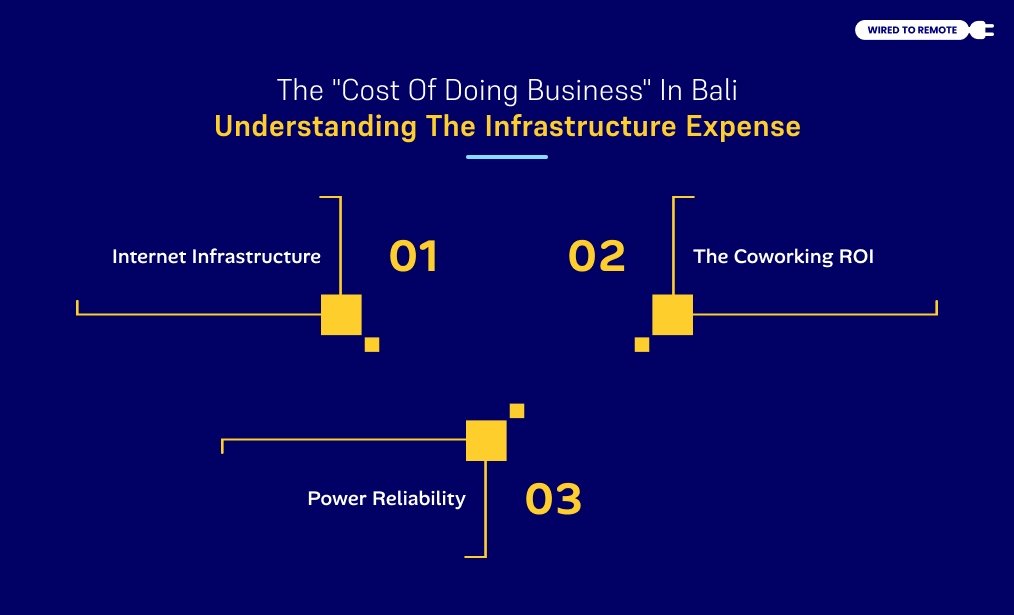
When it comes to talking about the cost of living in Bali as a digital nomad, there is one very important thing that you simply cannot skip.
And that is the cost that goes into your infrastructure. And by that, we aim to emphasize things like taking care of the internet and power reliability.
You see, in a corporate environment, connectivity is the primary overhead. For instance, a power outage during a board meeting is a professional failure.
Internet Infrastructure:
Firstly, while “Free Wi-Fi” is ubiquitous, it is rarely sufficient for high-stakes video conferencing. Standard villa Wi-Fi averages 30-50 Mbps.
As a result, professionals now opt for Starlink Mini or dedicated Fiber-to-the-Home (FTTH) setups. The respective costs, for instance, of these two options are:
- Starlink Monthly Subscription: About $50 – $65.
- 5G Mobile Backup (Telkomsel/Orbit): About $15 for 50GB.
The Coworking ROI:
Secondly, the cost of living in Bali as a digital nomad comes with the pressure of being productive. And most of us are well aware of the fact that productivity requires ergonomics and noise control.
Premium coworking spaces like BWork, Tribal, or Outpost offer “Deep Work” zones and soundproof Skype booths.
- Monthly Unlimited Pass: $180 – $260.
- Private Office Suites: $500 – $800/month.
Power Reliability:
Finally, there is reliability on power – something that is non-negotiable as a remote worker. Bali’s grid (PLN) is generally stable but prone to flickers during the rainy season.
A Portable Power Station (e.g., EcoFlow) is a recommended one-time investment of $350 – $600 to ensure 100% uptime for laptops and routers.
Cost Of Living In Bali: Where To Stay In Bali As A Remote Worker?
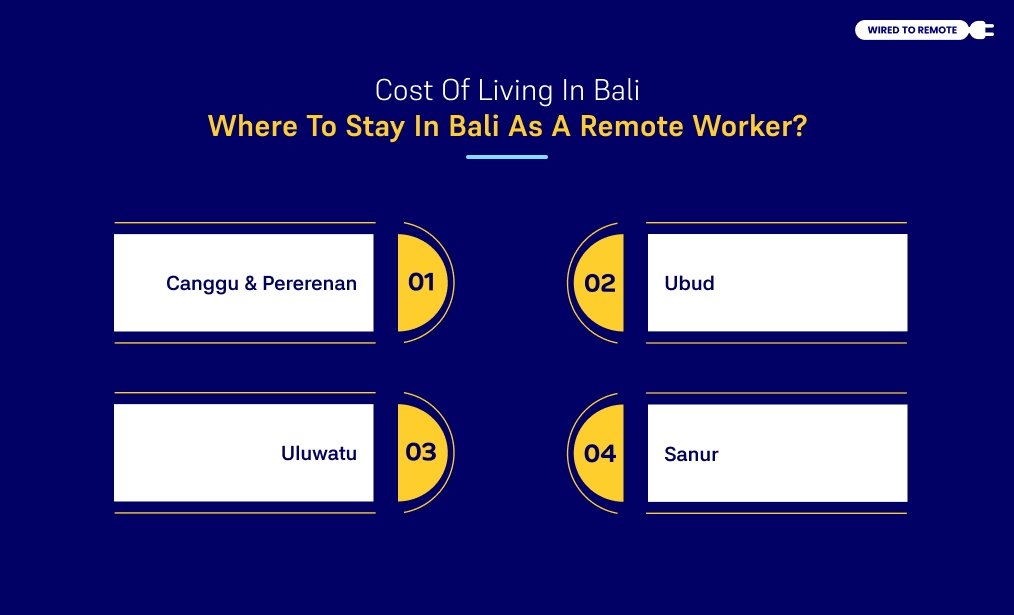
Now, Bali is definitely one of the best places for digital nomads. However, your choice of neighborhood is a strategic business decision. It dictates your networking ROI and your operational “burn rate.”
Canggu & Pererenan:
Firstly, as Bali’s so-called Silicon Valley, this location features the largest number of innovators and multimillionaire company owners. (Source: Eco-Business)
Furthermore, the extension of the area at an exponential rate caused serious traffic congestion. In general, you will be able to get a really nice 1-bedroom villa for around $1,800 – $2,600/month.
Ubud:
Secondly, Ubud is a great environment if you are a writer, need to focus, or just want a break from work.
Moreover, the jungle setting is usually 3 to 5 degrees cooler than the coast, meaning fewer costs for AC.
Also, just in case you wanted to know, you can have private 1-bedroom villas for $1,200 – $1,900/month.
Uluwatu:
This location is best for wealthy remote working leaders who like top-notch design and don’t want to be in a crowded place. (Source: Our Year in Bali)
Besides the networking opportunities that are around surf culture and located at luxurious cliff-top venues, the area also boasts luxury 2-bedroom villas that can be leased for $3,500 – $5,500/month.
Sanur:
Finally, there is Samur. This is the sensible choice for families and people intending to stay for a long time.
It features reliable infrastructure, concrete sidewalks, and very quick access to international hospitals.
It is normal that a huge 3-bedroom house for a family is going to run about $1,500 – $2,200/month.
Food, Fuel, And Daily Logistics
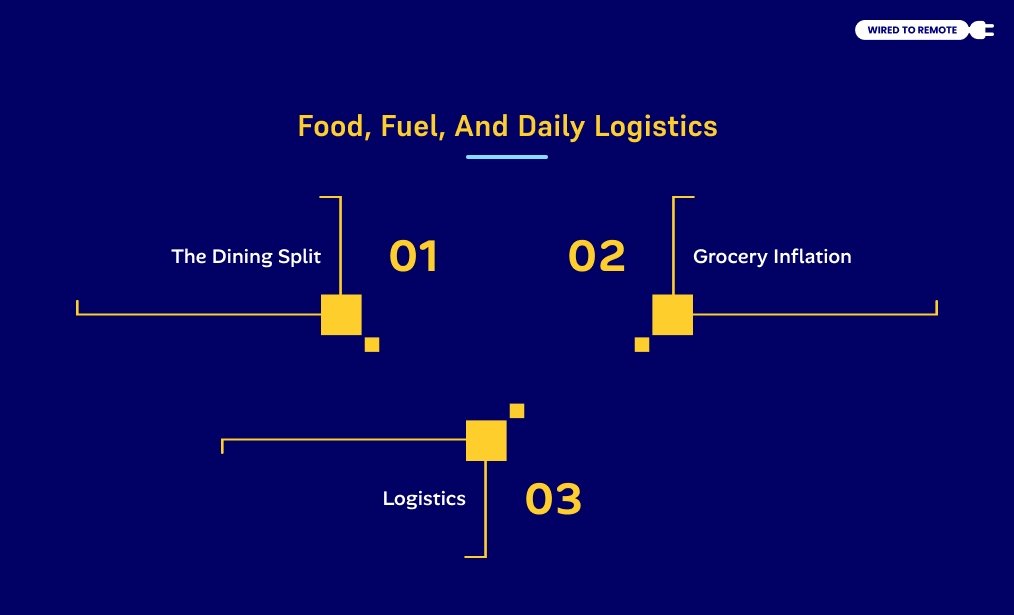
As someone living in Bali for remote work, understanding the Bali food scene is very important. The gap between local “Warung” pricing and “Executive” dining is the widest in Southeast Asia.
The Dining Split:
- Local Warung (Nasi Campur): $2.50 – $4.00.
- Western Brunch/Cafe Meal: $12 – $18.
- Fine Dining (3-course): $45 – $70.
Grocery Inflation:
Local produce (tropical fruits, eggs, and local poultry) is inexpensive. However, imported goods carry a “Comfort Tax.”
- Australian Steak (200g): $18.
- Imported Berries: $8 – $12.
- Wine/Spirits: A 200% luxury tax makes a standard bottle of imported wine cost $35 – $50.
Logistics:
Most professionals use Gojek or Grab.
- Scooter Rental (NMAX 155cc): $120 – $180/month.
- Private Driver (Full-time): $500 – $700/month.
Legal, Visas, And Tax Compliance

Managing your legal status is a fixed monthly cost that provides operational security.
Operational security in Bali requires moving beyond “grey area” visa runs to formal residency.
For the professional remote worker, this centers on the E33G Remote Worker Visa and understanding Indonesian tax residency triggers.
The Remote Worker Visa (E33G)
Firstly, the E33G is a dedicated KITAS (Limited Stay Permit) for professionals employed by companies outside Indonesia. (Source: Bali.com)
The E33G Remote Worker Visa (KITAS) provides legal residency for professionals employed by non-Indonesian entities.
Furthermore, key requirements include a $60,000 USD annual income and $2,000 USD in personal savings.
Additionally, the visa is valid for one year (renewable) and costs roughly $500–$1,000 USD via agents.
Tax Residency & Compliance
Indonesia determines tax status by duration of stay, not just visa type. For instance, staying over 183 days triggers domestic residency.
While residents typically report global income via an NPWP (Tax ID), E33G holders often qualify for exemptions on foreign-sourced earnings. (Source: Bali Visa)
Furthermore, budget $300/year for a tax consultant to navigate Double Taxation Agreements (DTA) and ensure full compliance.
Comprehensive Monthly Budget Breakdown
Here is a chart that shows you an estimation of the monthly budget breakdown when it comes to calculating the cost of living in Bali.
| Category | Beginner | Intermediate | Advanced |
|---|---|---|---|
| Housing (Inc. Utilities) | $950 | $2,000 | $4,800 |
| Work (Coworking/Internet) | $120 | $250 | $500 |
| Food & Dining | $500 | $1,000 | $1,800 |
| Transport | $100 | $250 | $800 (Private Driver) |
| Visa & Legal (Pro-rated) | $150 | $200 | $350 |
| Health Insurance | $80 | $150 | $300 |
| Social/Networking | $100 | $250 | $600 |
| Total Monthly Burn | $2,000 | $4,100 | $9,150+ |
The Value Proposition: Why Know About The Cost Of Living In Bali?
If your primary goal is to save the maximum amount of money, Bali is no longer the optimal choice. Central Vietnam, Northern Thailand, or parts of South America offer lower absolute costs.
However, Bali offers the world’s best Infrastructure-to-Lifestyle ratio. The value is found in the “soft” benefits.
For instance, these include:
- Talent Density: You are constantly surrounded by 7- and 8-figure business owners, making “accidental networking” a daily occurrence.
- Service Economy: The ability to outsource laundry, cleaning, and cooking for less than $300/month buys back roughly 15-20 hours of professional time per week.
- Wellness Integration: High-end gyms and recovery centers (sauna/ice baths) cost $100 – $200/month, providing a level of physical maintenance that would cost $1,000+ in London or New York.
In 2026, Bali is a destination for the Growth-Minded Professional. It is a place to scale your business while optimizing your personal well-being.
Most experts recommend that you do not budget for the life you have now. Rather, budget for a life that allows you to operate at 100% efficiency.



Leave A Comment