

The topic of the day: Digital nomad visa Bali!
For quite some time, the idea of working in a bamboo villa in Ubud or at a beachside cafe in Canggu seemed like a kind of risky stretch of the law. You would arrive on a tourist visa, try hard to convey the idea of “remote work” to an immigration officer, and then rely on luck.
Fast forward to 2026, and the situation is totally different. Indonesia has gone as far as launching a special visa for remote workers, giving them exactly what they have always wanted: legal security.
Whether you’re a software engineer for a tech giant in San Francisco or a freelance consultant with a global client base, here is exactly how you can call the Island of the Gods your office this year.
Digital Nomad Visa Bali: Quick Facts At A Glance
| Visa Length | Up to 1 year |
| Possible to Extend | Yes, subject to approval and current immigration rules |
| Minimum Income Requirements | Around $60,000 USD per year |
| Time for Visa Applications | Typically 5 – 10 working days, though it can take longer depending on the application |
Digital Nomad Visa Bali: Navigating The New E33G Remote Worker Visa (The Official KITAS)
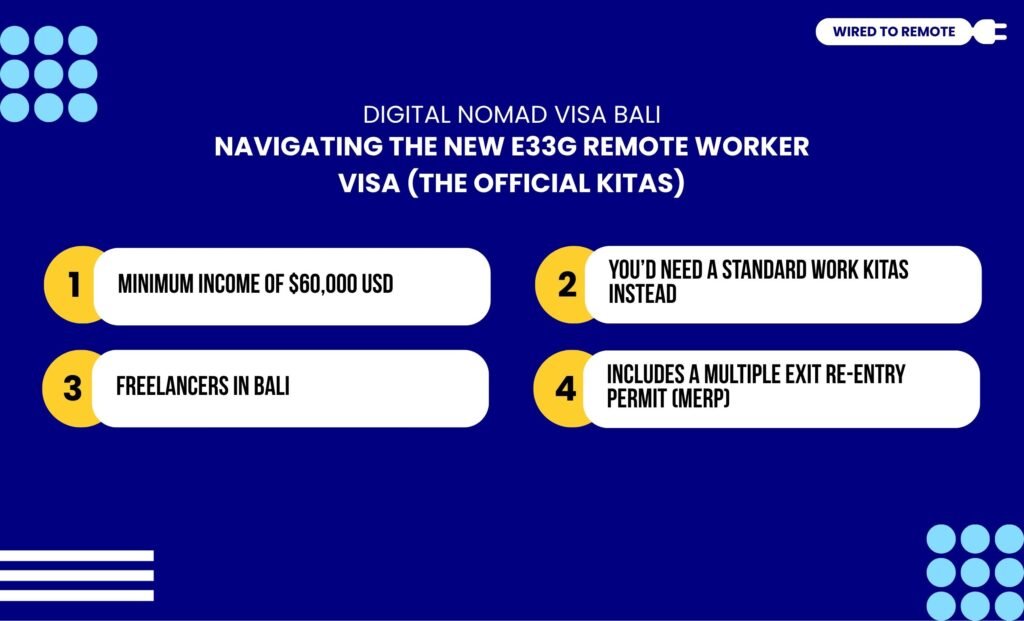
Bali is genuinely one of the best countries for digital nomads. If you are planning to stay in Bali for a year or more, the E33G Remote Worker Visa (officially a KITAS or Limited Stay Permit) is your “gold standard”.
Unlike the old social visas, this permit explicitly recognizes remote work as a valid reason to live in Indonesia.
Minimum Income And Savings Requirements
The Indonesian government is looking for established professionals for this specific permit. To qualify, you must demonstrate a minimum annual income of $60,000 USD.
You’ll also need to show a personal bank statement with a consistent balance of at least $2,000 USD maintained over the last three months.
Eligibility: Who Can (And Can’t) Apply?
The E33G is strictly for those employed by companies registered outside of Indonesia. If your employer has an Indonesian branch that pays you locally, you don’t qualify for this nomad visa. You’d need a standard work KITAS instead.
Additionally, as of early 2026, citizens of certain “restricted” countries (including Afghanistan, Nigeria, and North Korea) currently face significant hurdles or ineligibility for this specific stream.
Freelancers In Bali
If you are a freelancer and are looking for the digital nomad visa Bali requirements, we have sad news for you.
According to Bali.com, you can’t actually do freelancing activities in Bali (Indonesia), such as:
- Providing workshops.
- Running classes.
- Managing social media accounts for local businesses.
The platform also mentions that there is no type of Freelance KITAS that would permit you to work as a freelancer.
“You can get employed by a company but not being self-employed and generate income while working and operating in Indonesia,” they state.
Digital Nomad Visa Bali Duration, Extensions, And Multiple Entry Perks
One of the biggest wins for the E33G is its flexibility. It is initially issued for one year and can typically be renewed for a second year.
Because it is a KITAS, it includes a Multiple Exit Re-entry Permit (MERP). Basically, this means you can jet off to Singapore or fly home for the holidays without your visa being canceled.
Alternative Visa Paths For Remote Workers In Bali
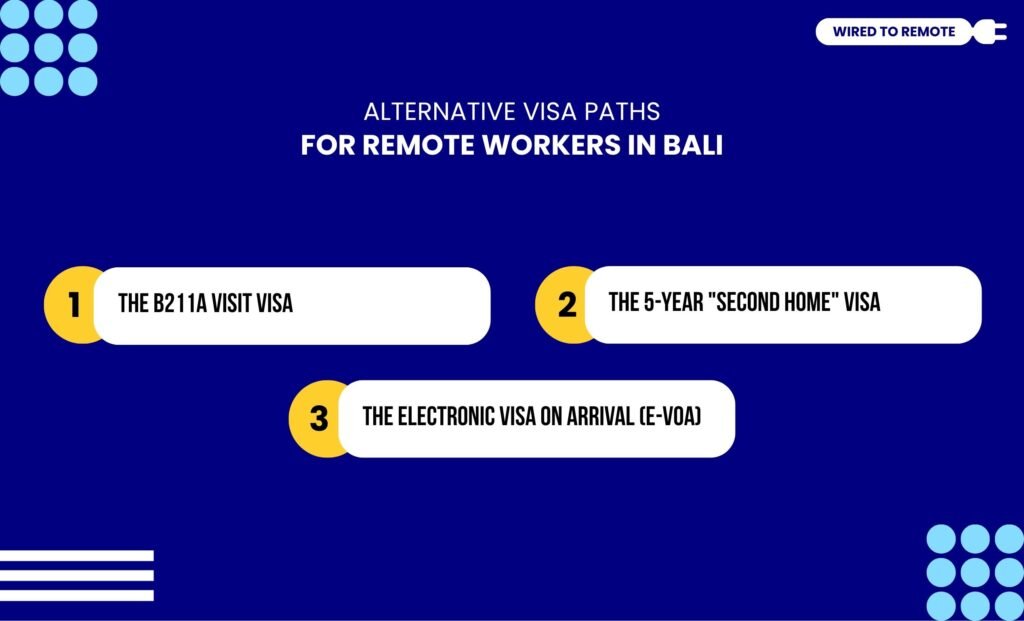
Not everyone meets that $60k salary threshold, and that’s okay. There are other legal ways to enjoy the Bali lifestyle depending on your budget and timeline.
The B211A Visit Visa: Best For Short-Term Stays
The B211A remains the most popular choice for freelancers or those “scouting” the island. It grants an initial 60-day stay and can be extended twice for 60 days each, giving you a total of 180 days (roughly six months).
The catch – it is a single-entry visa. If you leave the country for a quick trip, your digital nomad visa Bali expires, and you have to start the application process over again.
The 5-Year “Second Home” Visa Vs. The Mythical Nomad Visa
You may have seen headlines about a “5-year tax-free nomad visa.” In reality, this usually refers to the Second Home Visa.
While it allows for a 5- or 10-year stay, it requires a massive financial commitment – typically a deposit of IDR 2 billion (approx. $130,000 USD) in an Indonesian state bank.
For most nomads, the E33G is the more realistic long-term play.
When To Use The Electronic Visa On Arrival (e-VOA)
The e-VOA is perfect for digital nomads coming for a “workation” of 30 to 60 days. You can apply online before landing, and it’s easily extendable for an additional 30 days. It’s the least paperwork-heavy option but lacks the resident perks of a KITAS.
The 2026 Bali Tax Guide For Digital Nomads
Tax is the “elephant in the room” for any remote worker. While Bali is beautiful, the Indonesian tax office (DGT) has become significantly more integrated with immigration data in 2026.
The 183-Day Rule And Tax Residency
In Indonesia, you are generally considered a domestic tax resident if you spend more than 183 days in the country within any 12-month period.
Once you cross this threshold, you are legally required to register for a tax ID (NPWP) and report your worldwide income.
Foreign Sourced Income vs. Local Taxation
The good news? Under the E33G, if your income is entirely earned from outside Indonesia and you stay under the residency threshold, you typically aren’t taxed by Indonesia on that income.
However, if you become a resident, you may need to leverage Double Taxation Avoidance Agreements (DTAAs) to ensure you aren’t paying tax twice – once in your home country and once in Indonesia.
Step-by-Step Application: How To Apply For Digital Nomad Visa Bali?
The process is now almost entirely digital, but it requires precision.
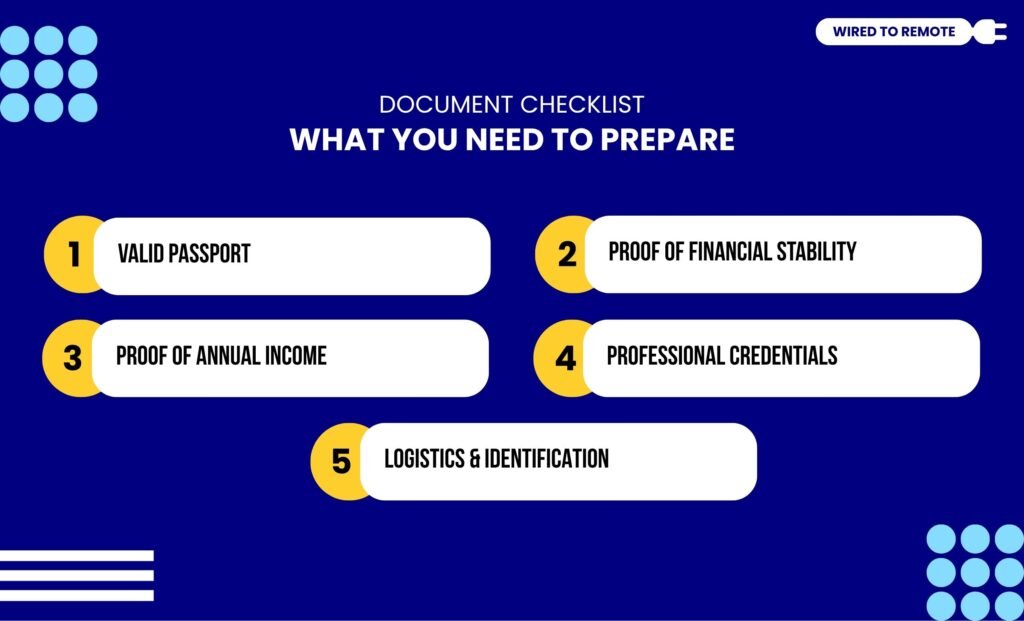
Document Checklist: What You Need To Prepare
Here are some of the things, according to Bali Visas, that you need to keep handy when applying for a digital nomad visa Bali:
1. Valid Passport:
Must be valid for at least 6 (six) months beyond your intended stay. (Note: For long-term permits like the 1-year KITAS, some official agencies like Maha Bali Legal and LMI Consultancy confirm this 6-month minimum requirement.
2. Proof Of Financial Stability:
Personal bank statements for the last 3 months showing your name, dates, and balance history.
- Offshore Applicants: Minimum balance of $2,000 USD equivalent.
- Onshore Applicants: Minimum balance of $5,000 USD equivalent (if applying while already in Indonesia).
3. Proof Of Annual Income:
Documentation proving a yearly income of at least $60,000 USD (e.g., bank statements, tax returns, or official payslips).
4. Professional Credentials:
- Curriculum Vitae (CV): A current resume detailing your professional background.
- Remote Work Contract: A signed employment contract with a company located outside of Indonesia.
- Certificate of Incorporation: Legal proof of the existence of your employing company overseas.
5. Logistics & Identification:
- Recent Color Photograph: A clear, passport-style photo.
- Travel Itinerary: Details of your planned entry and activities while in Indonesia.
- ITK/Permit Number: Only required if you are transitioning from a different permit while already onshore in Indonesia.
Using The Official e-Visa Portal
All applications go through the Official Indonesian e-Visa Portal. You’ll create an account, upload your documents, and pay the fee online via credit card.
Costs, Processing Times, And Biometric Registration
The government fee for the E33G is roughly IDR 7,000,000 (approx. $430 USD), but with processing and KITAS card fees, the total often reaches $600 – $1,000 USD. Processing usually takes 7 to 14 business days.
Please keep in mind one thing: Once you land in Bali, you have a set window (usually 30 days) to visit the local immigration office for biometric registration (fingerprints and photos) to finalize your stay permit.
Life On The Ground: Working From Bali’s Top Nomad Hubs
Once the paperwork is done, the fun starts. Bali is essentially divided into “tribes” based on your work style. Here are some of the popular working spaces in Bali as a digital nomad:
Canggu: The High-Speed Networking Capital
Firstly, if being around other entrepreneurs and influencers is your thing, then that makes Canggu the place for you.
It also happens to have the highest concentration of coworking spaces like Dojo and Tropical Nomad. However, be aware that the traffic there can get really hectic.
Ubud: Quiet Focus And Creative Communities
Writers, designers, and anyone else interested in a more “Zen” type of environment will find no match for Ubud.
Moreover, even out in the jungle, the internet is nowadays pretty fast, and the local culture is mainly about wellness and sustainability.
Uluwatu: Surf, Sun, And Scenic “Zoom Rooms”
Finally, the up-and-coming location for 2026, Uluwatu, is a place for the remote worker who wants to sail on the waves while working.
Additionally, it’s a little more spread out. Therefore, the scooter will definitely be your mode of transport to the cliffside cafes.



Leave A Comment