
Disengagement is rarely sudden.
It builds quietly in small shifts. A missed detail here. A delayed reply there. Nothing serious on its own.
That’s why it often goes unnoticed until it starts affecting the team.
So, if you’re paying attention, though, the signs of a disengaged employee are very consistent – not dramatic, but repeatable.
And that is precisely why I am here to help you understand all the top signs that an employee is disengaged and might just leave at the drop of a hat.
Stay tuned.
Signs Of A Disengaged Employee:
So without wasting any time, let’s check out the top signs of a disengaged employee in detail:
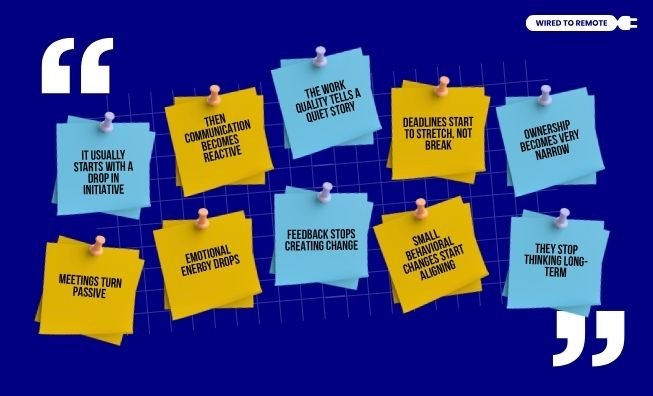
1. It Usually Starts With A Drop In Initiative:
This is where things begin.
The person is still working, deadlines are mostly fine, and there are no complaints. However, suddenly, they stop leaning in.
Earlier, they would question things, suggest improvements, and fix gaps without being asked.
Now? They just wait.
Moreover, they follow instructions well but don’t go above and beyond. That extra layer of thinking disappears.
That’s often the first real shift. And it’s easy to ignore because output hasn’t dropped yet.
2. Then Communication Becomes Reactive:
After the initiative drops, communication changes. You notice you’re the one starting most conversations.
Moreover, updates don’t come in unless you ask. And when they do, they are short. Just enough to answer the question.
It’s not rudeness. It’s reduced involvement. The person is still participating, but only when required.
Also, this creates a subtle drag on the team – work keeps moving, but with more friction.
3. The Work Quality Tells A Quiet Story:
This part is important because it’s rarely obvious. Disengaged employees don’t suddenly produce bad work. They produce safe work.
So, it’s the sort of work that meets the requirement, but does not push for better.
Also, you might notice:
- Fewer thoughtful details.
- Less effort in structure or clarity.
- No attempt to refine beyond the basics.
Additionally, if you’ve seen their earlier work, the difference stands out. If not, it can pass as ‘acceptable,’ at best.
That’s why this stage often lasts a while.
4. Deadlines Start To Stretch, Not Break:
A fully disengaged employee might miss deadlines. But before that, timelines simply become flexible.
So, ‘Almost done’ becomes common – and so does ‘just a bit more time.’ Also, since each delay is reasonable on its own, it gets hard to counter or confront.
However, the pattern matters.
When someone is engaged, they push to finish. When they are disengaged, they drift toward completion.
5. Ownership Becomes Very Narrow:
This is one of the clearest shifts.
Earlier, they cared about the final outcome, not just their part. Now they focus only on assigned tasks.
So, if something falls outside that, they don’t step in. Instead, you might hear, “I wasn’t handling that part,” which is fair. But also telling.
Also, they are no longer thinking like a contributor to the whole, but just as a performer of tasks.
6. Meetings Turn Passive:
This one is easy to spot if you watch closely.
So, you will find them attending every meeting -they listen to everything but respond only when asked.
But they don’t participate naturally. No spontaneous input or questions. Also, no challenge to ideas.
Over time, they become someone the team forgets to ask. And that’s when disengagement becomes visible to others, too.
7. Emotional Energy Drops:
This is less about behavior and more about presence.
So, there is no visible frustration. No open negativity. But there is also no excitement. Moreover, wins don’t feel like wins. Instead, problems don’t trigger urgency.
Everything sits at the same flat level. This emotional neutrality is often mistaken for professionalism. In reality, it’s disconnection.
8. Feedback Stops Creating Change:
At some point, feedback loses impact. And I’ve seen it happen in front of my eyes to more than one employee.
You will see that the person listens and even expresses their acknowledgement. But does not act differently.
There is no pushback. But there is also no effort to improve. This usually means they are no longer invested in getting better. Only in getting through.
9. Small Behavioral Changes Start Aligning:
This is where patterns become clearer. One change means nothing. Several together mean something.
So, you might see:
- Slower response times.
- More frequent minor delays.
- Reduced availability.
- Less visibility in shared work.
None of these is serious alone. But together? They show reduced engagement.
10. They Stop Thinking Long-Term:
This is the strongest indicator.
All engaged employees think ahead – they ask about growth. Moreover, they always look for opportunities.
Disengaged employees don’t. You won’t see them asking for more. Also, they stop planning their next steps – instead, they operate in the present only.
That shift in time horizon is hard to reverse if it goes on too long.
What’s Actually Happening Underneath?
It helps to understand this because behavior alone can mislead. Disengagement usually comes from one of three places:
1. Lack of clarity: The person is unsure what success looks like. So they stop pushing.
2. Lack of control: They feel like decisions are out of their hands. So they reduce effort.
3. Lack of meaning: The work no longer feels important. So they disconnect from it.
Sometimes it’s one of these. Often it’s a mix. So, if you don’t identify which one it is, any fix will be temporary.
What Helps (In A Real, Practical Sense)?
You don’t need a heavy approach here; you need accuracy. So, here’s what I think can help in a real, practical sense:
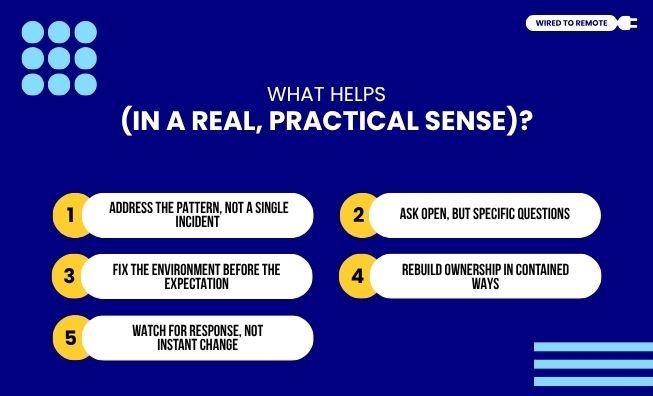
1. Address The Pattern, Not A Single Incident:
Don’t say, “You missed this deadline.”
Instead, point out what you’ve observed over time: “I’ve noticed you’ve been less involved in discussions and updates lately.”
This keeps the conversation grounded.
2. Ask Open, But Specific Questions:
Avoid generic questions like “Is everything okay?”
Instead, try asking: “Does the work feel clear right now?” or “Is anything making it harder than it should be?”
These lead to better answers.
3. Fix The Environment Before The Expectation:
If the issue is unclear briefs or messy workflows, fix that first. Also, pushing for better performance in a broken system rarely works.
4. Rebuild Ownership In Contained Ways:
Give them something small but complete. For example, give them a task they can own end-to-end.
This restores a sense of control, which often improves engagement.
5. Watch For Response, Not Instant Change:
You won’t see a turnaround in a week.
However, you will see signals:
- More proactive updates.
- Slightly better involvement.
- Improved attention to detail.
Those are early wins.
Find Out The Top Signs Of A Disengaged Employee Today!
Disengagement is not loud. It is patterned.
So, if you look at it for just one moment, you’ll miss it. But if you look at the situation for a few weeks, it becomes obvious.
The goal is not to react to every small dip. Instead, the goal is to notice when small dips start forming a direction.
That’s the point where you can still turn things around.



Leave A Comment