
Whether it is an in-office or a remote company, evaluating employees based on their performance is not new. But the methods used for this evaluation can be revolutionary.
That’s how the bell curve method came into the picture.
Traditionally, it segregates the employees of the firm into separate categories — top, average, and low performers. So, based on their performance, the employees can be boxed into these three core groups.
Now, there is a constant debate going on about the fairness and relevance of this graph for appraisal decisions.
Especially in a remote team, its importance is highly questioned. So, here I have brought you a complete guide on using the bell curve appraisal in remote teams, focusing on —
- Its basic categories,
- Steps to implement it efficiently,
- Its pros and cons, some tips, and more.
So, come dive right in!
What Is A Bell Curve Appraisal?

Before jumping right into the steps of implementing the bell curve appraisal, let’s look into its concept and importance in climbing the corporate ladder.
Understanding The Concept Of A Bell Curve
First things first, a bell curve is a statistical method to represent the workforce performance using a curve graph.
That is, the distribution of the performance data is placed to create a bell-shaped graph. Then, it is divided into three categories—
- Low performance
- Expected performance
- Outstanding performance.
So, based on the placement of the employee’s score, they get appraisals. Helping the managers make an unbiased and data-driven decision about promotions.
Context Of The Bell Curve Appraisal In HR
Now, in remote HR activities, bell curve appraisal offers a simple process to segregate the employees based on data. So, the right workers can be rewarded for their efforts.
This way, the HR can systematically manage the employee assessments even in a remote setting. Ensuring that the employee ratings align with the company’s expectations.
Moreover, HR can use the bell curve appraisal for—
- Rewarding the outstanding performers,
- Providing support to average-performing employees, and
- Addressing issues with the low performers.
How Does The Bell Curve Appraisal Work? A Step-by-Step Process
The implementation of the bell curve appraisal can be a difficult task. Especially in a remote setup, its implementation needs to be a thoroughly followed process.
So, here is how the method works in a remote team—
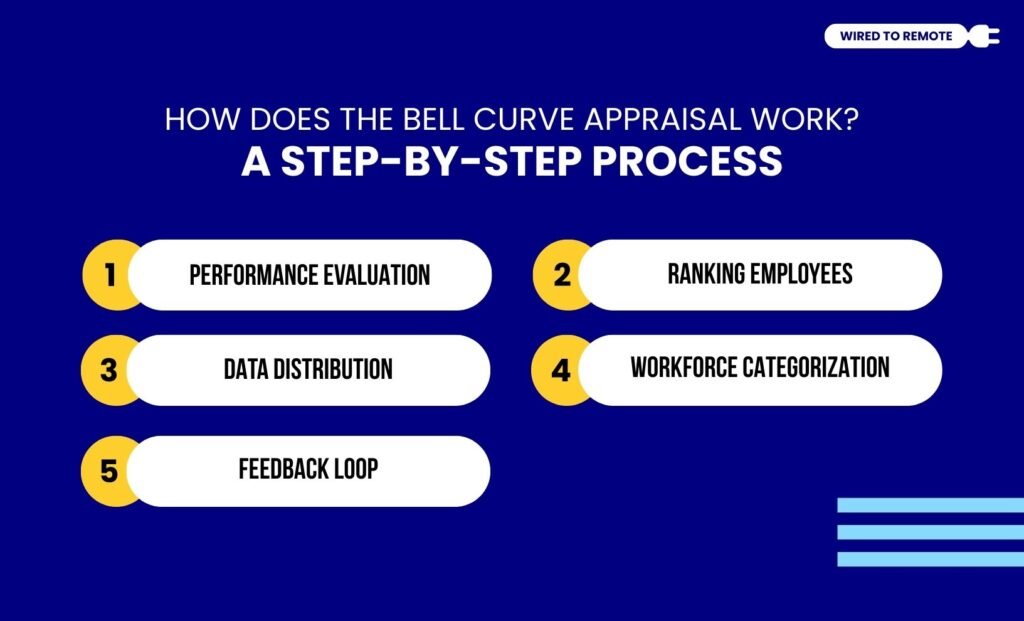
- Performance Evaluation: Using diverse key performance metrics can help in having a systematic and standardized evaluation process.
- Ranking Employees: Based on performance evaluation, the employees can be ranked into diverse categories. So, the reward system is unbiased.
- Data Distribution: Moreover, the entire data of the workforce can be distributed in a bell-shaped curve to find the optimal performance rate for each category.
- Workforce Categorization: Also, the ranked employees from the workforce can be categorized under three foundational categories—
- Top performers (Top 10%) — Showing outstanding efforts and contributions.
- Average performers (Middle 80%) — Meeting the expected goals and objectives.
- Low performers (Bottom 10%) — Failing to meet the optimal target with their performance.
- Feedback Loop: Finally, the feedback cycle helps the ranking employees to use constructive feedback and criticisms to improve their performance.
How To Categorize Remote Employees With The Bell Curve?

Generally, the distributed data on the bell curve is divided into three categories. Making it easier to categorize the remote employees based on their performance.
1. Top Performers
Firstly, the top performers are rewarded with bonuses and promotions for their efforts and contributions. So, they are valued for their potential and given leadership roles.
2. Average Performers
Unlike the top performers, average ones meet the expectations. So, they are given positions within teams to ensure the workflow is streamlined.
Additionally, they receive training and useful resources to ensure the employees can outperform themselves. So, the bell curve can use better data distribution.
3. Low Performers
But for the low performers, the key issues and problems are highlighted. That is, the company provides strategies and improved policies to address these bottlenecks to ensure their performance is adequate.
Pros And Cons Of The Bell Curve Appraisal System
Even though it is a highly adopted employee performance evaluation method, the bell curve appraisal comes with its own set of benefits and challenges.
| Pros | Cons |
|---|---|
| 1. Helps in objectively distributing the workforce into low, average, and top performers. | 1. Unnecessarily creates an over-competitive work culture. |
| 2. Offers a consistent and standardized evaluation method for employee performance. | 2. Demotivates employees with the categorical ratings. |
| 3. Removes bias in rating the performance. | 3. Provides a rigid framework that affects small remote teams. |
| 4. Ethically supports the promotions, rewards, and career planning. | 4. Lack of a feedback cycle for the improvement of employees. |
Things To Keep In Mind To Implement The Bell Curve Appraisal
Now, simply knowing about the bell curve appraisal is not enough. That is, you need to properly implement it within the system to ensure it measures the performance and ranks the employees.
So, here are some tips to ensure that the bell-curve is effectively helping with the unbiased employee evaluation in the remote setup —
- Training managers to clearly communicate the key objectives to the employees.
- Providing regular check-in meetings and feedback to smoothly run the workflow.
- Adjusting the flexibility of the high-performing teams in the data distribution.
- Considering the difference in roles, dynamics, and business goals before conducting the performance assessment.
So, by keeping these few things in mind, you can seamlessly incorporate the bell curve appraisal in the remote employee assessment.
Instead of relying on biased and impractical performance-measuring metrics, it is better to choose the traditional bell curve method.
Just that, it might be difficult to implement it in a remote work culture. But with the right measures, you can adopt it easily.
FAQs
Here, I have brought you some questions around the bell curve appraisal for the remote employees that most workers look for.
Unfortunately, no. Given that bell curve appraisal works on a forced distribution method, it fails to consider the dynamic conditions of the remote work culture.
Making it appear unfair and inappropriate with skewed performance ratings.
So, remote teams need to implement certain methods and contextual ways to ensure that the bell curve adoption is smooth and seamless.
Since the bell curve appraisal method eminently compels the managers to forcefully distribute the employees based on their performance, it appears rigid and unfair.
So, in an attempt to remove leniency and bias or cultivate talent, the method demotivates the remote employees. Making the work culture toxic and inappropriate for small teams.
Bell curve appraisal can be quite effective for remote teams when the company or the work culture has the following characteristics. For instance—
• It is a large organization with big teams.
• Follows a timely or structured employee review cycle.
• Combined with other performance evaluation tools for an accurate assessment of the remote employees’ work performance.



Leave A Comment