
In a professional setting, performance appraisal holds a critical space.
That is, it provides the perfect strategic process that plays the dual role — motivating employees and helping managers evaluate the workforce performance.
Especially in a remote setup, where the employees and the employers have zero direct contact. Supervision over employees’ work and performance becomes a Herculean task.
And, implementing traditional methods yields no real-time results. So, remote managers are choosing modern methods to balance the dynamic work culture with performance evaluation.
But do you know — “How these modern methods of performance appraisal evaluate employees?” — Well, no need to worry, your remote buddy’s got your back.
Being in a remote culture for so long, I have seen the performance appraisals evolve with the dynamism of diverse jobs.
So, in this blog, I will be delving into the major modern approaches by focusing on—
- Key differences between traditional and modern perfromance appraisals,
- 7 major modern performance appraisal methods,
- Common implementation challenges, tips to choose the right one, and more.
So, come dive right in!
What Is Performance Appraisal?
To explain in simple terms, performance appraisal refers to a quarterly or annual evaluation of the employees’ performance.
That is, it provides a strategic method to assess the employees’ productivity based on the completion of the KPIs. So, it is easier to monitor their progress and the overall efficiency of the workforce.
Moreover, the main purpose of performance appraisal is to ensure that the company’s goals and objectives are aligned with the efforts of the remote workers.
So, when each employee meets their individual goals, the company objectives are also met simultaneously. Highlighting the direct contribution of the workers to the growth.
In addition to this, these performance appraisals determine the promotions or training requirements in the workforce. Ensuring the employees get recognized for their contributions.
Why Traditional Methods Are Irrelevant In Remote Work?
Traditional methods of performance appraisals include— subjective grading, paired comparison, and ranking methods —which consider the employees’ past performance and behavioral qualities.
But, in a remote setup, the workforce is diversely located. So, conducting a direct observation on each employee is nearly impossible.
Moreover, traditional methods prioritize past efforts and outcomes. But in a dynamic job market, objectives change continuously. So, sticking to past performance fails to give a clear present picture.
And, this leads to outdated feedback that has no imminent effect on the performance of the employee. Turning the entire appraisal strategy into a redundant process.
How Modern Methods Evaluate Employee Performance?
Unlike the traditional ones, modern methods of performance appraisal focus more on the achievements of the job roles. So, it prioritizes the employee’s job completion score over their personality.
That is, the modern techniques evaluate the employees objectively. Offering a more holistic assessment score to rank their contribution and productivity.
Moreover, these methods use measurable indicators to track the performance in real-time. So, the feedback can be adjusted based on the present performance rather than the outdated data from the past.
As the report from Jot Form highlights the difference between the traditional and modern methods— “Traditional methods tend to measure an employee’s past performance and focus on assessing employee personality traits — such as initiative, dependability, and leadership potential — while modern methods weigh job achievements more heavily, regardless of the employee’s personality traits, which is thought to be a less biased approach.”
What Are The Modern Methods Of Performance Appraisal For Remote Workers?
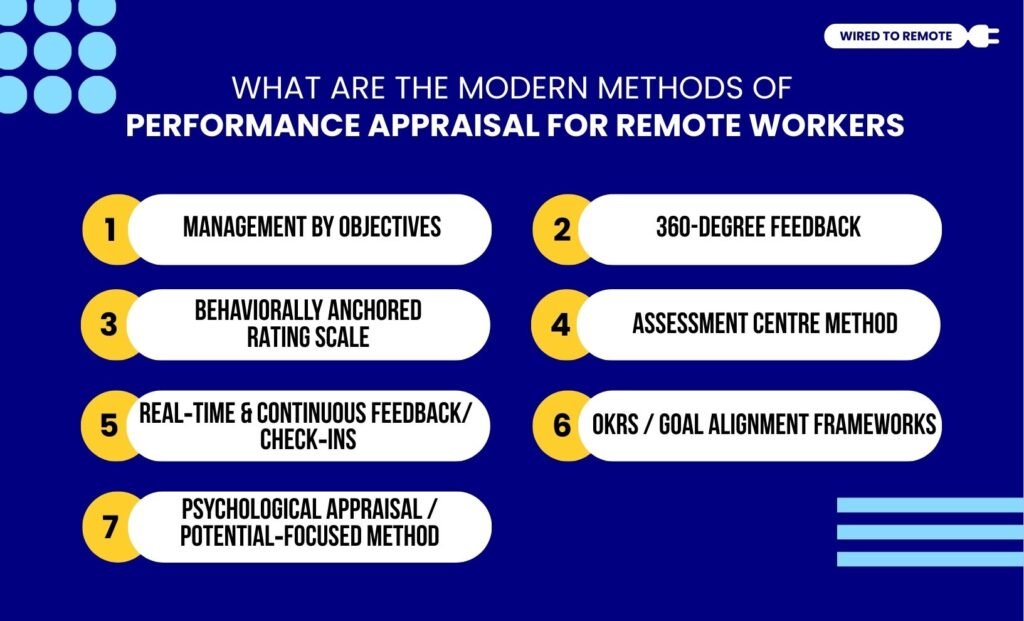
Although there are countless modern methods of performance appraisal, here I have brought you the 7 major ones. So, the list goes on like—
1. Management By Objectives (MBO)
Firstly, the MBO method primarily focuses on aligning the business objectives with those of the employees’ goals. So, when the employees meet their goals, the main business objectives are also met.
For this, the board of managers and the business partners come together to set clear goals for employees. So, the managers can plan the work objectives that directly reflect the business objectives.
2. 360-Degree Feedback (Multi-Rater)
As the name suggests, 360-degree feedback covers the entire management for complete feedback on an employee’s performance.
That is, it collects feedback data from the key members— clients, managers, subordinates, peers, and mentors.
So, it offers a complete evaluation of the employee’s performance from multiple angles. Making the process simple and holistic with dynamic responses.
3. Behaviorally Anchored Rating Scale (BARS)
Another modern method is the BARS method, which assesses both the performance and the behavioral patterns of the employee.
That is, it combines the quantitative evaluation with the qualitative one. So, it is easier for managers to assess the employee using a holistic approach.
Moreover, the behavioral patterns are evaluated using numerical ratings. Giving a measurable metric for understanding how employees are behaving within the workplace.
4. Assessment Centre Method
Now, the assessment center method is exactly like it sounds. That is, it creates a hypothetical space to evaluate the performance, personality, and social skills of the workers.
For instance, it develops written test modules to assess the eligibility of employees to carry out the daily activities of the job role.
So, through situational questions, role-playing exercises, and technical problems, the managers evaluate the capabilities of the workers. Deciding how to employ them for maximum productivity.
5. Real‑time And Continuous Feedback / Check‑ins
One of the best approaches of modern methods is the real-time and continuous feedback.
That is, managers monitor the performance of the employees and provide real-time feedback. And, this continuous feedback helps employees to adjust their workflow to boost productivity.
In addition to this, constructive feedback and frequent check-ins help employees focus on improving their performance based on future developments.
And, this directly contributes to the overall growth of the companies.
6. OKRs (Objectives And Key Results) / Goal Alignment Frameworks
Now, the OKRs method is designed as a goal-setting framework to evaluate the performance of employees.
That is, it qualifies the measurable goals to drive performance and achieve the strategic business objectives. So, the employees are inspired and action-oriented to meet the targets.
Generally, this method creates one quality objective and adds a few measurable key results to it. So, the employees can directly connect the targets with an aspirational objective.
7. Psychological Appraisal / Potential‑focused Method
Finally, the psychological appraisal provides the framework to evaluate the future performance possibility of the employees.
That is, it collects past performance data and predicts how beneficial the employee will be for the team in the future.
And, this assessment is usually conducted through in-depth interviews, private employee conversations, and psychological tests.
So, it is easier to analyze the key behavioral components of the employees— interpersonal skills, cognitive abilities, intellectual traits, and emotional quotient.
Making it easier to predict their behavior in the future with changing work dynamics.
Common Challenges Of The Modern Methods Of Performance Appraisal
Although modern approaches to performance appraisals make evaluation simpler, they come with a set of common challenges, which include—
- Firstly, a lack of training of managers in using these methods can result in biased or inconsistent employee evaluations.
- Moreover, making the evaluation metrics or the process overly complex can demotivate employees with poor grades.
- In addition to this, if the performance appraisal is conducted as a perfunctory task, it might hinder the development of the team.
- Finally, overloading the employees with daily feedback can turn into demotivating the candidate and bring negative results.
Tips To Choose The Right Method For Your Remote Team
Just knowing about the modern appraisal strategies is not enough. That is, remote managers should know which one will be more beneficial for their teams.
So, here are some tips to choose the right one—
- If you have diverse teammates, it’s best to employ a feedback-based performance evaluation process.
- Moreover, if you are managing different cross-functional teams, employing the MBO or OKRs method can help track performance.
- Alternatively, you can employ the combined 360-degree approach with the MBO method to set goals and give continuous feedback to a multi-variate workforce.
- Finally, if you need a clear and standardized evaluation method, then it is better to incorporate a blended approach of different methods.
Now, these modern methods of performance appraisal can simplify the employee evaluation process while ensuring growth for the organization.
So, if you are still doubtful whether to employ them or not, let me assure you that implementing them can remarkably boost productivity and efficiency.
FAQs
Here are some of the common questions around modern methods of performance appraisal that remote recruiters look for.
Generally, traditional methods prioritize past performance and employee personality traits. Mostly, the performance is evaluated with subjective rating scales. But modern methods focus on the achievements of objectives, data-driven job reports, and incorporate continuous feedback and development. So, it is more future growth-focused compared to the traditional models.
Since the modern method focuses on growth, appraisals and feedback should be given continuously. That is, either quarterly or monthly, the managers can give the appraisals and feedback to the employee based on their performance ratings. This way, it becomes easier to make immediate adjustments to strategies, work plans, and time management for improving performance.
Generally, it is advisable for organizations to use more than a single method for employee performance appraisal. Since no single method can comprehensively cover all the aspects of performance evaluation, combining multiple methods can help create an effective evaluation process. So, managers assess each employee on fair terms and rate them for their actions, efforts, and behavior in the professional field.
In the Peer or 360-Degree feedback model, ensuring fairness is not that difficult. That is, managers need to establish clear objectives, use standard criteria, keep the employee performance information confidential, and train them for identified gaps. Moreover, they should provide continuous feedback for the development of the employees. Making the process fair and consistent for all employees.



Leave A Comment