

If you have been in search of the ultimate guide or handbook for Bali digital nomads, we have got your back!
The era of the “budget backpacker” is over. We are now seeing a sophisticated, professional migration.
As of early 2026, Bali remains the premier global hub for distributed work. According to the data, a 22% year-over-year increase in dedicated coworking square footage.
However, success here now requires a roadmap. Recent reports indicate that 84% of professionals prioritize community and internet reliability above all else. Fortunately, Bali leads the market with fiber speeds exceeding 100 Mbps. (Source: My Nomad Space)
But there is a catch. Local inflation has pushed the cost of living in prime zones like Canggu up by 15% since 2024. If you want to thrive in 2026, you must understand the reality of Bali digital nomads.
If you are planning to shift to Bali – or spend a few days there – this is the handbook that you need. To make the right choice, keep reading!
Bali Digital Nomads Guide: Ultimate Handbook
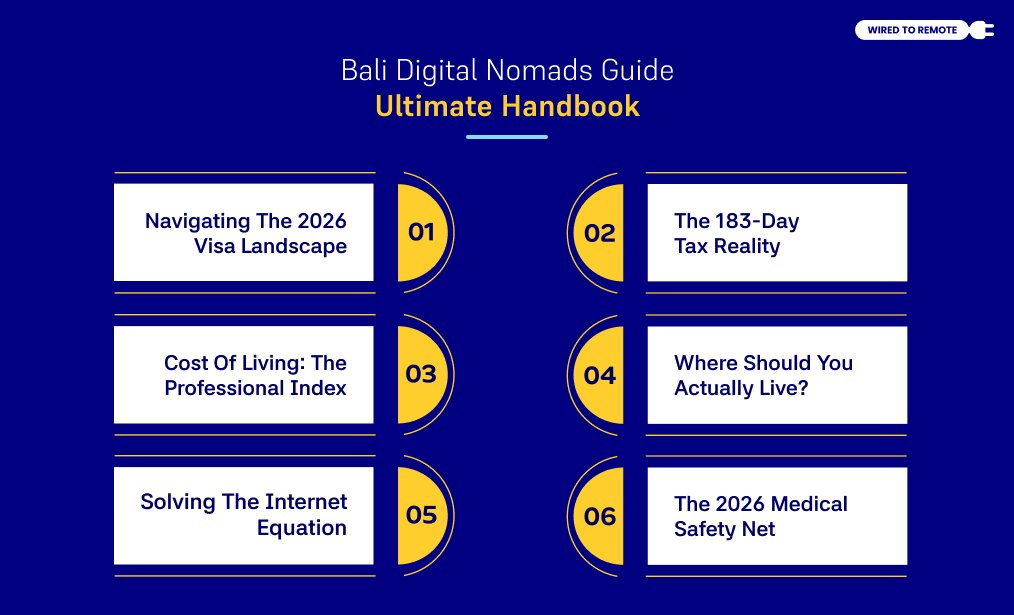
While Bali is one of the best places for digital nomads in the world, thing’s might not go smoothly if you do not have a clear idea about the place.
Here are the things that you must definitely keep in mind when you are panning to move to Indonesia and live in Bali as a remote worker:
Navigating The 2026 Visa Landscape
In 2026, Bali’s “grey area” for remote work is officially dead. To stay legal, you need the E33G Remote Worker Visa (KITAS) – the new professional gold standard.
As we have already mentioned at length in our Bali Digital Nomad Visa guide, this “one-year golden ticket” grants you essential stability. These include things like opening local bank accounts and legally registering a scooter. However, the barriers to entry are high.
To qualify, you must prove a minimum annual income of $60,000 USD through official pay slips. Additionally, you must maintain a $2,000 USD bank balance for at least three months.
Fortunately, if you are already on the island, you can often apply onshore. This is a huge win, as it lets you avoid those expensive and exhausting “visa runs.”
If you’re just doing a “trial run,” the B211A Social Visa still covers you for up to 180 days. Meanwhile, the Visa on Arrival (VoA) remains the most efficient choice for short 30-to-60-day “workcations.”
Crucially, avoid the “Freelancer Trap.” As of 2026, immigration has ramped up audits. Using fake “Investor KITAS” shell companies is a high-risk gamble that leads straight to deportation.
Therefore, we strongly advise against the DIY route. Use reputable agents like BaliEasy or Bali Connect and expect to pay between IDR 8 million and 15 million for professional processing.
The 183-Day Tax Reality
Secondly, we always tell nomads to watch the calendar. Indonesia uses a physical presence test called the 183-Day Rule.
Essentially, if you spend more than 183 days here in a year, you become a Domestic Tax Resident. Consequently, you become liable for tax on your worldwide income. Rates range from 5% to 35%.
Furthermore, the government launched the Coretax Administration System this year. This digital app tracks all resident taxpayers.
However, you might find a loophole.
Some high-skill roles qualify for a four-year tax exemption on foreign income under the Omnibus Law. Always consult a local pro before your 184th day.
Cost Of Living: The Professional Index
Bali is no longer a “cheap” destination. For the 2026 professional, your budget depends on your neighborhood and your cost of living in Bali.
In short, expect to spend between $2,500 and $3,500 USD per month. This covers a private pool villa, premium coworking, and international dining.
Specifically, villa prices vary wildly:
- Canggu/Seminyak: $1,500 – $3,500+ monthly.
- Sanur/Ubud: $700 – $1,400 monthly.
Moreover, watch out for hidden costs. Electricity for a large villa with constant AC can hit $400 per month. Meanwhile, a local warung meal still costs just $2.
Where Should You Actually Live?
Choosing a neighborhood is a trade-off between networking and focus.
Canggu & Berawa remain the social heart. Go here if you need to meet founders and crypto-experts. But beware, the traffic is now at an all-time high.
Conversely, Uluwatu offers a premium “slow living” vibe. It attracts surfers and high-end nomads seeking quiet. Sanur is the stable choice for families.
Finally, we recommend Seseh or Pererenan for “Deep Work.” They offer proximity to Canggu without the constant noise.
Solving The Internet Equation
In 2026, the internet is a utility, not a perk. Most top-tier hubs (coworking saces and cafes in Bali) now use Starlink satellite failover to ensure 100% uptime.
For instance, Livit Hub (Sanur) is the “Gold Standard.” It offers 24/7 access and corporate-grade infrastructure. B-Work (Canggu) is the best for high-energy networking. Tropical Nomad is the safest bet during monsoon storms because of its Starlink integration.
Before signing a lease, perform three checks:
- Redundancy: Does the villa have a second ISP?
- Power: Is there a UPS (Battery Backup) for the router?
- Noise: Visit the site at 8 PM to check for nearby construction or ceremonies.
The 2026 Medical Safety Net
Standard travel insurance is no longer enough. For a remote worker, a medical emergency is a catastrophic financial risk.
Therefore, ensure your policy includes Emergency Medical Evacuation. An airlift to Singapore can cost $50,000.
Also, stick to international-grade clinics like BIMC or Siloam. Expect to pay $200–$400 monthly for a premium plan with local direct-billing.
Strategic Risk Management: What To Avoid In 2026
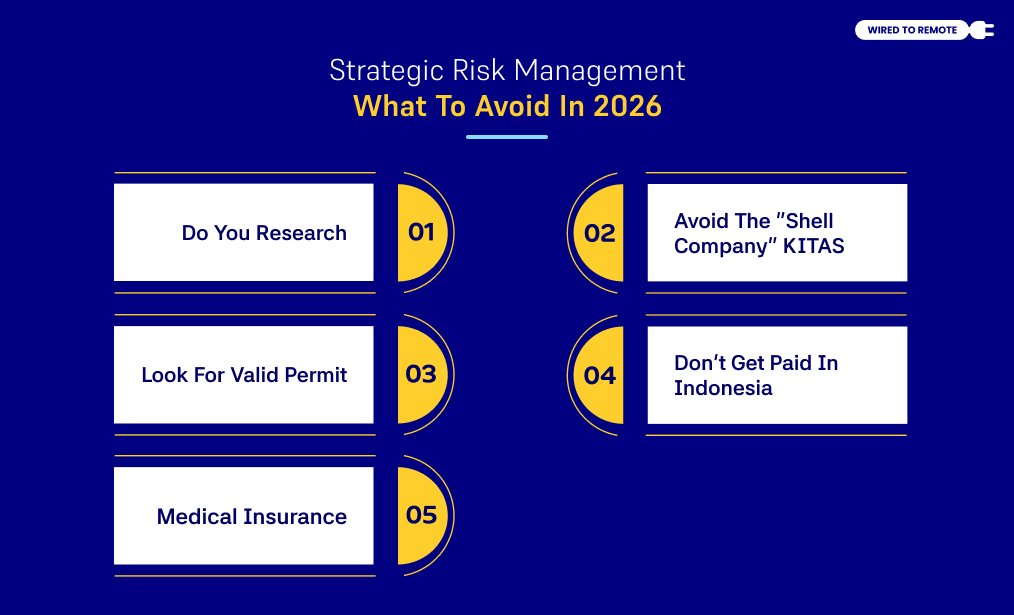
In 2026, the cost of a mistake isn’t just a fine – it’s deportation. As a professional, you must treat your residency like a business asset. Here are the red flags that you should monitor and avoid to stay safe:
Do You Research
First, never blindly trust “Visa Solutions” from influencers. Social media is full of hearsay. Many “shortcuts” offered by agents are actually illegal workarounds. Instead, verify every piece of advice against official 2026 regulations.
Avoid The “Shell Company” KITAS
Secondly, as we have mentioned earlier, immigration audits have peaked. If an agent offers an Investor KITAS via an “umbrella” company you don’t actually own, walk away.
You are legally responsible for the fiscal obligations of that company. If they fail an audit, your visa is the first thing to go.
Look For Valid Permit
Thirdly, never work for Indonesian companies without a valid work permit. Even occasional freelance gigs or social media management for a local cafe are illegal.
Crucially, this includes “soft work” like teaching yoga, DJing, or running retreats. If you are generating income within Indonesia, you need an employment KITAS – not a remote worker visa.
Don’t Get Paid In Indonesia
Whether it’s cash-in-hand or into a local account, keep your finances offshore. All remote income must flow from outside the country.
Additionally, avoid advertising your villa as a sublease on Facebook groups. Immigration now monitors these marketplaces; they consider subleasing an unlicensed business activity.
Medical Insurance
Finally, don’t skip international medical insurance. Accidents are the #1 reason nomads leave Bali prematurely.
Without Emergency Medical Evacuation coverage, a single scooter mishap could cost you $50,000 USD. Protect your peace of mind and your bank account.
Your First 48 Hours: The Checklist For Bali Digital Nomads
Immediately upon arrival, pay the mandatory Tourist Tax.
Next, if you’re staying over 90 days, register your phone’s IMEI at the airport. You cannot use a local SIM without this.
Finally, watch the road. Bali now uses ETLE (Electronic Traffic Enforcement). Cameras ticket you automatically for missing helmets. These fines link to your passport and can block your visa renewal.
Is Bali Safe For Digital Nomads?
Is Bali safe? In short, yes, but you must manage your risks strategically. At present, violent crime remains extremely low. Yet, petty theft and road accidents are significant operational hazards.
Data shows that while Indonesia’s crime rate is lower than that of many Western hubs, scooter accidents account for over 80% of nomad medical emergencies. (Source: Bali Police Traffic Directorate)
Furthermore, with the 2026 rollout of ETLE (digital traffic enforcement), safety is now linked to your legal status – serious violations can flag your visa.
Crucially, the biggest threat is “health safety.” Without medical evacuation insurance, you are one crash away from a $50,000 USD bill.
Therefore, our final advice to you will be: stay alert, wear a helmet, and protect your assets.


Leave A Comment