
When we first landed in Mexico City, laptop in tow, we fell for the same myth that hundreds of remote workers still believe. We expected to easily find an official, neatly packaged application called the “Mexico Digital Nomad Visa.”
Instead, our digging revealed a completely different legal reality. We quickly learned that, unlike the Bali digital nomad visa, Mexico does not have a specific, branded “Digital Nomad Visa.”
If you plan to work remotely from Mexico, you must navigate the legal framework of the Temporary Resident Visa (Visa de Residente Temporal).
This is the exact mechanism immigration lawyers and clued-in expats use.
In this blog, we will explain the following things:
- The reality of the Mexico Digital Nomad Visa.
- Eligibility criteria and financial requirements.
- Step-by-step guide to apply for the visa.
- Expense and updated fees.
- Tax for digital nomads in Mexico.
- Best places for digital nomads in Mexico.
Therefore, keep reading!
Tourist Entry Vs. Legal Residency: Mexico Digital Nomad Visa Reality Check
For years, digital nomads used the 180-day FMM tourist card trick. They would cross the border, work from a café in Condesa, and repeat a “border run” every six months.
However, times have changed.
We have watched immigration officials tighten these rules significantly. Today, relying on a tourist visa for remote work is a massive risk.
| Feature | Tourist Entry (FMM) | Temporary Resident Visa |
|---|---|---|
| Legal Work Status | Strictly illegal for remote work | Legally permitted for foreign-sourced income |
| Stay Duration | Up to 180 days (often cut to 7–30 days) | 1 to 4 years |
| Banking & Logistics | Restricted to foreign cards | Open local bank accounts & lease property |
| Border Stress | High risk of denial at entry | Seamless, guaranteed entry |
So, basically, if border control discovers that you are working on a tourist visa, you face potential deportation. And that is the reason why the Temporary Resident Visa is your only path to long-term peace of mind.
Mexico Digital Nomad Visa Alternative: What Is The Temporary Resident Visa?
Regulated under the 2011 Migration Law, the Mexico Temporary Resident Visa is the premier long-term option for foreigners staying over 180 days. (Source: Consul Mexico)
While not explicitly designed as a digital nomad visa, it has become the most popular pathway for remote workers employed by overseas companies or clients.
The visa is initially granted for one year and can be renewed for up to four years total. This structure provides remote workers with exceptional stability without forcing an immediate commitment to permanent residency.
As Citizen Remote correctly stated, for nomads seeking a legal, secure base in Mexico, this framework offers the ideal balance of flexibility and long-term security.
Who Uses The Temporary Resident Visa?
The Mexico Temporary Resident Visa primarily helps financially self-sufficient foreigners seeking long-term stays. It serves the following group of people:
- Digital nomads and remote employees working for non-Mexican companies.
- Freelancers with international clients.
- Retirees living off passive foreign income or personal savings.
Benefits Of Mexico Temporary Resident Visa
Some of the major benefits of the Temporary Resident Visa include:
- Extended stay.
- Affordable cost of living.
- Networking opportunities.
- Tax benefits.
- Easy access to residency.
Eligibility Criteria And Financial Requirements
To qualify for the Temporary Resident Visa as a remote worker, you must prove “economic solvency” to the Mexican government.
These requirements are tied to the Unidad de Medida y Actualización (UMA) and Mexico’s daily minimum wage. Because the Mexican Peso has strengthened against the US Dollar and Canadian Dollar, the actual thresholds have risen sharply.
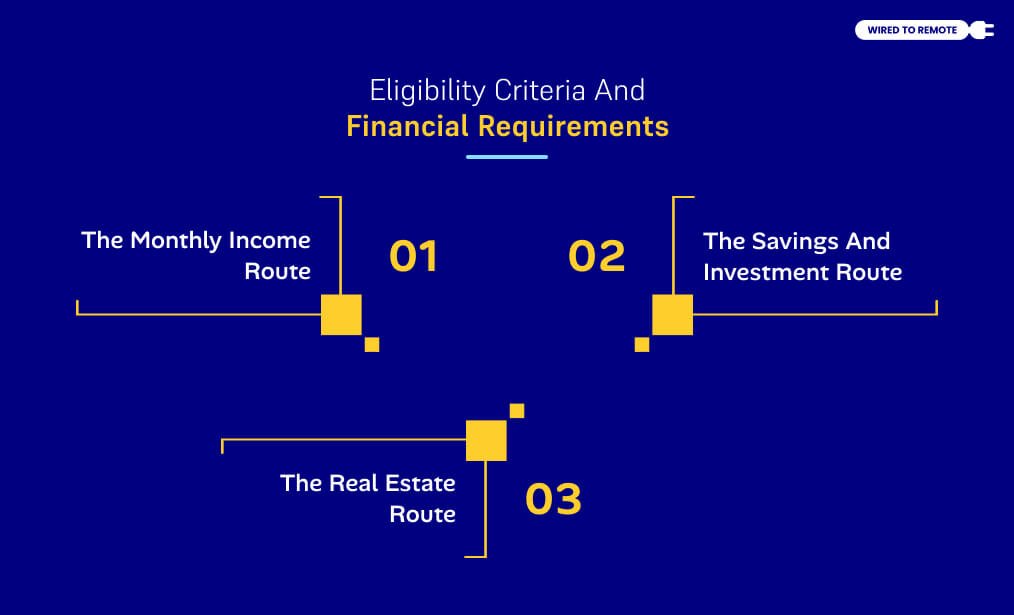
1. The Monthly Income Route
You must show a net monthly income of roughly $4,000 to $4,500 over the past 6 months. You must prove that this money comes from foreign employers, international clients, or offshore investments.
2. The Savings And Investment Route
If your monthly income fluctuates, you can qualify by showing an average monthly bank or investment balance of $70,000 to $75,000 over the last 12 months.
3. The Real Estate Route
Alternatively, you can qualify if you own debt-free property in Mexico worth at least $346,000.
Please Note: Consulate Variance
Every single Mexican consulate operates like its own independent kingdom. The Mexican Consulate in Miami may demand $4,500 in monthly income, while the office in London or Chicago might accept $4,000. Always check the specific website of your chosen consulate before booking.
Document Requirements:

• Visa application form.
• Valid passport.
• Identity documents.
• Original and photocopy of the migratory document (Canadians).
• Photograph.
• Payment of fees (credit or debit only)
Step-by-Step Application Process
You cannot change your status from a tourist to a temporary resident while inside Mexico. The entire process requires careful planning across two distinct phases.
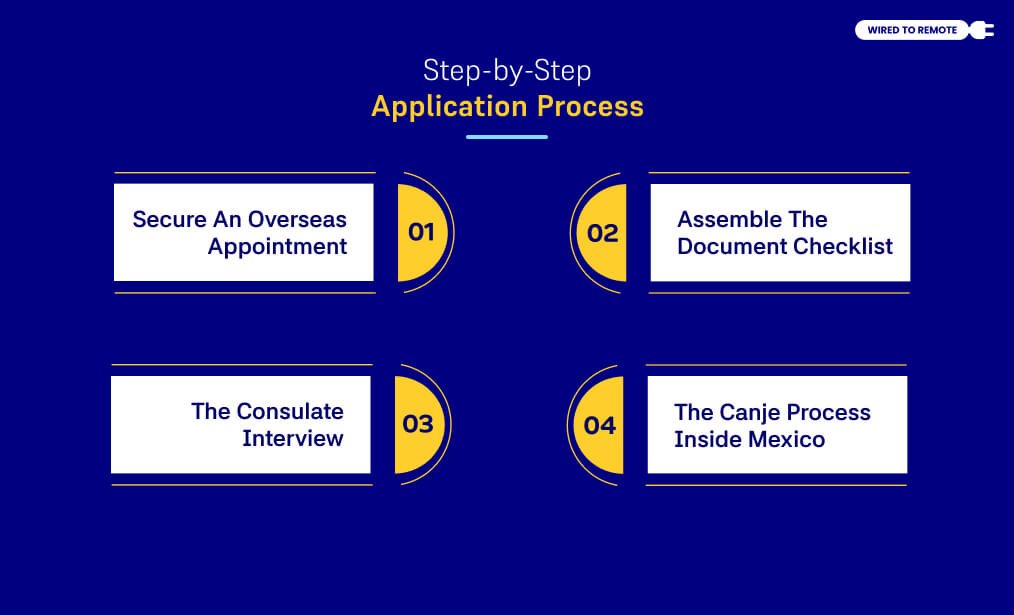
Step 1: Secure An Overseas Appointment
Log onto the official government portal to schedule an interview at a Mexican consulate outside of Mexico. Spaces fill up within minutes, so you must monitor the portal daily.
Step 2: Assemble The Document Checklist
Do not leave your paperwork to chance. You must bring:
- The official visa application form (printed double-sided).
- A valid passport with at least six months of remaining validity.
- 6 months of certified bank stubs showing your remote salary, or 12 months of investment statements.
- An employment contract or freelance client agreements proving your income originates outside Mexico.
Step 3: The Consulate Interview
This interview is a formal evaluation. The immigration officer will review your documents to confirm you will not compete for local Mexican jobs.
Clearly state: “I work remotely for a company located outside of Mexico, and my income is entirely foreign-sourced.”
Once approved, they will place a temporary visa sticker in your passport.
Step 4: The Canje Process Inside Mexico
The passport sticker is only valid for a single entry and expires after 180 days. Once you cross the Mexican border, you have exactly 30 days to visit a local Instituto Nacional de Migración (INM) office.
Here, you will complete the canje (exchange) process. Officers will take your fingerprints and photos, then issue your physical Residente Temporal card.
Cost Of Mexico Temporary Resident Visa For Digital Nomads [Updated Fees]
It is easy to fall into the trap of over-complicating things when you first calculate your relocation budget.
However, based on our latest digging of the official consular schedule, there is a sharper legal reality that every digital nomad should be aware of.
If you are applying for your residency sticker from an overseas consulate, you must budget for two distinct, non-negotiable payment phases:
Phase 1: The Outbound Consular Application Fee
Before you can legally cross the border as a resident, you must pay a standard application processing fee at your local Mexican consulate. The newly updated baseline fee is $56.00 USD.
For those applying from a consular office inside Canada, the administration has locked in the cost at $79.00 CAD, operating under a mandated institutional exchange rate of 1.41 CAD per USD.
Here’s a quick view of the Consular Office payment rules:
| Payment Method | Rule and Location |
|---|---|
| Canadian Debit / Credit Cards | Accepted directly on-site at the consulate counter |
| Cash Payments | Prohibited at the counter. Must be paid at a local CIBC branch per instructions |
We would advice you to pay close attention to your specific jurisdiction’s payment rules. Canadian consulates strictly prohibit physical cash handling at the counter.
You must pay via credit/debit card on-site or take a deposit slip directly to a local CIBC branch before your passport sticker is issued.
Phase 2: Domestic INM Issuance Costs
Once your sticker is approved and you arrive inside Mexico to complete your mandatory 30-day canje (exchange) process, you will pay the physical card issuance fees directly to the Instituto Nacional de Migración (INM). These fees scale based on the duration you request:
- 1-Year Temporary Resident Card: 11,141 MXN (Approx. $640–$660 USD).
- 2-Year Extension Card: 16,693 MXN.
- 3-Year Extension Card: 21,143 MXN.
- 4-Year Maximum Card: 25,058 MXN.
Tax For Digital Nomad

The intersection of remote work and Mexican tax law is complex. If you want to avoid legal trouble, you must understand two core concepts:
Foreign-Sourced Income
If you live in Mexico but your income comes entirely from employers or clients based in the US, Canada, or Europe, you generally do not owe income tax to Mexico. You remain tied to your home country’s tax system.
The 183-Day Tax Residency Rule
If you spend more than 183 days in Mexico during a calendar year, the tax authority (Servicio de Administración Tributaria or SAT) can legally consider you a tax resident.
If you establish a primary physical home or generate any local income within Mexico, you must register for a tax ID (RFC) and pay local taxes. Always consult a cross-border tax specialist to evaluate your specific situation.



Leave A Comment