
Is Bali safe for digital nomads in 2026?
To begin with, Bali remains one of the safest cities in Southeast Asia from a statistical point of view. That said, “safety” as such is a concept that has fundamentally changed for a professional remote worker.
It used to be that one just had to steer clear of getting mugged or having one’s belongings stolen. These days, one’s safety also includes one’s legal status, personal finances, and the proper functioning of the infrastructure needed to perform one’s work.
In a professional way, you need to consider your risks very carefully and make the necessary changes to your lifestyle. It is true that crimes of a violent nature are still quite rare.
However, operational hazards such as getting involved in a traffic accident or falling victim to an online scam are currently higher than ever.
If you are planning to move to Bali as a digital nomad, keep reading!
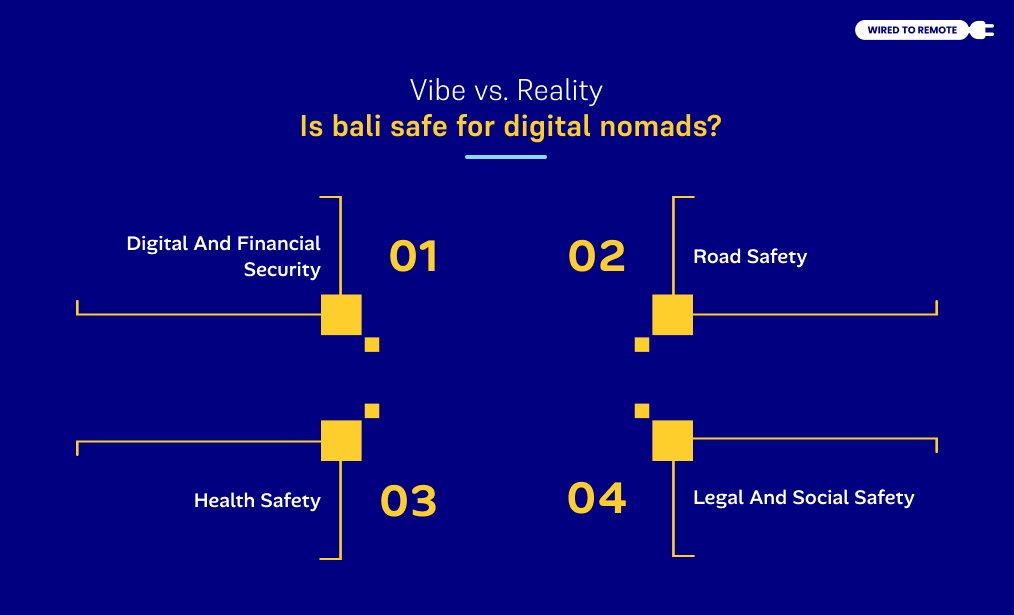
Vibe vs. Reality: Is Bali Safe For Digital Nomads?
To understand Bali, you must look past the Instagram filters. To be very honest, the island is safer than most major Western cities.
The 2026 Crime Index consistently ranks Indonesia’s homicide and violent crime rates significantly lower than those in the US or Europe.
However, petty theft is a different story. In hubs like Canggu and Uluwatu, phone snatching remains a common “opportunistic” crime.
Consequently, we always advise nomads to avoid using their phones while sitting on a moving scooter. It only takes a second for a passing rider to grab your $1,200 device.
Furthermore, the island’s safety is managed by the Banjar (local village councils). These community-led security teams keep residential areas incredibly stable.
If you live in a neighborhood with a strong Banjar, your risk of home burglary is nearly zero.
Digital And Financial Security
In 2026, the biggest threat to your “Money” isn’t a mugger – it’s a skimmer. Digital security is now a core component of nomad safety.
First, never use a standalone ATM in a quiet area. Data from the Bali Police shows that 70% of financial fraud occurs via skimming devices on older, unmonitored ATMs. Instead, only use machines located inside bank branches or major supermarkets.
Better yet, leverage the QRIS (Quick Response Code Indonesian Standard) system.
In 2026, you can pay for almost anything – from a $1 coffee to a $2,000 villa lease – using a QR code linked to your digital bank. This removes the need for physical cards and protects you from skimming entirely.
Additionally, prioritize your hardware security. Most cafes in Bali have excellent Wi-Fi, but they are public networks.
Therefore, always use a high-grade VPN. If you lose your laptop, standard travel insurance often fails to cover professional-grade gear. Ensure you have a “tech-rider” policy that covers the full replacement value of your workstation.
Road Safety
We cannot stress this enough!
Scooters – although highly efficient – are the most dangerous part of Bali. Statistics show that road accidents account for over 80% of medical emergencies for nomads.
First, the 2026 rollout of ETLE (Electronic Traffic Law Enforcement) has changed the game. Cameras now blanket major intersections.
If you ride without a helmet, the system tickets you automatically. Crucially, these violations link to your passport. Multiple fines can flag your record at immigration, potentially blocking your E33G Visa renewal.
Secondly, check your license. To be “safe” legally and physically, you need an International Driving Permit (IDP) with a motorcycle stamp.
If you crash without one, your insurance provider will likely deny your claim. This leaves you responsible for medical bills that can easily exceed $10,000.
Alternatively, if you aren’t an experienced rider, don’t learn in Bali. Use Gojek or Grab. These ride-hailing apps are safe, cheap, and eliminate the risk of being involved in a high-speed collision.
Health Safety
Health safety in 2026 is about more than just avoiding “Bali Belly.” It is about having a catastrophic failure plan.
Essentially, you must have Medical Evacuation Insurance.
There are world-class medical facilities in Bali, like BIMC and Siloam. They basically offer services at international standards of quality.
Still, if your medical needs are very complicated, such as surgeries or neurological trauma, you might have to be airlifted to Singapore. Such an airlift without any special evacuation coverage can cost you more than $50,000 USD only for the flight.
Besides that, be very careful of your surroundings. It is known that tropical diseases like Dengue Fever are more likely in certain seasons.
Therefore, pick those properties that take proper mosquito control measures and use very effective mosquito repellents – especially in the rainy season. Practicing health safety is something that one should do every day rather than a one-time setup.
Legal And Social Safety
Believe it or not, in 2026, being a “legal” nomad is a safety strategy. If you are on the correct E33G Remote Worker Visa, you have legal standing in the country.
Conversely, if you fly under the radar on a tourist visa, you are vulnerable. You cannot easily report crimes to the police, and you risk deportation during routine immigration checks.
Moreover, staying legal protects you from “scam” agents who thrive on nomads’ fear of being caught.
Socially, safety is tied to respect. Bali is a deeply religious island. If you respect local ceremonies and follow the “Nomad Code of Conduct,” the community will protect you.
If you disrespect a temple or ignore Nyepi (the day of silence), you lose the “community shield” provided by the Banjar.
Neighborhood Safety Matrix: Where To Stay?
Choosing the right area can cut your risk in half. Based on our analysis of 2026 trends, here is the breakdown:
- Sanur: The “Gold Standard” for safety. It is walkable, well-lit, and quiet. Ideal for families and senior nomads.
- Uluwatu: Highly safe in terms of “vibe,” but high risk for road accidents due to steep, winding hills.
- Canggu: The highest ROI for networking, but also the highest rate of phone snatching. You must remain alert here.
- Ubud: Very safe for solo female travelers, though digital security is a priority as older cafes may have weaker Wi-Fi encryption.
Is Bali Safe For Solo Female Nomads?
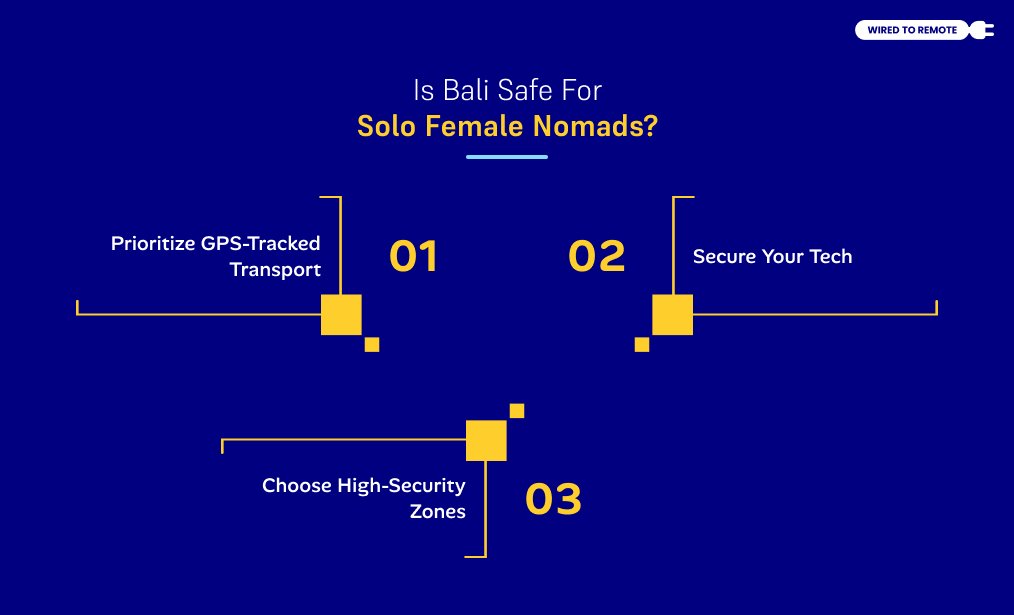
Is Bali safe for women? Well, if you’re looking at the data, Bali remains one of the most welcoming hubs for solo women in 2026.
Statistically, violent crime is incredibly rare here. The local Balinese culture is built on deep-rooted respect, which translates into a naturally safe environment.
However, safety for a female nomad isn’t just about the absence of crime. Rather, it’s about managing your operational environment.
1. Prioritize GPS-Tracked Transport:
First, stick to GPS-tracked transit. We always advise solo women to prioritize Grab or Gojek over unmarked transport.
These apps provide a digital paper trail for every trip, which is a massive security “win.” Consequently, you eliminate the risk of being overcharged or taken on a “scenic” route.
2. Secure Your Tech:
Secondly, watch the petty theft. Opportunistic phone snatching happens, especially in high-traffic zones like Berawa.
Therefore, keep your tech secured and avoid walking alone through unlit shortcuts late at night. Consequently, we would recommend a crossbody strap and keeping devices away from the roadside.
Ultimately, if you stay alert and respect the local customs, Bali is an incredibly secure base for your professional career.
3. Choose High-Security Zones:
Finally, hubs like Ubud and Canggu have massive, vetted female networks.
Furthermore, if you’re ever in doubt about a neighborhood or a local service, these groups provide real-time, “boots-on-the-ground” intel that is more reliable than any blog.
How To Stay Safe In Bali As A Digital Nomad? [Practical Tips]
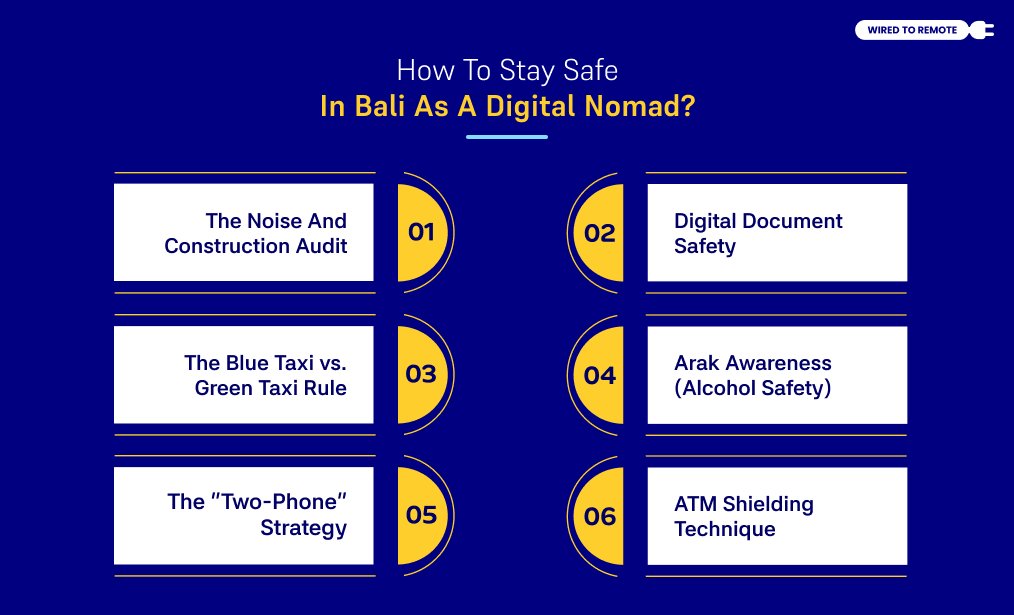
Here are some of the tips that will make living in Bali as a digital nomad better and safer. Take a look at them:
1. The Noise And Construction Audit
Safety for a nomad includes mental health and productivity safety. Before signing a long-term villa lease, check local construction maps in community groups or visit the site at 7:00 AM.
Crucially, a “safe” neighborhood quickly becomes a nightmare if a jackhammer is running 10 feet from your desk for 12 hours a day.
2. Digital Document Safety
Secondly, it would be best if you could store encrypted digital copies of your passport, E33G visa, and IDP on a cloud service that allows offline access.
Also, in case of the phone being snatched, you should be able to prove your identity at an embassy without needing your physical device.
3. The Blue Taxi vs. Green Taxi Rule
If you aren’t using a ride-hailing app, only use Blue Bird Taxis. They offer a 100% metered guarantee and GPS-tracked dispatch.
Consequently, you avoid the “fake” taxis that still exist in 2026 – always verify the logo and driver’s ID before getting in.
4. Arak Awareness (Alcohol Safety)
Stick to branded, sealed bottles or reputable beach clubs. Methanol poisoning from bootleg “Arak” remains a rare but real risk. Therefore, if a cocktail price seems “too good to be true,” it likely is.
5. The “Two-Phone” Strategy
Carry a budget “burner” phone for scooter navigation and keep your primary device hidden in your bag.
This minimizes the financial sting of a snatching. Additionally, it keeps your primary banking and work apps off the street and out of reach.
6. ATM Shielding Technique
Always use your free hand to completely cover the keypad when entering your PIN. Modern skimmers often use tiny pinhole cameras. Ultimately, if they can’t see your finger movements, your card data is useless to them.
The Verdict: Is Bali Safe In 2026?
Yes, but only if you are disciplined.
The island is a professional paradise, but it punishes the reckless. If you wear a helmet, secure your digital assets, and stay on the right side of the 183-day tax rule, your risks are minimal.
Bali is safer than your average Western city, provided you treat the island with the professional respect it deserves.


Leave A Comment