

Today’s topic is the Portugal digital nomad visa!
Have you ever wished that you could work while sitting in a café under the sun in Lisbon? Remote workers have been able to take advantage of tourist loopholes for many years.
However, luckily, the situation has completely changed now!
Portugal has formally made the Portugal digital nomad visa, also known as the D8 visa, available.
Through this legal avenue, you are given complete security and peace of mind as you get to live in those gorgeous film-covered apartments while you continue to derive your income from foreign sources.
It doesn’t matter whether you are a freelancer or work remotely full-time for a single company: this route is perfectly safe and easy to follow.
It will enable you to move your remote workspace to Europe more quickly than ever before.
The only requirements are that you have a remote work contract and earn at least €3,680 per month. This is equivalent to four times the local minimum wage.
Portugal Digital Nomad Visa: Quick Facts At A Glance
| Visa Length | Up to 1 year (temporary stay) or 2+ years (residency route) |
|---|---|
| Possible to Extend | Yes, depending on the visa type |
| Minimum Income Requirements | Around €3,280/month (4x Portuguese minimum wage) |
| Time for Visa Applications | Typically 4–8 weeks |
Portugal Digital Nomad Visa: Understanding The D8 Remote Worker Visa
Portugal can really be considered as one of the countries with the most appealing locations for lifestyle-oriented workers in Europe.
Should you plan on staying for more than just a few months, the D8 Digital Nomad Visa would be your stepping stone.
This visa, unlike other tourist or short-stay visas, is targeted at remote workers whose main source of income is from outside Portugal.
For more details on the official visa, you can visit this site: Portugal Immigration Portal
Income And Savings Requirements To Be Met
Being eligible means showing that your monthly income is stable and at least € 3,280 (approximately four times the Portuguese minimum wage) in net.
Besides that, you will also have to submit evidence of your savings.
The number most individuals present is a bank balance between € 9,000 and € 12,000, though there is no strict figure set by law.
Eligibility: Who May Apply?
This visa targets individuals who reside outside the EU/EEA and work remotely for a company or clients that are not in Portugal.
If your employer is a Portuguese company or you earn locally, you will be required to have a separate work visa.
Besides that, candidates have to submit proof of accommodation, valid health insurance, and a police record with no convictions.
Freelancers In Portugal
Portuguese law does not discriminate against freelancers as some other jurisdictions do.
However, if you are both self-employed and have international clients, you can still use the D8 visa for entry, as long as your income comes from outside Portugal.
Nonetheless, additional permits, or even a completely different system of permits, may be needed if you are working directly with Portuguese clients.
Portugal Digital Nomad Visa Duration, Extensions, And Residency Benefits
One of the biggest advantages of Portugal’s system is flexibility.
You can apply for:
- A temporary stay visa (up to 1 year), or
- A residency visa, which can be extended and eventually lead to permanent residency or even citizenship.
The residency route is especially attractive since it allows travel across the Schengen Zone and access to public services.
Alternative Visa Paths For Remote Workers In Portugal
Most people can’t meet the minimum income requirement for a D8 visa, and that’s totally okay. In Portugal, there are other options that can match your situation.
The D7 Passive Income Visa: Best For Flexible Earners
Among those who have made the D7 visa their top choice are freelancers, retirees, and digital nomads with a few sources of income and/or less income.
Rather than large sums of money, it relies on stable passive or online income, making it easier to qualify.
You can learn more here: Portuguese Government Visa Info
The Schengen Tourist Visa: Short-Term Option
If you want to visit for less than 90 days, it is very convenient to use a Schengen visa.
However, it doesn’t grant you the right to a long-term stay for remote work, so it’s better to use it for a trial stay than for permanent residence.
The “Golden Visa” Alternative
The Golden Visa program in Portugal was one of the main ways to obtain a residence permit, but following the latest changes, the option to purchase real estate has been significantly restricted.
Though it’s still available, albeit in a different form, it is no longer the most attractive option for digital nomads because of the higher financial requirements.
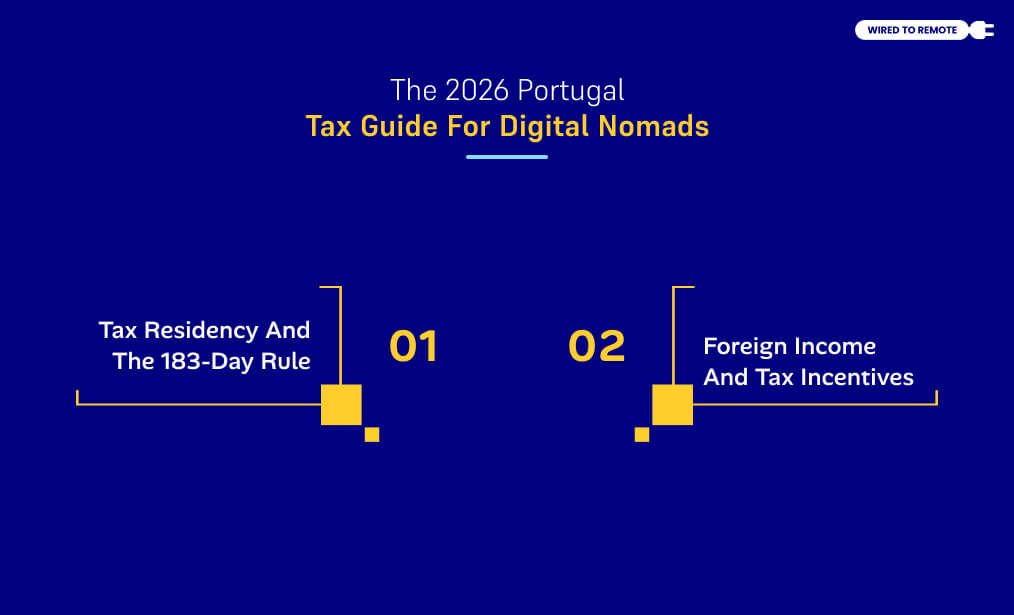
The 2026 Portugal Tax Guide For Digital Nomads
Relocation taxes are usually the most baffling aspect, and taxes in Portugal are no different.
The nation has revised many rules lately, especially regarding foreign income and residency.
A. Tax Residency And The 183-Day Rule
Staying in Portugal more than 183 days in a year qualifies you as a tax resident in most cases.
Consequently, you must obtain a tax number (NIF) and report your worldwide income.
B. Foreign Income And Tax Incentives
Portugal used to have a program called NHR (Non-Habitual Resident) that gave tax benefits on foreign income.
Though it has now been changed, there are still some incentives based on your profession and income type.
The country has also signed tax treaties with several countries to prevent double taxation, so you won’t end up paying tax twice on the same income.
The 2026 Portugal Tax Guide For Digital Nomads
Taxes can be one of the most difficult and irritating aspects of relocation, and Portugal is no exception.
The country has recently changed several policies, particularly those related to foreign income and residency.
A. The 183-Day Rule And Tax Residency
If you spend over 183 days in Portugal during a year, you are usually treated as a tax resident.
As a result, you will be required to get a tax number (NIF) and report your worldwide income.
B. Foreign Income And Tax Benefits
Portugal was one of the countries offering the NHR (Non-Habitual Resident) regime, which allowed tax benefits for foreign income.
Even though the regime has changed, some tax advantages still depend on the type of your job and income.
To prevent double taxation, Portugal has signed agreements with many countries, so you are not taxed twice on the same income.
Your Simple Guide to the Portugal Digital Nomad Visa
Would you like to sip your espresso while you work in Lisbon, typing on your laptop? The Digital Nomad Visa in Portugal might allow you to live that lifestyle!
Submitting formalities might make you feel like giving up, but the whole process is very simple. We also put together your steps and order.
Gather Your Paperwork
When it comes to your documentation, gathering papers is a priority. Think of this as your master plan for wonderful Portugal.
Your application pack should have the following:
- A Valid Passport: Make sure the expiration date is at least 6 months after your planned arrival date.
- Proof of Income: Collect your recent pay slips and bank statements. Show through your monthly earnings that you can cover your living expenses.
- Proof of Savings: Provide evidence of funds in your bank account to demonstrate financial security.
- Proof of Remote Work: You must demonstrate that your work is location-independent.
You can submit your work contract or freelance agreement for clients/dependents who are outside of Portugal.
- A Place to Stay: You can approve your accommodation by booking a hotel, an Airbnb, or renting a place so that you can prove you have accommodation when you arrive.
- Health Insurance: Purchase a comprehensive, valid international health plan that covers your health needs while living abroad.
How To Apply
As soon as you finish with your paperwork, you should make your move. It is necessary to apply in person at the Portuguese consulate or at the official visa application center in your country.
The first step is to visit the official Portuguese Consular Services website, where you can set up your meeting and provide the information requested in the forms.
Fees, Timelines, And Next Steps
There are a few important things to consider before booking your ticket:
- The Price: The visa fee typically ranges from €90 to €180.
- The Duration
On average, it takes 4 to 8 weeks to receive your permission, so don’t wait until the last minute to submit your application.
Sometimes it may take longer if you apply during peak seasons!
- The Last Step
Even after your flight lands in lovely Portugal, you haven’t achieved everything yet.
You will be required to attend a brief session with local immigration officials.
This is during which they will take your fingerprints (biometrics) and issue your legitimate residency card.
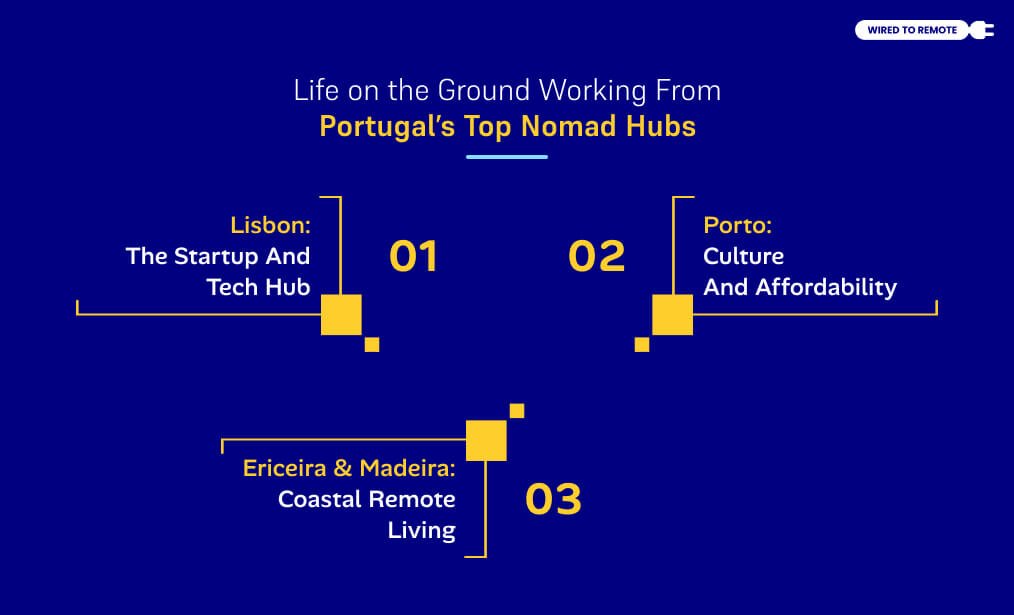
Life on the Ground: Working From Portugal’s Top Nomad Hubs
When you first arrive, you will discover that Portugal has some wonderful work-friendly locations.
Whatever your way of life, there is a perfect spot just waiting for you to open your laptop.
A. Lisbon: The Startup And Tech Hub
When it comes to high-energy environments, Lisbon is the place to be.
This vibrant city has numerous modern coworking spaces, internationally recognized startups, and a welcoming community of expatriates.
This, among other things, greatly facilitates networking and making friends.
B. Porto: Culture And Affordability
Porto may be the right choice for you if you want a quieter lifestyle. Living costs are lower than in Lisbon, so it is quite economical.
Besides, the town is ideal for artistic people who desire a historical setting without the crowds.
C. Ericeira & Madeira: Coastal Remote Living
If you dream of staying by the sea, Ericeira and Madeira are the places to see. In particular, the island of Madeira is known for its digital nomad village.
This has excellent internet access. Hence, you can keep up with your remote work while enjoying your daily walk on the beach without any problems.


Leave A Comment