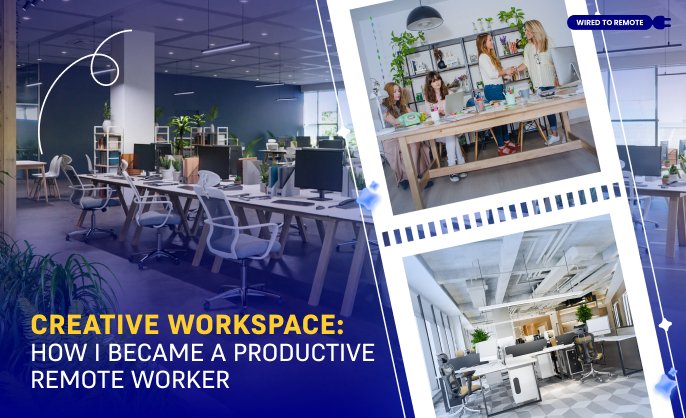
Today’s topic: How a creative workspace boosts productivity?
I’ve pivoted from intellectual cafes in France to buzzing Bali beaches, and I’ve learned the hard way: “working from anywhere” is a trap without a system.
My early days were a messy reality of sand-clogged keyboards, dead batteries, and sun-blinded screens.
And guess what?
I wasn’t living the dream – I was burning out with a posture like a question mark.
Eventually, I realized that, as a digital nomad, while my “office” changes every fortnight, my environment is my only controllable lever.
While I have now retired from the life of a digital nomad, I have learned something really valuable. And that’s the fact that your workspace is a psychological tool.
And this is irrespective of whether you’re in a studio or hopping time zones. If you don’t master it, it will master you.
If you are trying to find your best hack to boost your productivity and are negotiating whether you really need a creative workspace, keep reading!
Creative Workspace Strategies To Boost Productivity As A Remote Worker
Did you know that, according to research, employees who work in a well-designed and creative workspace tend to be about 32% more productive? (Source: Harvard Business Review)
Apparently, these workspaces foster a much better performance. How? Well, through:
- Reduced physiological strain.
- Increased control over surroundings.
- Enhanced opportunities for collaborative peer interaction
And I have experienced this personally. So, with the knowledge that I have gained through my experience, I have the (almost) perfect guide for you.
Here is my unfiltered, brutally honest guide on how I hacked my workspace to stay productive without losing my mind.
1. I Stopped Looking For “Vibes” And Started Looking For “Zones”
Let me really explain this point. Early on, I realized that my brain needed a “physical anchor” to know it was time to work.
When your living room, kitchen, and office are all in the same ten-foot radius, your brain gets confused.
It doesn’t know whether to look for snacks, watch Netflix, or write a strategy deck. And I am sure this is a problem most of us have faced.
Now, the moment I check into a new Airbnb or co-living or coworking space, the first thing I do isn’t unpacking my clothes – it’s designating a Focus Zone.
My “Portable Office” Ritual:
I carry a specific, lightweight desk mat in my backpack. It doesn’t matter if I’m at a shaky wooden table in a hostel or a sleek marble counter in a rental.
When that mat is laid out, the “office” is open. It’s a psychological trigger that tells my nervous system to settle down and focus.
And when I’m done, I roll it up and put it away. This act of “closing the office” is the only thing that stops that “living at work” feeling.
The Sight-Line Rule:
I never face my bed. If I can see the unmade duvet, my brain subconsciously wants a nap. If I face the kitchen, I’m constantly thinking about what’s in the fridge.
I always position myself to face a window or a blank wall.
Minimizing my visual field to just my work and a neutral background has been the single biggest boost to my deep-work sessions.
2. I Invested In A “Body-First” Tech Stack (The Hard Way)
I used to think a laptop stand was for “settled” people with permanent offices.
And that’s not all – I thought I was too “minimalist” for extra gear. Then I spent a month in Bali with a neck so stiff I could barely turn my head to see the sunset.
I’ve learned that you can’t be creative if your body is screaming at you. If you are a remote employee, you are an “industrial athlete,” and your gear matters.
The Eye-Level Setup:
I now carry a foldable Roost stand and a separate Bluetooth keyboard and mouse. It adds about 600g to my bag, but it saves me 8 hours of “tech neck” every day.
If your eyes are level with the top third of your screen, your spine stays neutral. I found that I can work for six hours straight with this setup and feel better than I did after two hours of hunching over a laptop.
Active Posture Breaks:
I don’t believe in “perfect” posture anymore – I believe in “next” posture. I use a timer to force myself to stand up every 50 minutes.
If I’m in a place with a high counter, I’ll spend half the day standing. If not, I do two minutes of stretching.
When you’re working from chairs that were clearly designed for aesthetics rather than 8-hour shifts, movement is your only insurance policy against chronic pain.
3. I Learned To Hack My Senses (Because Silence Is A Myth)
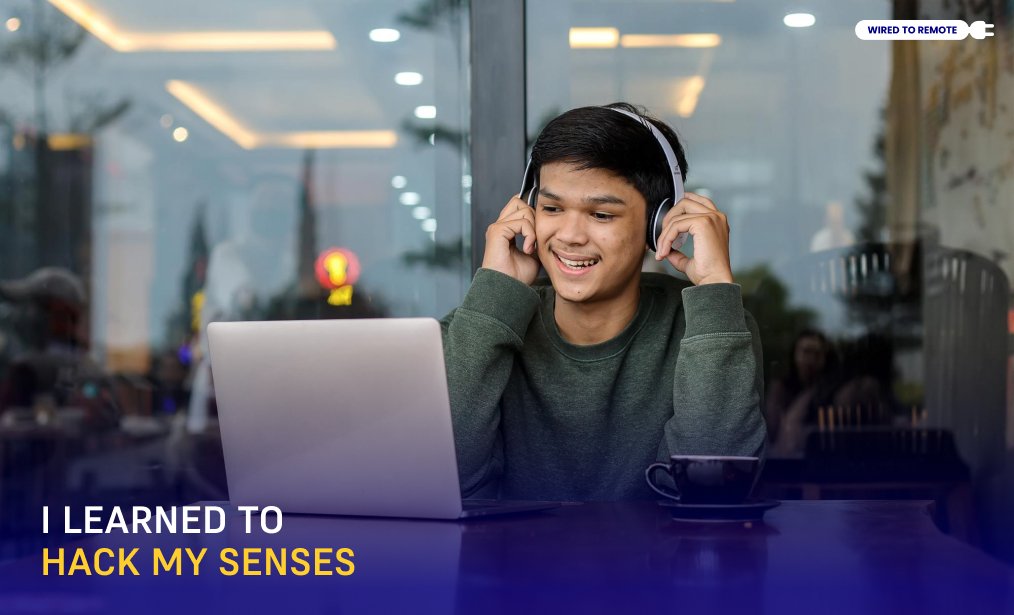
As a nomad, you quickly realize that you cannot control the world. There will be construction noise in Medellin, roosters in Thailand, and someone having a loud breakup on Zoom at the cafe table next to you.
My Audio Sanctuary:
I don’t just use noise-canceling headphones – I use Brown Noise.
Unlike white noise, which is high-pitched and can be grating, brown noise sounds like a deep, low-frequency roar – like a massive waterfall or the inside of an airplane cabin.
It creates an “audio floor” that masks human speech perfectly. When the headphones go on and the brown noise starts, the physical world around me disappears.
Personally, it’s the closest thing to a “Do Not Disturb” sign for my brain.
The Scent Association:
This sounds like “woo-woo” advice, but it’s pure science. I carry a small tin of peppermint balm. I rub a little on my wrists right before I start a high-stakes task.
My brain has built a powerful association over the years:
Peppermint = Focus.
Now, the moment I smell it, I slide into a state of concentration almost instantly. It’s a way to carry “stability” in my pocket, no matter how chaotic my external environment is.
4. Why I Treat My Digital Space Like A Clean Desk
Since my physical desk changes constantly, my “digital desk” has to be my sanctuary. I’ve found that digital clutter is actually more exhausting than physical clutter because it’s always “on.”
The “Clean Slate” Ritual:
At the end of every single workday, I force myself to close every single tab. I empty my “Downloads” folder and move files to their proper cloud storage.
Walking into a cluttered digital space the next morning with 40 open tabs is the fastest way to trigger “decision fatigue” before I’ve even had my coffee.
Notification Lockdown:
I’ve turned off every single notification on my laptop except for my calendar. If I’m in the zone, I don’t want to know about a Slack “ping” or an “urgent” email.
I check those on my schedule. As a nomad, your time is your most precious currency – don’t let an app spend it for you.
The Cable Management Habit:
I carry a small tech pouch for all my wires. Nothing kills my mood faster than a “rat’s nest” of cables spilling out of my bag.
By keeping my tech organized, I reduce the “setup friction” that often leads to procrastination.
5. Managing The “Isolation Tax” And Mental Health
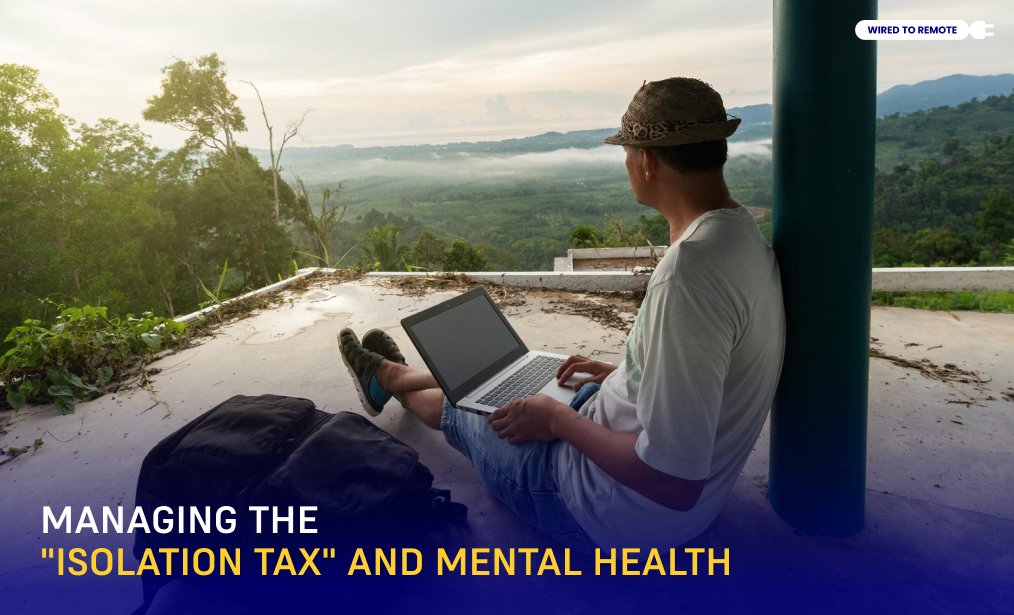
The biggest struggle of the remote life – and the one nobody tells you about – is that you never feel like you’re truly “off.” Your laptop is always there, glowing in the corner of your eye.
The “Exit” Strategy:
When I hit my goals for the day, I physically shut my laptop and put it inside its sleeve and then inside my bag. I don’t leave it open on the table.
If it’s out of sight, it’s out of mind.
This allows me to actually enjoy the city I’m in rather than feeling guilty for not “checking one more thing.”
The Hydration Habit:
It sounds basic, but I’ve tracked my productivity, and 70% of my “mid-day slumps” were actually just dehydration.
I carry a 1-liter insulated bottle and make it a goal to finish it twice during work hours. It keeps my energy levels stable and prevents the “brain fog” that leads to sloppy work.
The Inspiration Board:
Since I don’t have a cubicle wall to pin photos to, I have a dedicated folder on my desktop called “Why.”
It’s full of photos of my family, my favorite travel memories, and screenshots of goals I’ve reached.
On the days when the Wi-Fi is down, and I’m feeling lonely in a foreign country, I look at that folder to remind myself why I chose this life.
My Two Cents On Creative Workspace: Infrastructure is a Mindset
I used to think being a digital nomad was about the freedom to work from a hammock. It’s not. It’s about having the discipline to build a sanctuary wherever you land.
Whether you are working from a home office or a co-working space in France, you are the CEO of your own environment.
You don’t need a $2,000 ergonomic setup to be successful. You just need to respect your brain and your body enough to give them the boundaries they need.
By taking 15 minutes to set up my “Focus Zone,” masking the world with brown noise, and staying hydrated, I’ve managed to maintain a higher level of productivity on the road than I ever did in a corporate office.
And please trust me when I say this: remote work is a gift. But it’s a gift that requires a foundation.
So, don’t just “work from home” – design a life that allows you to work at your best, and then have the discipline to walk away when the work is done.
Leave A Comment