

The global race for European Union residency has entered a chaotic new phase. Over the past few years, Mediterranean havens have systematically pulled up their drawbridges.
For example, Spain completely abolished its popular real estate route. Meanwhile, Portugal heavily restricted its property pathways, and Greece hiked metropolitan investment thresholds to a staggering €8,00,000.
Consequently, a surprising dark horse has emerged in northeastern Europe. Latvia now offers the lowest corporate entry point in the entire European Union. Because of this, the Latvia Golden Visa Program is experiencing a massive resurgence.
Recent residency data shows that program approvals surged by nearly 35%. High-net-worth individuals are scrambling for alternative footholds in the Schengen Area. However, does an investment visa make sense for someone with a laptop?
The short answer is yes.
Yet, the structural reality reveals a complex landscape. You must navigate hidden corporate tax quotas, sudden legislative shifts, and strict language bottlenecks.
Therefore, digital nomads must look beyond marketing brochures. You need to understand how this program stacks up against Latvia’s dedicated Digital Nomad Visa (DNV).
The Basics: Mechanics Of The Latvia Golden Visa
The Latvia Residence by Investment (RBI) framework grants non-EU nationals a 5-year Temporary Residence Permit (TRP).
Traditional visas tie your legal status to local employment or university enrollment. In contrast, this program anchors your residency to a financial contribution.
The government takes about three to eight months to process the TRP. Afterward, you must renew the physical residency card annually. To qualify, remote workers must choose one of four approved pathways:
LATVIA GOLDEN VISA PATHWAYS (2026)
| Pathway | Minimum Capital Investment | Required State Fees and Budget Contributions | Total Minimum Upfront Cost |
|---|---|---|---|
| Business Equity | €50,000 | €10,000 state contribution | €60,000 |
| Real Estate | €250,000 | 5% government fee (€12,500) | €262,500 |
| Government Bonds | €250,000 | €38,000 state fee | €288,000 |
| Bank Deposit | €280,000 | €25,000 state fee | €305,000 |
The Business Equity route serves as the most popular choice for location-independent professionals. It represents the cheapest formal gateway into the EU investment market.
However, you must account for hidden government fees. The €50,000 business injection requires a mandatory, non-refundable €10,000 state budget contribution up front.
Thus, the true baseline entry cost rises to €60,000.
Why The Golden Visa Appeals To The Nomad Lifestyle
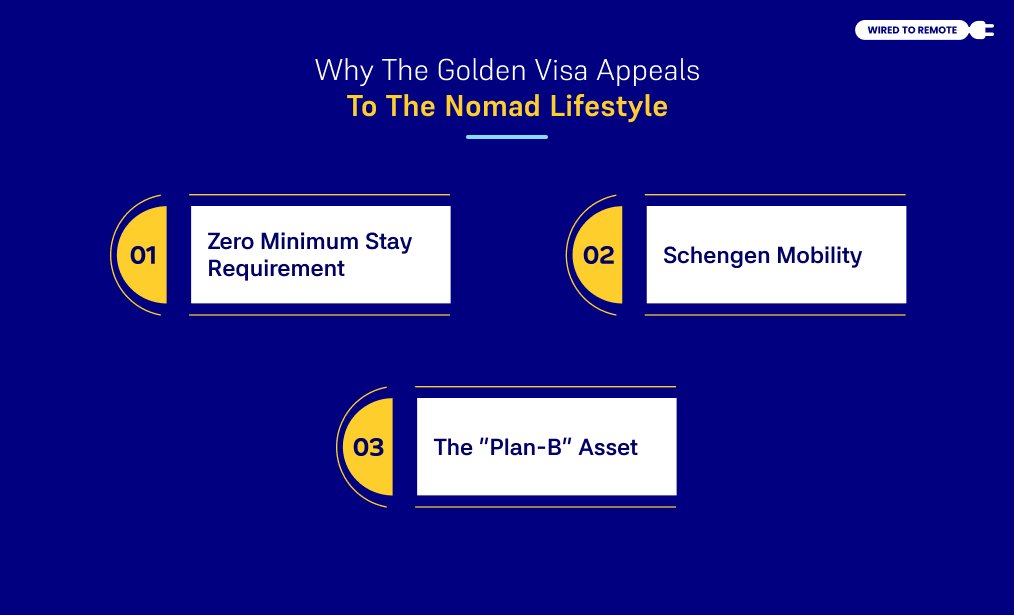
The Golden Visa solves the structural headache of traditional border-hopping for high-earning remote workers. Specifically, it offers three distinct operational advantages:
Zero Minimum Stay Requirement:
Traditional European residency permits require you to live in the country for 183 days a year. Fortunately, the Latvia Golden Visa completely bypasses this physical presence test.
You only need to visit Latvia once per year for your annual biometric check to maintain card validity.
Schengen Mobility:
The visa functions as a key to Europe. Holders move visa-free through the 29 countries of the Schengen Zone.
You can stay for up to 90 days within any rolling 180-day window. As a result, you can maintain a home base in Riga while spending winters in Spain.
The “Plan-B” Asset:
Tech founders and freelancers view the Golden Visa as a strategic insurance policy. It secures permanent access to Europe. Best of all, it never forces you to uproot your lifestyle.
The Reality Check: Complex Pitfalls For Remote Workers
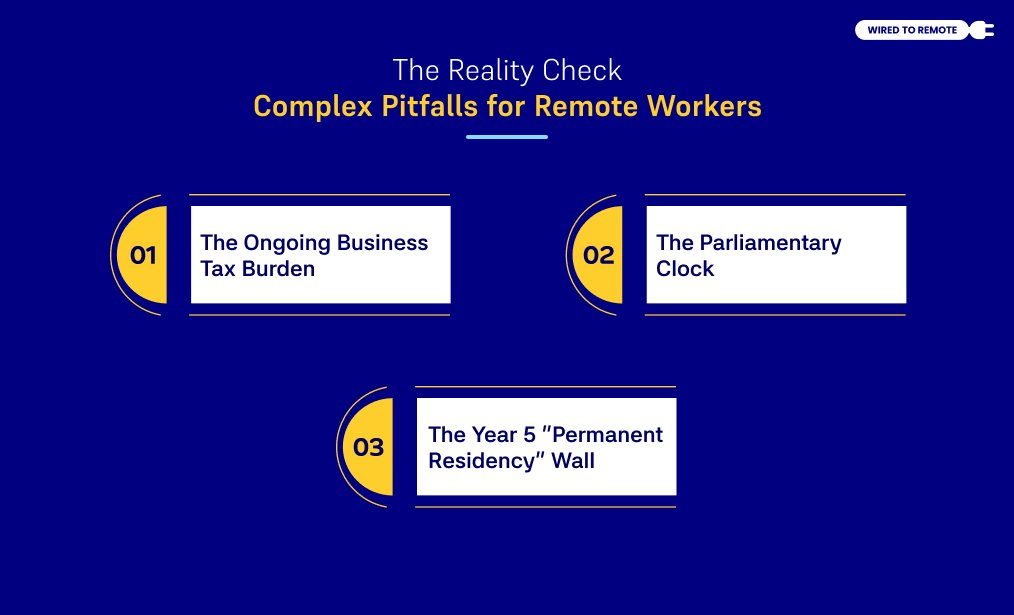
Despite the clear lifestyle perks, treating an investment visa like a nomad permit exposes freelancers to severe structural traps.
The Ongoing Business Tax Burden
First, the €50,000 corporate investment pathway requires active management. It is not a passive stock purchase.
To keep the 5-year residency permit active, the underlying Latvian company must pay at least €10,000 in annual corporate taxes to the state.
If you invest in a local business, you must conduct extensive due diligence. Ensure the company can hit this tax threshold year after year.
If the business fails to clear the €10,000 tax quota, the government will immediately revoke your residency card.
The Parliamentary Clock
Second, the program faces potential regulatory adjustments. The Latvian Saeima (Parliament) actively debates proposals to shorten the validity of new business equity visas.
They want to cut the five-year term down to a two-year rolling renewal. Current applications still follow the stable 5-year rules.
Furthermore, the state will grandfather in existing holders. Even so, the window to lock in low-maintenance, long-term terms is narrowing.
The Year 5 “Permanent Residency” Wall
Third, immigration marketing often conflates maintaining a temporary visa with earning permanent residency (PR).
You can maintain your temporary Golden Visa card indefinitely with just one visit a year. However, transitioning to Permanent Residency at Year 5 triggers strict physical stay mandates.
You must prove you legally resided inside Latvia for four out of the preceding five years. Furthermore, you must pass a mandatory A2-level Latvian language exam and a test on the national anthem.
Mastering an intensive Baltic language while traveling outside the country presents an incredibly difficult hurdle for a digital nomad.
Golden Visa vs. Digital Nomad Visa: The Strategic Split
For the vast majority of remote workers, Latvia’s dedicated Digital Nomad Visa (DNV) is a far more practical choice
However, the DNV features a major geographic restriction. This restriction leaves certain nomads with no option but the investment route.
| Feature | Latvia Golden Visa (RBI) | Latvia Digital Nomad Visa (DNV) |
|---|---|---|
| Primary Requirement | Financial asset investment inside Latvia | Remote employment/contracts outside Latvia |
| Upfront Capital Cost | €50,000 minimum + processing fees | Minimal visa processing fees (~€60–€120) |
| Income Threshold | Proof of passive self-subsistence | €4,213 per month (2.5x gross average) |
| Corporate Restrictions | None (global income allowed) | Employer must be in an OECD country |
| Dependents and Family | Spouses and minors included from Day 1 | Strictly no dependents allowed |
| Validity Limit | 5 years, indefinitely renewable | Max 2 years (1-year term + 1 renewal) |
Most importantly, you must consider the OECD Catch. To qualify for Latvia’s DNV, your remote employer or freelance business must be legally incorporated within an OECD member state. This includes countries like the US, UK, Canada, or an EU nation.
If you register your business in a non-OECD jurisdiction – like the UAE, Cayman Islands, or Malaysia – Latvia explicitly bars you from the Digital Nomad Visa. For these individuals, the Golden Visa represents the only viable pathway to secure legal residency in Latvia.
Additionally, the DNV completely bans family members. A remote worker traveling with a partner or children cannot use the nomad visa to move as a household.
Conversely, the Golden Visa automatically grants residency cards to spouses and minor children.
Verdict: Who Should Buy In?
The Latvia Golden Visa can work for remote workers, but it serves a very specific niche. You should view it as a structured corporate tool rather than a casual travel permit.
The program fits high-earning founders and non-OECD entrepreneurs perfectly. It helps those who need long-term Schengen access, want to relocate their family, and require a low-maintenance backup plan.
On the other hand, solo freelancers with OECD-registered businesses should avoid it. The high capital lock-up and the annual €10,000 corporate tax requirement make the Golden Visa an unnecessary expense.
In that case, choose the standard Digital Nomad Visa. It allows you to enjoy Baltic remote work hubs at a fraction of the cost.



Leave A Comment