
I’ve spent weeks digging through Residency Malta Agency documentation, cross-checking fee structures, and talking to people who’ve actually gone through the process.
If you’re considering the Malta Digital Nomad Visa, here’s everything I’ve learned, laid out the way I wish someone had laid it out for me.
What Is The Malta Digital Nomad Visa?
The Malta Digital Nomad Visa, officially called the Nomad Residence Permit, is a one-year residence permit. It grants non-EU, non-EEA, and non-Swiss nationals the right to live in Malta while being employed remotely for employers or clients based outside the country. [Source: Residency Malta]
This digital nomad visa officially started in 2021, and it is still one of the most open digital nomad programs in the Mediterranean area.
So, who exactly is this for?
I am talking about employees of foreign companies, freelancers with international clients, and owners of a business who have a majority share in the company registered outside Malta.
If your income comes from Maltese sources, this permit isn’t for you.
Key Requirements For Malta Digital Nomad Visa At A Glance
Before I get into the details, here’s the quick-answer version, since I know most people just want the numbers first:
- Minimum income: €3,500 gross per month, or €42,000 per year
- Nationality: Must be a third-country national (not EU/EEA/Swiss)
- Employment type: Remote employee, freelancer, or foreign business owner
- Health insurance: Mandatory, covering the full stay
- Accommodation: Proof of rental or property purchase in Malta
- Age: 18 or older, with a clean criminal record
- Duration: 1 year initially, renewable up to three times (4 years total)
This income threshold was raised from the earlier €2,700/month requirement to keep pace with Malta’s rising median wage, so if you’ve seen older articles quoting lower numbers, they’re outdated.
How Much Does The Malta Digital Nomad Visa Actually Cost?
This is where I’ve seen the most conflicting information online, so let me break it down as clearly as I can.
The core government fees are modest: a €300 application fee plus a €27.50 fee for the physical residence card, per applicant.
If you’re bringing family members, each dependent adds their own government fees on top of that.
The real cost isn’t the application – it’s living in Malta itself.
After you have added the costs of rent, health insurance, document translation and certification, and general setup expenses, an approximate first-year budget for a single applicant could range from 5,000 to 20 000 based on your way of life and the location you opt for.
It is well worth looking into the cost of living in Malta thoroughly before you decide, as the rent in such areas as Sliema or St Julian’s, for example, is quite a bit higher than in the quiet towns or even Gozo.
Documents You’ll Need
I’ve organized this into categories because the paperwork trips up a lot of applicants:
- Proof of income: Bank statements from the last 3–6 months, employment or service contracts, tax returns
- Identity documents: Valid passport, passport-style photos
- Health insurance: A policy covering your entire stay in Malta
- Accommodation proof: Signed lease or property purchase agreement
- Background check: Police conduct certificate issued within the last 6 months
- Motivation letter: Explaining your remote work situation and reason for relocating
One detail that catches people off guard: the Residency Malta Agency does not accept screenshots of bank statements.
You need PDFs downloaded directly from your banking portal, or certified paper copies. I mention this because I’ve seen applications delayed purely over this technicality.
Common Reasons Applications Get Refused
Based on what I’ve researched, applications are typically refused for one of these reasons:
- Incomplete or improperly formatted documentation
- Failing the due diligence background check
- Insufficient or unverifiable income
- Inability to demonstrate genuine remote work arrangements
- Being a national of a country subject to visa restrictions
The Tax Situation Explained
This is genuinely one of Malta’s biggest draws for remote workers, so I want to walk through it carefully.
During your first 12 months on the Nomad Residence Permit, your foreign-sourced income is exempt from Maltese income tax.
After that exemption period, if you become a Maltese tax resident and elect into the regime, your authorized work income is taxed at a flat 10% rate – a dramatic reduction compared to Malta’s standard progressive tax rates, which climb as high as 35%. [Source: Wise]
That said, I want to be clear about something a lot of guides gloss over: holding the Nomad Residence Permit and being a Malta tax resident aren’t automatically the same thing.
The 10% rate only kicks in once you actively elect Malta tax residency. If you don’t, your home country’s tax rules generally continue to apply.
Given how much nuance is involved here, this is one area where I would strongly encourage speaking with a qualified Maltese tax adviser rather than relying on any single article, including this one.
Renewal Requirements
The permit lasts for one year only at a time. You can renew it 3 more times, so the maximum duration of the permit is 4 years.
Renewal will be possible only if you document that you have been physically residing in Malta for at least five months in total over the last year.
Besides this, you should also present evidence that you still fulfill the income and employment requirements.
It’s worth noting the Nomad Residence Permit doesn’t lead directly to permanent residency or citizenship – if that’s your long-term goal, you’d need to look at a different Maltese residency pathway entirely.
Bringing Family Members
Good news for people moving with a partner or children: the main applicant is allowed to add family members in the same application.
The ones that qualify as dependents are spouses, unregistered partners (who can prove two years of cohabiting), minor children, and adult children who either rely on the parent’s income or, living independently, would be a problem physically.
Each additional dependent typically requires demonstrating an extra 20% of Malta’s median wage on top of your base income, so larger families need to plan their income proof accordingly.
Why Remote Workers Choose Malta
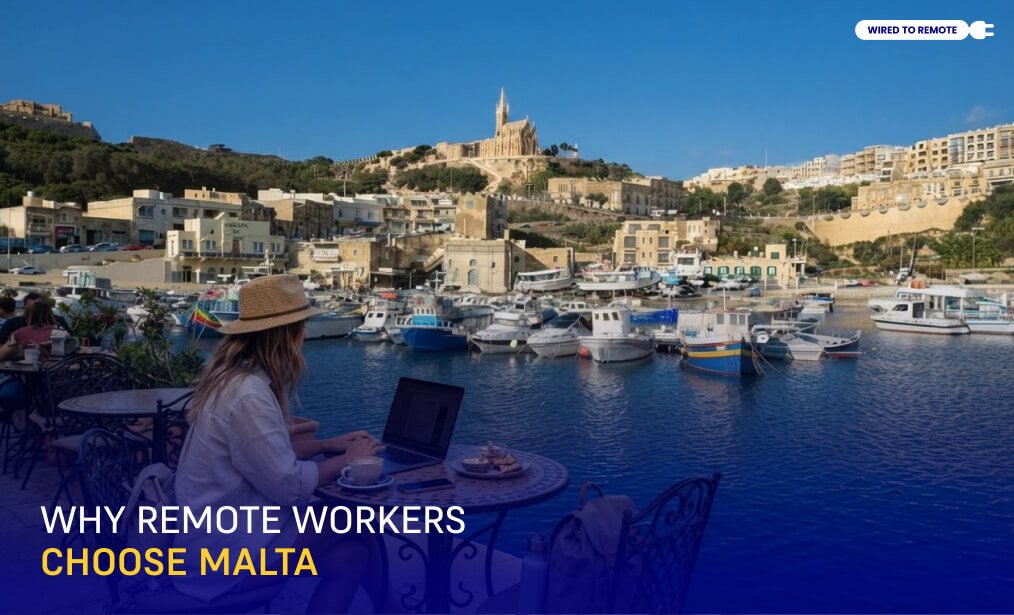
Besides the visa procedures, I believe Make sure to elaborate why Malta is always one of the top destinations for nomads.
Being an official language, English eliminates one major obstacle commonly found in many other European countries.
Malta is equipped with stable high-speed internet. There are plenty of options for coworking spaces in Malta, in particular in areas like Sliema and Valletta.
Additionally, there is a very active community of remote workers. This it really simple for you to get acquainted from your very first day.
The lifestyle side matters too.
Malta offers a genuinely Mediterranean pace of life. It features plenty of local coffee shops. These spots double as informal workspaces. You will also find many great restaurants to explore after work.
Malta is a full Schengen member state. Holding this permit grants you visa-free travel privileges. You can visit 28 other Schengen countries.
This allowance lasts up to 90 days within any 180-day period. This flexibility is a huge bonus for active travelers.
Research the best areas to live before you settle. Do this ahead of your actual approval date. Local neighborhoods differ significantly in total cost. They also vary in noise levels and expat density.
Sort out a Malta eSIM before you land. This ensures instant data connectivity upon arrival. Doing this prevents you from scrambling for local SIM cards at the airport.
Is Malta Safe For Digital Nomads?
I get asked this constantly, and it’s a fair question before uprooting your life.
Generally, people consider Malta one of the safer countries in the EU for expats and remote workers.
However, I would always recommend doing your own deeper research into whether Malta is safe for your specific circumstances – particularly around neighborhood-level safety, since this can vary between busier tourist zones and quieter residential areas.
My Final Take On Getting The Malta Digital Nomad Visa
As per what I saw, the Malta Digital Nomad Visa is very approachable. It is currently one of the most cost-effective EU programs. This program beats Malta’s investment-based residency routes. Those options require six-figure financial commitments.
The program sets an income threshold of €42,000. This target is highly achievable for many remote professionals. Additionally, the application process is relatively fast. The official tax treatment is also genuinely competitive.
However, this guide offers only a detailed starting point. It does not replace professional legal or financial advice. Immigration rules change frequently. Tax regulations also shift, and personal situations differ greatly.
You should double-check the latest requirements directly. Contact the Residency Malta Agency for current rules. Also, talk to a qualified immigration or tax professional. They will review your specific case before you apply.

Leave A Comment