
Quick Answer: Is Malta Safe?
Yes, Malta is safe for digital nomads. I found that Malta consistently ranks among the top 25 safest countries in the world on the Global Peace Index, and the US State Department places it at Level 1 (“Exercise Normal Precautions”) – its lowest risk category.
Violent crime is rare, homicide rates sit below 1 per 100,000 residents, and the most common risk you’ll actually encounter is opportunistic petty theft in busy tourist zones.
If you’re weighing whether is Malta safe enough to base your remote work life there, the short version is: it’s one of the more low-friction, low-risk choices in Europe right now.
Why I Keep Getting Asked “Is Malta Safe?”
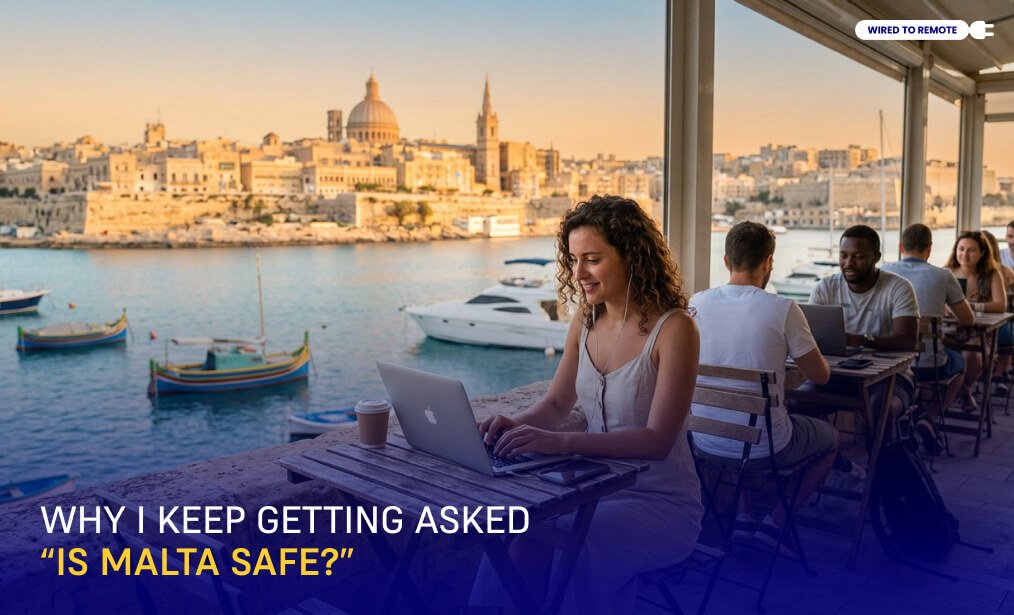
Every time someone messages me about relocating for remote work, Malta comes up within the first few questions.
It makes sense – between the Mediterranean weather, the English-speaking population, and a dedicated Malta digital nomad visa, it’s become one of the default shortlist destinations for location-independent professionals.
But before anyone books a flight, they want to know: is Malta safe enough to actually live in, not just visit for a week?
I’ve spent time digging through crime data, government travel advisories, and firsthand accounts from nomads already on the island to answer this properly.
Safety isn’t just a single statistic – it’s how comfortable you feel walking home after a coworking session runs late, whether you can leave your laptop bag on a café chair for two minutes, and whether the healthcare system will actually take care of you if something goes wrong.
On all of these counts, Malta holds up well.
What The Data Actually Says About Safety In Malta
According to Eurostat, only a small share of Malta’s population reported experiencing crime, violence, or vandalism in their area as of late 2023 – and that figure has been trending downward since 2019.
Numbeo’s most recent Crime Index rates Malta well below the European average, and the CrimeMalta Observatory’s 2024 Annual Crime Review recorded a homicide rate of roughly 0.7 per 100,000 residents, with a 100% homicide solve rate going back to 2018.
Violent crime actually decreased year-over-year, while theft – mostly pickpocketing and entertainment-district snatching – ticked up slightly.
That distinction matters: what you’re statistically at risk of in Malta is losing a phone off a café table, not physical harm.
The Global Peace Index places Malta in the top tier of the world’s most peaceful nations, ahead of countries like the UK, France, and Italy.
So when I ask myself is Malta safe compared to the rest of Western Europe, the honest answer is that it performs better than several countries digital nomads consider “obviously safe” by reputation alone.
Where The Risk Actually Concentrates
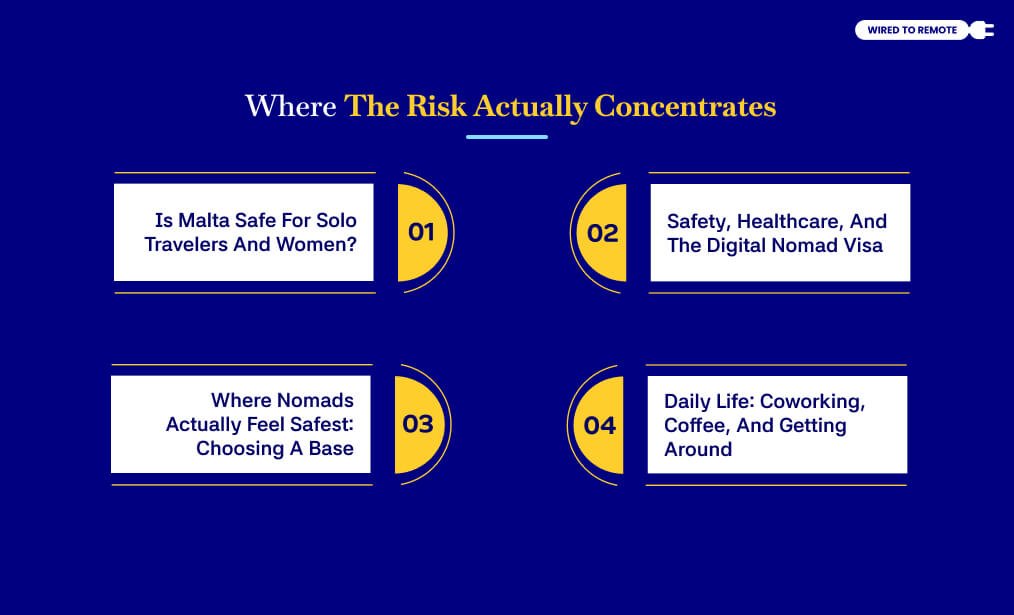
Malta isn’t completely risk-free – no country is – and I think it’s more sensible to discuss the matter in particular rather than just repeating the phrase “it’s safe” again and again.
Actually, the most typical, recurring problem is petty crimes, which mostly occur in certain areas: the nightlife zone of Paceville, crowded buses, ferry terminals, and busy markets in Valletta and Sliema.
Thieves are after tourists who are distracted, not residents who are going about their daily routine, so once you’ve got into a rhythm and are no longer appearing to be a tourist in the first week, your risk decreases quite a bit.
However, late-night brawls in Paceville are a risk, and they’re almost always incidents between tourists at night that are alcohol-related, rather than any attacks on nomads or residents.
Driving is arguably a bigger practical hazard than crime.
Maltese traffic patterns and narrow roads catch a lot of newcomers off guard, and I would honestly rank “learning to navigate Maltese roads” above “worrying about street crime” on the list of things to actually prepare for.
Is Malta Safe For Solo Travelers And Women?
People often ask this next appropriate question. Female solo travelers share their experiences online. They walked alone along Sliema, Valletta, and Mellieħa. They never felt scared during their walks, even late at night.
Public transport works well during the day. Locals and tourists use ride-hailing apps often. They prefer Bolt and eCabs because people regard these apps as honest options. Traditional taxi meters are less reliable.
Malta is famous for being LGBTQ+-friendly.
It ranks among the top European countries. The country provides complete legal equality. Strict anti-discrimination laws protect everyone. This information proves Malta is inclusive. Safety means more than just low crime statistics.
Safety, Healthcare, And The Digital Nomad Visa
If you’re planning to apply for the Malta digital nomad visa, safety extends beyond crime rates into infrastructure – and this is where Malta genuinely earns its reputation.
The country has both public and private healthcare systems, with Mater Dei Hospital serving as one of the best-equipped medical facilities in the Mediterranean.
That’s not a small detail if you’re moving somewhere long-term and want reassurance that a medical issue won’t derail your work or your finances.
On the digital side, cybercrime is the one category actually rising in Malta, driven partly by its sizeable online gaming and financial services sector.
Your remote working situation is secure. You are not unsafe. However, you should get accustomed to standard security rules. Follow the same rules at home and in the office.
Use a virtual private network on public internet connections. Update your software versions regularly. Buy a Malta eSIM for exclusive connectivity. Use this eSIM when you cannot trust cafe Wi-Fi.
Protect your data during sensitive business transactions. Secure your connection when you log into banking websites.
Where Nomads Actually Feel Safest: Choosing A Base
Once people are convinced is Malta safe isn’t a trick question, the next thing they ask me is where to actually live.
In my research, the best places to live in Malta for remote workers tend to be Sliema, St Julian’s, and Valletta itself – all walkable, well-lit, well-served by transport, and close to coworking infrastructure.
Gozo is the quieter alternative if you want the safety profile of Malta with a slower pace and fewer crowds.
Cost is naturally part of this decision too. The cost of living in Malta varies a fair amount by neighborhood.
For instance, rent in Sliema or St Julian’s runs higher than in quieter residential pockets. However, you’re paying for proximity to the coworking and social infrastructure that makes remote life easier in the first place.
I would treat the safety of a neighborhood and its cost as two sides of the same decision rather than separate line items.
Daily Life: Coworking, Coffee, And Getting Around
Malta’s remote work scene has matured enough that finding a coworking space in Malta is no longer a challenge – most cluster around Sliema, St Julian’s, and Valletta, the same areas that rank highest for everyday safety.
Working from a proper coworking space rather than hopping between cafés also solves a lot of the low-level theft risk. And that’s mainly because you’re not leaving a laptop unattended at a coffee shop Malta table while you order.
Speaking of which, if you’re wondering where to eat in Malta, the tourist-heavy strips in Sliema and Valletta are safe but pricier.
So, heading slightly inland to residential areas gets you better food at lower cost with essentially the same safety profile.
None of the areas popular with digital nomads carry any real risk beyond standard city-center awareness.
How Malta Compares To Other Digital Nomad Hubs
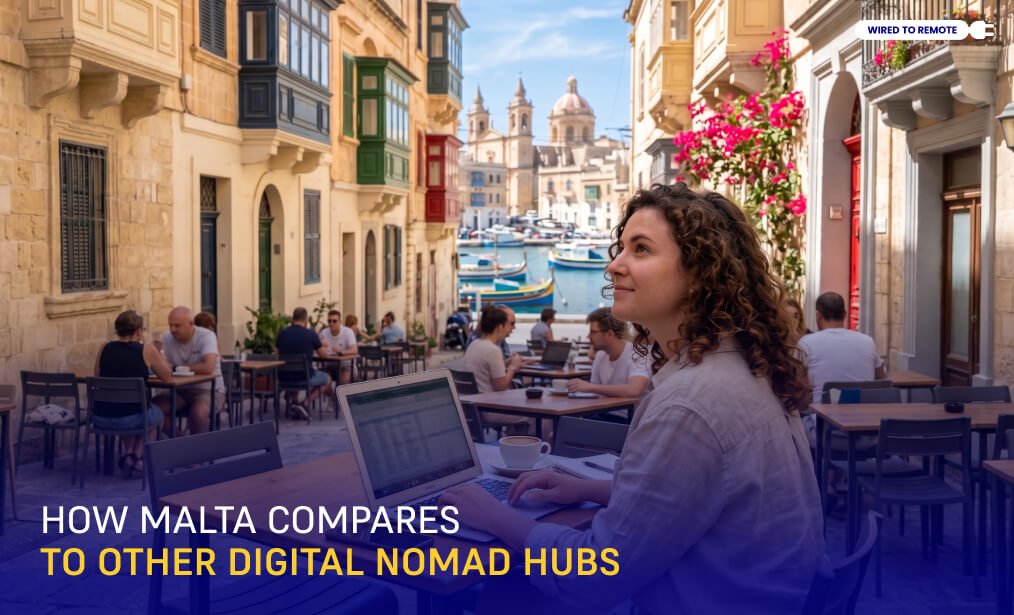
If you’re still deciding between destinations, it helps to see Malta in context rather than in isolation.
Malta ranks as a top country for digital nomads. The nation belongs to the European Union. Locals speak English widely. The island maintains a low crime rating. This safety profile sets it apart from other destinations.
Let me give you a quick comparison.
Lisbon offers amazing coworking spaces. The city hosts a vibrant nomad community. However, Lisbon faces notable crime rates. Thieves commit frequent thefts and break-ins there.
These crime levels closely match the statistics in Malta. A smaller island offers distinct advantages. Malta remains highly predictable. You can move safely from place to place.
The cost of living in Bali as a remote worker is lower than in Malta. However, Bali’s safety considerations – road conditions, healthcare access outside major hubs, natural disaster exposure – are meaningfully different and worth weighing separately.
Safety in Latvia is also strong on paper. However, its climate and shorter daylight hours in winter make it a very different lifestyle proposition than Mediterranean Malta.
And the cafe scene for remote workers in Porto is charming and affordable, with a safety profile similar to Malta’s. This makes Portugal Malta’s closest real competitor if language and visa pathways are your deciding factors rather than safety alone.
My Take, After Going Through The Data
Is Malta safe?
I looked up government advisories. I checked independent crime indexes. And I read personal accounts from digital nomads currently staying in Malta.
My first-hand answer is also yes. You must apply basic common sense precautions. These are the same precautions you use in any European city.
Zip up your bag at the markets of Valletta. Avoid walking alone in Paceville after midnight. Bring your laptop with you to the city. Find a proper coworking space for your work.
Additionally, do not leave your equipment unguarded while you grab a coffee. Relax and feel safe about the rest of your trip. Beyond that, Malta earns its reputation.



Leave A Comment