
As digital nomadism is slowly becoming the norm in the corporate world, countries are providing visas for remote workers.
Opening doors to explore new cultures while working for foreign companies.
And, among the countless countries, Croatia remains one of the top 3 choices to kickstart a digital nomad career.
That is, along with its exquisite natural beauty, it offers diverse benefits for alien workers. So, they feel part of the growing expat community and contribute to the Croatian economic conditions.
Now, the Croatia Digital Nomad Visa is not exactly the same as those offered by Japan, Germany, Australia, or Spain.
So, your remote buddy is here with the perfect guide on the Croatian visa.
Here, in this article, I will be delving into the diverse aspects of the digital nomad visa of Croatia by highlighting—
- Its basics and key benefits,
- Eligibility criteria and documents required,
- Steps of the application process, some tips, and more.
So, come dive right in!
What Is The Croatia Digital Nomad Visa?
First things first, the Croatia Digital Nomad Visa is a temporary permit. That is, it allows non-EU/EEA residents to stay and work remotely for foreign companies in Croatia.
Moreover, it allows all kinds of remote workers to earn while exploring the rich natural scenic beauty and exquisite Croatian culture.
So, freelancers, solo entrepreneurs, and full-time remote employees can slip into the country with the visa as their official gate pass.
Now, as a temporary permit, it allows workers to stay in Croatia for 12 months or 1 year. But this permit can be renewed, and the tenure can be extended up to 18 months.
Key Benefits Of The Croatian Digital Nomad Visa
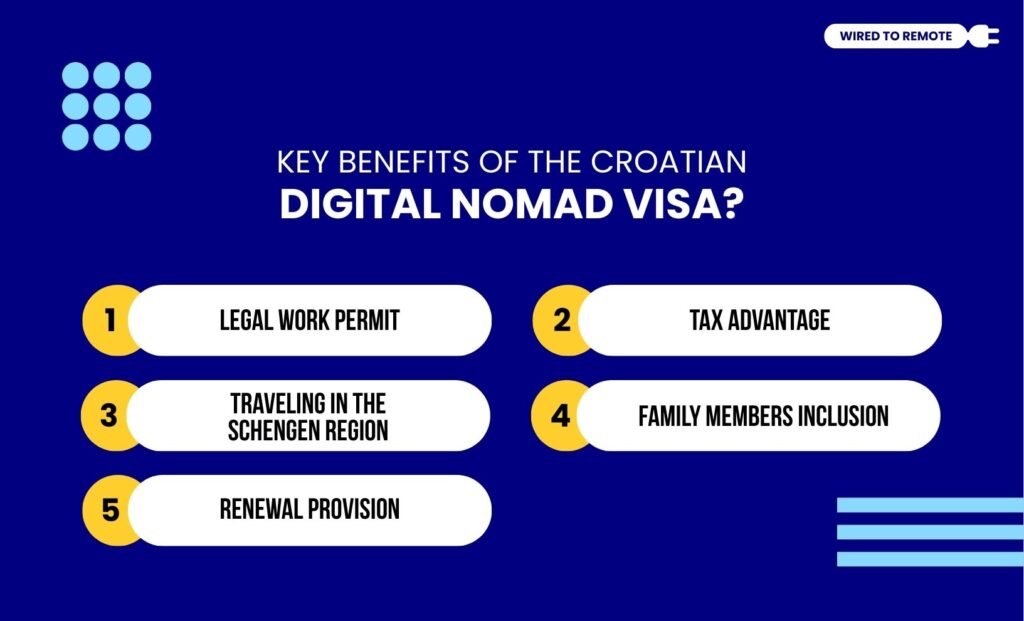
Most of the popularity of the Digital Nomad Visa of Croatia lies in its massive set of benefits. So, some of these attractive benefits include—
1. Legal Work Permit
Unlike a tourist visa, the digital nomad visa allows the remote worker to legally work for foreign companies and clients. So, they can stay, explore the Schengen areas, and earn at the same time.
2. Tax Advantage
Moreover, the visa exempts the remote employee from all kinds of taxation policies. Since the visa doesn’t provide any citizenship opportunities, it excludes the income of the alien employee from the income taxation brackets.
3. Traveling In The Schengen Region
Additionally, with this single Croatian visa, remote workers or digital nomads get permission to travel across the 27 Schengen countries fully visa-free. So, they can travel and explore other regions as a non-EU/EEA resident with this permit.
4. Family Members Inclusion
Also, the Croatian Visa for digital nomads allows the family members and dependents of the visa holder. That is, they can bring their immediate family members along with them through the visa.
5. Renewal Provision
Finally, the most attractive benefit is its renewal provision. That is, it allows the visa holders to renew the visa before expiration and extend the stay period up to 18 months of time.
What Are The Eligibility Criteria For The Croatia Digital Nomad Visa?
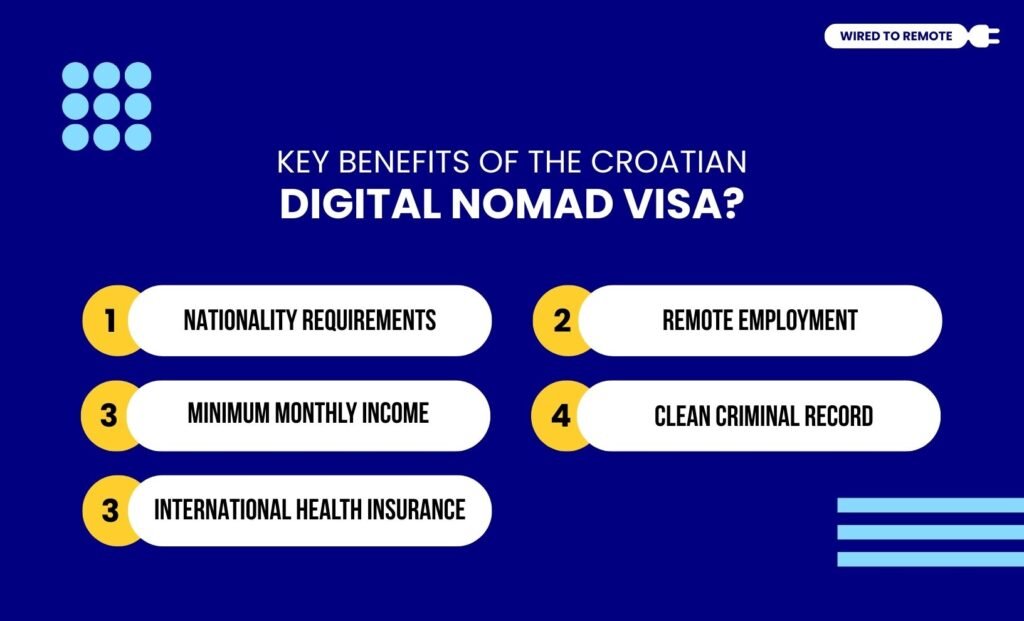
Given that the Croatian Visa provides travel permission for the Schengen areas, it comes with strict eligibility criteria. So, here are the eligibility criteria—
1. Nationality Requirements
Firstly, the remote employees need to be non-EU/EEA residents. Since the EU/EEA residents already have the rights and permissions to explore the Schengen region, this visa is available only for non-members.
2. Remote Employment
Moreover, it requires the remote workers to specifically work for foreign companies or clients. That is, they are technically forbidden to source their income from working for any local businesses or entities.
3. Minimum Monthly Income
Additionally, they need to earn a benchmark income to ensure they can sustain their livelihood in Croatia.
That is, the minimum monthly income of the visa holder should be HRK 17,300. But if they are bringing family members, for each member, the amount increases by 10%.
4. Clean Criminal Record
Moreover, the remote employee should have a clean criminal record. That is, it is specifically mentioned that the visa applicant cannot have any criminal convictions sentenced for 12 months or more.
5. International Health Insurance
Finally, the remote visa applicants should have international health insurance that covers most medical treatments and healthcare facilities in Croatia.
So, the remote worker can safely and comfortably live in Croatia without worrying about any sudden medical needs or emergencies.
What Are The Document Requirements To Apply For The Croatia Digital Nomad Visa?

Now, to apply for the Croatia Digital Nomad Visa, you need to keep some documents prepared. So, here is a list of the essential documents—
- Valid Passport: Firstly, the remote workers need to have a valid passport with at least 2 blank pages and 6 months of validity.
- Monthly Income Proof: Moreover, they need to provide monthly payslips, bank transactions, and other bank statements as income proof.
- Nationality or Identity Proof: Additionally, they have to provide official identification proof to show their citizenship and identity.
- Criminal Records: Also, a clean criminal record from the government must be included with the application form to ensure zero criminal convictions.
- Health Insurance: Moreover, a proper international health insurance should be provided that covers most of the medical facilities in Croatia.
- Temporary Residential Proof: Additionally, they need to provide proof of temporary residence in Croatia, like utility bills or a lease agreement.
- Remote Employment Details: Finally, they have to provide foreign employment contracts, client deals, and other remote work documents.
How To Apply For The Croatian Digital Nomad Visa?
With the documents prepared, you can apply for the Digital Nomad Visa of Croatia. So, here is the step-by-step guide to apply for the visa—
- Firstly, you need to prepare the essential documents and either go to the Croatian Embassy or visit the online Ministry of Foreign Affairs website.
- Then, you need to fill out the application form for the Croatian visa and attach the essential documents.
- After that, check the application fees and pay them along with the submission of the application form.
- Then, you need to wait for 4 to 8 weeks to get the approval after the processing of the application form.
- Finally, once the application is accepted, you will get the confirmation and the visa from the Croatian Embassy.
When countries are simplifying the digital nomad visa processes, what are you waiting for? Take this chance to make the dream of earning and exploring new places a reality.
Just choose one of the best digital nomad destinations, apply for the visa, and take the first flight to your dream place in a jiffy!
FAQs
Here, I have brought some of the frequently asked questions about the digital nomad visa in Croatia that most remote employees search for.
No. The Croatia Digital Nomad Visa is specifically designed for non-EU or non-EEA residents. Allowing them to work freely and reside in Croatia. Moreover, the EU/EEA citizens already have the rights and provisions provided under the visa. So, they don’t need to apply for this visa.
No. Since the Croatian digital nomad visa is designed as a temporary permit for remote workers to stay and work remotely in Croatia, it does not provide a future opportunity for permanent residency or citizenship. So, the workers can at most renew it and extend the stay for 18 months. But they cannot get permanent residency with this visa.
Yes, absolutely. Unlike other digital nomad visas, the Croatian one allows the remote employees to include their immediate family members— spouse or legal partner, minor children, and dependent adults. Just that, they can join the visa holder through the Family Reunification permit and mandatory health insurance for all the members.
Technically, overstaying the visa tenure can result in penalties. That is, if the remote workers or digital nomads overstay the extended period, they might be charged with fines, deportation, or even travel bans in the future. Also, they might be denied future visa permits for a long period of time. So, it is better to avoid overstaying the visa period.



Leave A Comment