
Quick Answer
To learn how to stay focused on a remote project, you must eliminate environmental friction, offload your scheduling to structured frameworks, and automate task tracking. Implement these five core actions immediately to protect your deep-work blocks:
- Build a dedicated workspace
- Apply time-blocking frameworks
- Centralize task tracking
- Enforce asynchronous updates
- Sanitize digital environments
Remote work has definitely changed the 9-to-5 work culture. In the current setup where a hybrid environment is the norm, office-bound working is not the only option anymore.
On the contrary, you not only can move but also change your working environment, set your own timetable, and work with people regardless of geography.
Yet, this convenience also comes at the expense of distractions. It is rather common for both digital nomads and hybrid workers to face challenges with attention and discipline, no matter where they are – at home or a crowded coffee shop.
So if you are determined to become effective in your remote job, stay on top of your things, and advance in your career over time, here’s what you can read!
By adopting good time-management habits, being exact with yourself, and getting hold of distractions from the web, you can be the one managing your working time.
And, in this way, not merely surviving but actually flourish in remote environments with flexibility.
What Makes Remote Project Focus So Challenging?
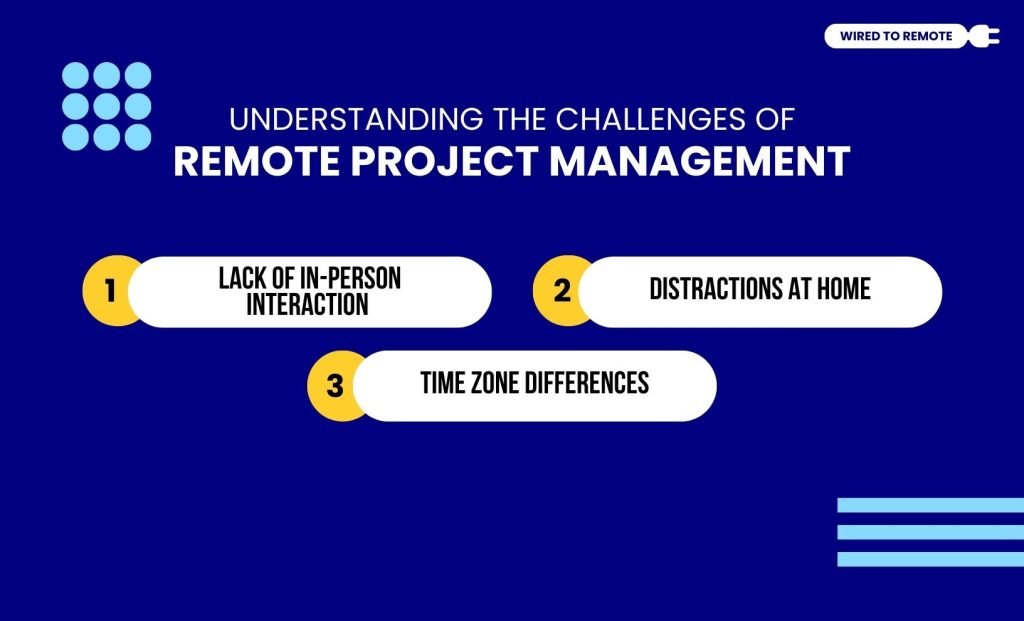
Before delving right into the best ways for staying organized and focused on your work, let’s try to understand the challenges of remote project management. It is evident that remote work management can have more challenges than traditional work because of limited communication options.
These challenges of remote work project include:
1. Lack of In-Person Interaction
It is not new that in a remote work culture face-to-face interaction is limited to video conferences and team meetings. There are no opportunities for in-person interaction in a remote work setting.
This lack of face-to-face interactions can often lead to miscommunication among the workers, which can cause chaos and confusion. Moreover, this confusion can affect your productivity by interfering with your organized work projects.
Additionally, you can lose focus when you are jumbled with unorganized projects and deadlines.
2. Distractions at Home
Another challenge for remote workers is the countless distractions you have at home. Yes, it is true. Even though the comfort of home is there in remote working, the distractions can affect your focus with your projects.
For instance, imagine you are handling a critical work project remotely, and suddenly your mother calls you from the other room. Your focus will shift from your project, and you will become curious why she was calling for you.
These kinds of distractions severely affect your focus and organized work projects.
3. Time Zone Differences
One more issue with remote project management is the time zone differences among colleagues. In a global work from home organization, people work from different locations and time zones remotely.
This creates a difference in the time zones of your fellow colleagues, which can affect the organizing of the remote projects.
For instance, one employee from Australia is working on a project at 10 in the morning. He needs some important details from the client to complete the work. However, the person handling the client communication lives in China and is not available at that time due to time zone differences.
As you can understand, this affects productivity and the smooth running of the work projects. Therefore, time differences can impact your focus as well as organized projects.
How To Stay Focused On A Remote Project?
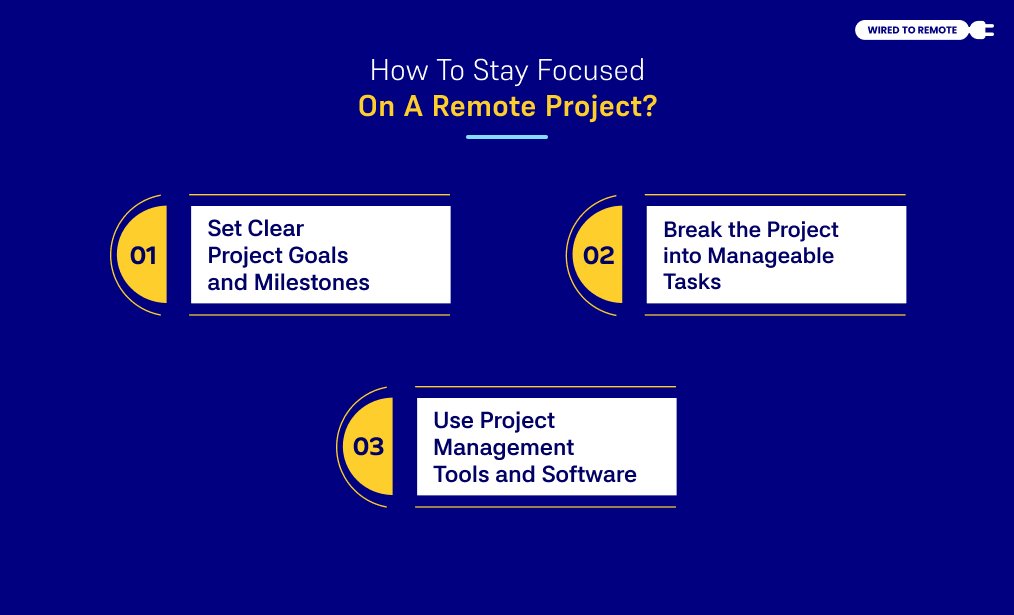
Now that you know about the challenges of remote project management, let’s delve into the key strategies you can use for staying organized.
1. Set Clear Project Goals and Milestones
To stay organized and focused, you need to set clear achievable goals for your projects. This will help you to set deadlines for your work and not let you feel overwhelmed.
Moreover, upon reaching the goals and milestones, you can treat yourself with some rewards to congratulate your efforts. This will keep you motivated to work and not lose focus while remotely working.
2. Break the Project into Manageable Tasks
When handling a huge project with multiple aspects, breaking them into manageable tasks can help you with organizing your work. Moreover, breaking the projects will help the managers to divide the work among the workers and manage the completion of the tasks.
Once you break the huge project into small manageable tasks, you can easily keep track of the progress of each task. This will help you to stay focused and organized with your work, even if you’re working remotely.
3. Use Project Management Tools and Software
Another useful tactic is to employ various project management tools and software for organizing your tasks. You can take the help of countless apps, like Trello or Asana, to break your tasks and keep track of their progress.
Moreover, with the proper management of your tasks via the tools and software, you’ll be more focused on work. As now you know which work is the top priority over which ones.
Time Management Techniques For Remote Projects
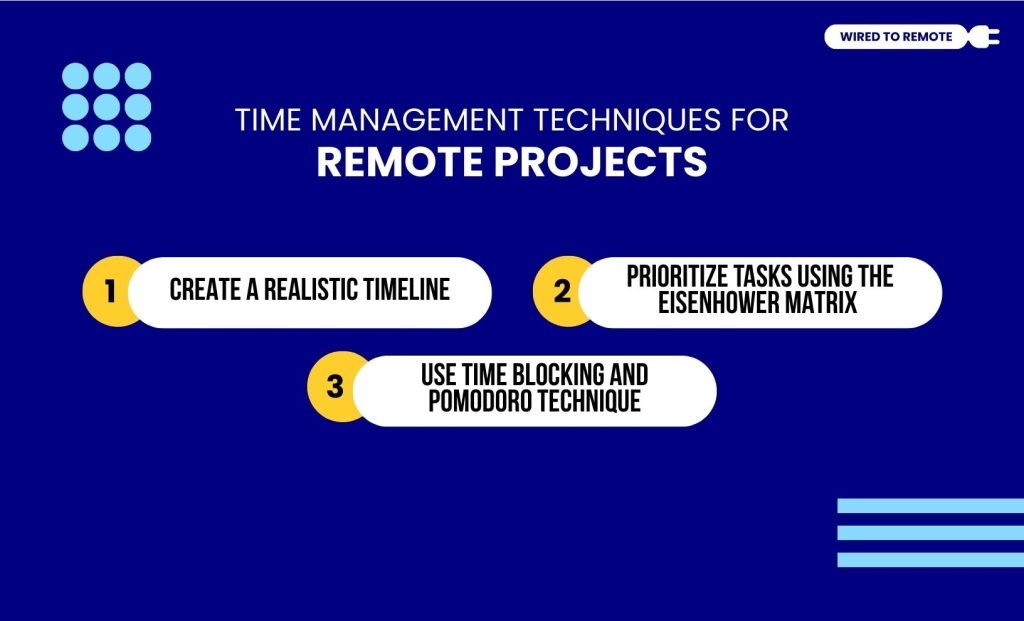
To further help you with your focus and organizing work, you can take the help of various time management techniques. These time management techniques are quite effective in managing remote projects.
Some of these techniques are:
1. Create a Realistic Timeline
You should make a realistic timeline for your tasks. The deadlines and progress period for your tasks should be mentioned in your timeline.
Moreover, this realistic timeline with your tasks will help you organize your tasks based on the priority. And, this will also let you focus on important tasks first and less important tasks later.
2. Prioritize Tasks Using the Eisenhower Matrix
If you want to stay focused and organized with your work, you need to know how to manage your time. You can use time management tools to identify the prioritized tasks from the less prioritized tasks.
For instance, the Eisenhower matrix enables you to formulate a timeline for your tasks and organize them based on their priority levels. Using this, you can easily focus on the important tasks first and later move on to less important ones.
3. Use Time Blocking and Pomodoro Technique
Another efficient technique is the Pomodoro technique and time blocking method. The two techniques slightly differ from one another; however, they are quite efficient in helping you manage your time for your work.
In the Pomodoro technique, you set a 25-minute work interval, followed by a 5-minute review session. And, in time blocking, you can flexibly keep time intervals based on the work nature and requirements.
In order to stay focused and organized, you can follow any of these techniques to manage your work.
Effective Communication For Remote Project Teams
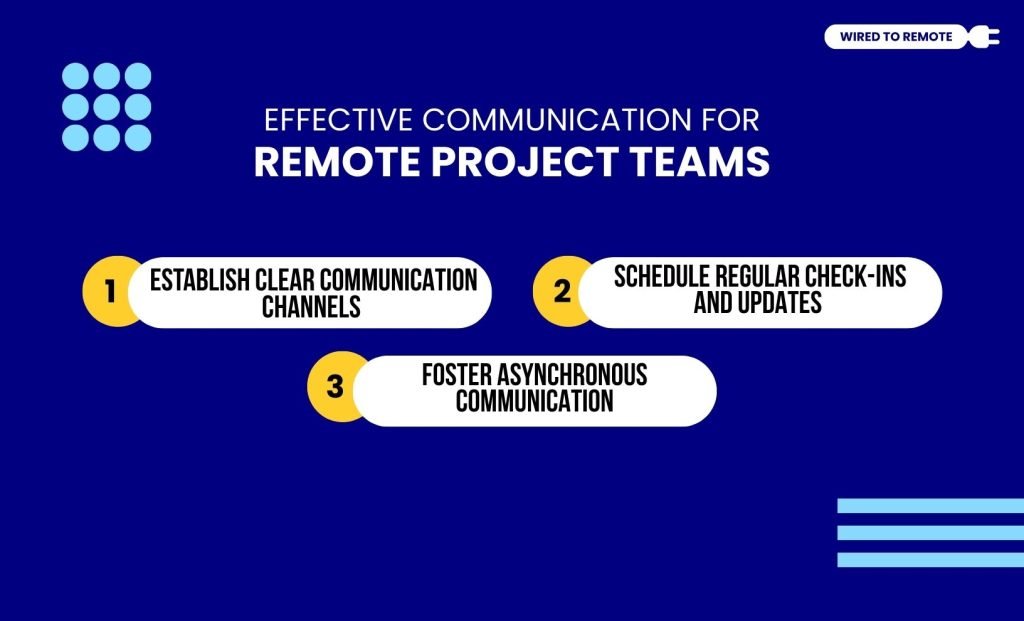
Effective communication is key to the success of remote work culture. So, it is essential to maintain effective communication between the employees for the successful execution of the remote projects.
To ensure that effective communication is maintained, you need to consider these:
1. Establish Clear Communication Channels
Your work-from-home organization should have proper communication systems and channels for workplace communication. Moreover, proper network connection and quality connectivity should be made available for better work communication.
In a remote work culture, you should try to maintain clear communication with your colleagues through these channels. Additionally, you need to ensure that effective workplace communication can be fostered, preventing any miscommunication.
2. Schedule Regular Check-ins and Updates
For the smooth working of the communication channels, the communication systems should be regularly updated and checked in.
Proper management and scheduling of updates for the communication technologies can help in maintaining the system functioning. Moreover, with updated technologies, you can easily communicate and organize your tasks and stay focused on your work.
3. Foster Asynchronous Communication
Another way to address the challenge of time-zone differences is by utilizing asynchronous communications, i.e., through emails or video and audio recordings that are delivered at a later time.
This helps in sending a message or piece of information from one person to another without the restriction of having to communicate in real-time.
Far away from the office, such a communication system also allows sharing information and delegating tasks to keep work running smoothly even without taking into account the variation in time zones amongst team members.
Staying Focused And Avoiding Distractions
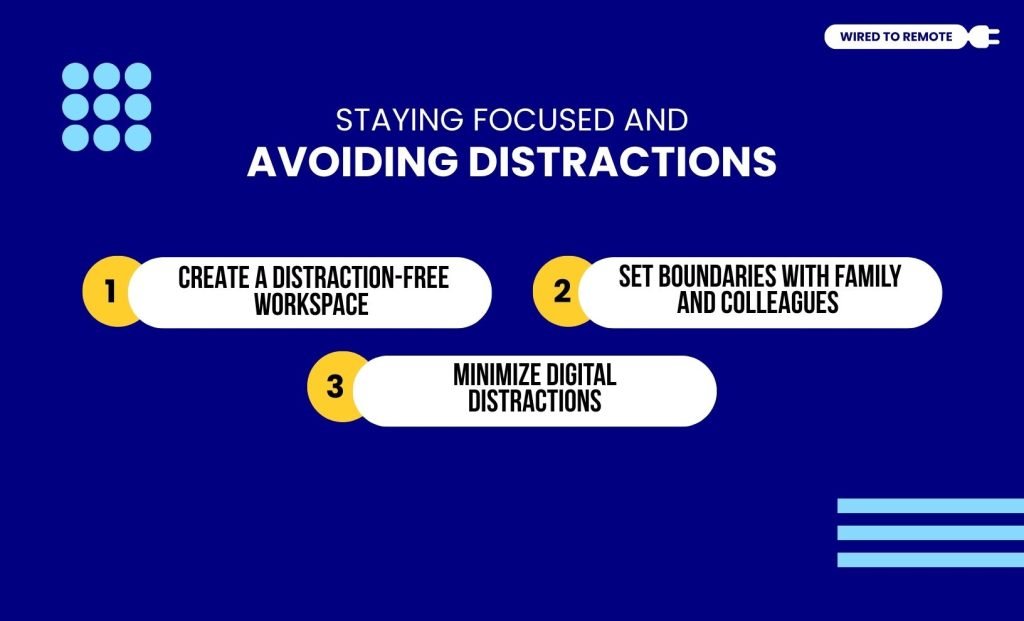
Finally, you have to employ certain habits to avoid being distracted with your surroundings in order to stay focused at work.
Some of these habits include:
1. Create a Distraction-Free Workspace
Dedicate your time to working only on the main things. So, it’s essential for you to have your work area that is quiet and doesn’t disturb you.
If you are not able to have your own office without being disturbed, it’s necessary to prepare your own place at home.
Besides, you are supposed to check that the place you are in has the appropriate mood for working without interruptions so that you can fully concentrate.
2. Set Boundaries with Family and Colleagues
When you are working, you need to create boundaries with your family, friends and colleagues. So that they do not interfere with your work and distract you with unnecessary chatter.
Furthermore, having boundaries during work hours can help you to get less distracted and keep your focus on work. This will help you to stay focused and organized at work.
3. Minimize Digital Distractions (Social Media or Email)
To keep a better flow and concentration while working, one should cut down on digital distractions.
When you disconnect from social networking and emails, it is easier to work with concentration.
In addition, turning off silent notifications and switching on the do-not- disturb function are ways of getting rid of these distractions.
The outcome of doing that is a reduction in the time and effort it takes to get your work done, plus it also allows you better time management at the workplace.
Tips And Tricks For Staying Organized And Focused On A Remote Project

Some tips and tricks for maintaining your focus in work are:
- Use project management tools like Trello or Asana.
- Set daily and weekly goals for progress tracking.
- Maintain a clear project scope and deadlines.
- Keep your workspace clean and organized.
- Regularly update your project documentation.
- Use shared calendars for team synchronization.
- Implement regular feedback loops for better clarity.
- Take breaks to recharge and avoid burnout.
Overcoming The “Isolation Loop”: The Psychological Impact On Remote Focus
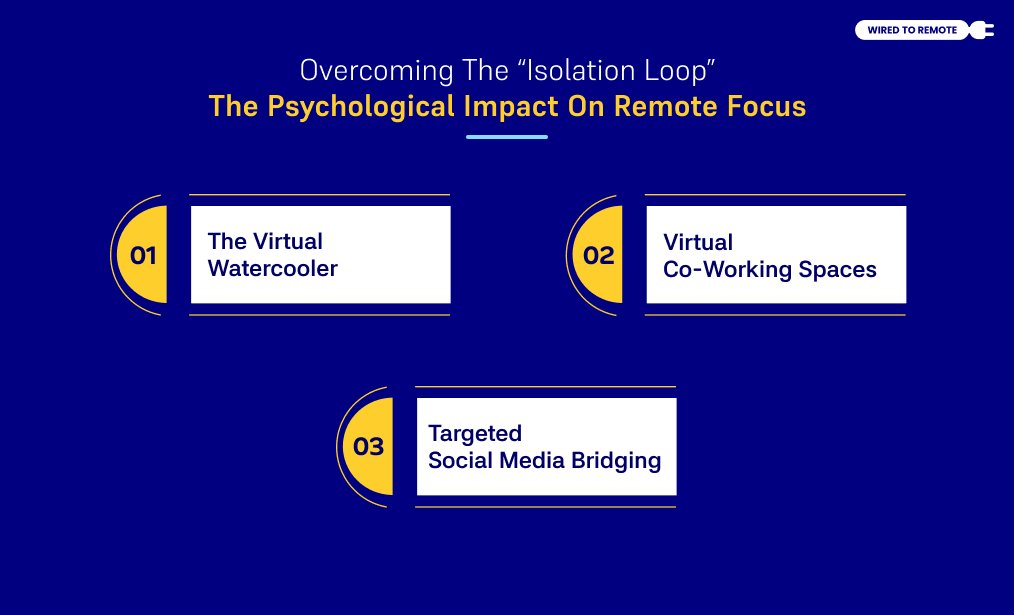
A massive blind spot in generic productivity advice is ignoring the psychological toll of location independence. Many professionals assume that learning how to stay focused on a remote project is purely a matter of time tracking and calendar scheduling.
However, when digital nomads feel socially isolated, their internal motivation drops, directly fracturing their cognitive endurance.
According to data published by Forbes, remote work explains a third of the recent rise in societal isolation and mental distress.
Furthermore, research utilizing the U.S. Household Pulse Survey found that a high frequency of remote work exceeding three days per week significantly increases the likelihood of chronic loneliness.
When your brain experiences isolation, it registers a threat response that lowers cognitive performance, making it nearly impossible to maintain deep focus on a complex client deliverable. [Source: PubMed]
To break this isolation loop and protect your workflow, you must implement psychological safeguards alongside your standard productivity tools.
The Virtual Watercooler:
Work with your project manager to set up optional 15-minute daily or weekly check-ins with your team. These blocks must remain completely unrelated to work deliverables
Building a basic human connection with your peers lowers professional anxiety and boosts your dedication to the shared team outcome.
Virtual Co-Working Spaces:
If you are traveling solo, leverage digital accountability platforms like Focusmate or Caveday.
These platforms pair you with another professional globally via a live, muted video feed for 50-minute blocks.
The simple psychology of being “seen” working completely transforms your ability to avoid tab-switching and stick to your project timeline.
Targeted Social Media Bridging:
A recent study on digital nomad loneliness published in Media, Culture & Society highlights that successful nomads proactively combat isolation by using niche platforms. Leverage localized Slack channels, Meetup groups, and expat forums to build bridging social capital.
Intentionally scheduling physical, in-person social interactions after your work hours gives your brain a concrete reward to look forward to, helping you stay disciplined during active deep-work windows. [Source: Sage]


Leave A Comment