

Today’s topic of dicussion: How to build relationships with remote teams?
When I first started working as a content marketing professional, I was assigned to manage a large and complex recovery project. The project’s success depended largely on the coordination amongst a team working remotely.
My first week as the content lead was a complete mess. The compressed timelines and the lack of effective communication amongst the team made things chaotic. As a solo remote freelancer, things have mostly been smooth for me professionally. But this was new.
Trust is the foundation of any professional relationship. The three elements that form trust – connection, reliability, and credibility – comprise the base of creative, flexible, and practical teamwork.
And my team lacked trust – the remote working environment made it difficult to form the elements that makeup trust.
For the next few weeks, I had only one goal – to figure out how to build relationships with remote teams.
As modern managers, we have a dynamic job role, and human relationships are one of them. Investing in relationship building with team members

• improves collaboration,
• boosts teambuilding,
• builds communication, and
• creates a productive, solution-driven working environment.
In this article, I’ll discuss the strategies that helped me cultivate strong, lasting relationships with my remote colleagues. You can implement my strategies and figure out how to build relationships with remote teams.
Stay tuned.
How To Build Relationships With Remote Teams?
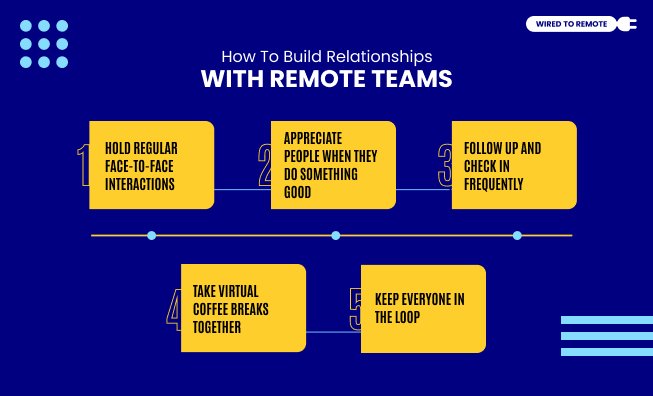
The question of the hour is: how to build relationships with remote teams?
Here are 5 easy yet very effective techniques to help you build relationships while working with remote teams. Moreover, taking these steps shows that you value your colleagues – it builds trust amongst team members, boosting the overall productivity and quality of work.
- Hold regular face-to-face interactions.
- Appreciate people when they do something good.
- Follow up and check in frequently.
- Take virtual coffee breaks together.
- Keep everyone in the loop.
1. Hold Regular Face-To-Face Interactions:
This tip is groundbreaking. Getting people on board might take a little longer, but it works. Whenever possible, opt for face-to-face interactions and video calls. Even if they turn their video off, let your team see you – smile often and encourage conversations.
I think this is vital for building relationships with my remote team. We don’t get to spend time together or interact much. So, finding out that one of my designers is a talented painter or that the SEO head has a pet cat curled up while she works helps me know my colleagues in ways audio calls would never allow.
Moreover, seeing your colleague’s face and working environment, instead of hearing only their voice, actually fosters a meaningful connection and boosts likeability – the Mere-Exposure Effect.
In addition, face-to-face interactions reveal body language cues, facial expressions, and quirks in a remote working setup. It also creates the space for building intimacy in working relationships, boosting overall productivity and project health.
2. Appreciate People When They Do Something Good:
Appreciation can go a long way in building professional relationships, even in a remote environment.
The idea is simple – you have to ensure that your team knows you appreciate and value what they bring to the table. So, when someone does something good, shed light on the same.
Point out what was done right, agree with some feedback, or just say, ‘good point.’ It is as easy as leaving a cute emoji under someone’s text on Teams.
Moreover, people will open up to you more when you take a few minutes to be optimistic about what they said or did instead of adding your opinions to the mix.
It is also important to show people that you are actually listening to them – it shows that everyone’s presence is vital for the smooth functioning of daily operations.
3. Follow Up And Check In Frequently:
This is imperative if you want to find out how to build relationships with remote teams.
You will always come across people who don’t speak much, especially during conference calls and group discussions.
These are also the same people who will need extra attention – you have to ensure that they know you hear them, too, even if they are not the loudest in the room.
Moreover, you can ask these team members, ‘how is your day going?’ or ‘how do you think the meeting went?’ or ‘What are your thoughts on this?’ Usually, asking people about their feelings and thoughts makes them feel heard and valued, reinforcing trust and a healthy, productive working relationship.
4. Take Virtual Coffee Breaks Together:
Working remotely can impart a sense of being ‘online’ all the time. So, you need to ensure your team does not get overwhelmed. You can spread optimism and allow people to talk about their personal lives while working.
In addition to letting your team get to know each other, you can schedule coffee breaks where the team can just relax together over a cup of coffee and conversation. You can also have quick celebrations – work anniversaries, birthdays, or other significant life events.
People can build trust when they can develop a warm personal relationship in a productive working environment.
Moreover, you should also remember that your team could be stressed about work or their personal lives. So, checking in quickly and asking a simple ‘how are you?’ can go a long way towards relationship building.
5. Keep Everyone In The Loop:
Finally, it is of utmost importance to remember that you cannot make assumptions about anyone, especially when working remotely. You don’t know these people in real life. So, don’t assume anything about a person’s situation, identity, and priorities.
Instead, consider asking questions – try to learn things about them and understand them as a person.
Keeping your team in the loop is also important – it could damage trust amongst team members if some colleagues are not updated with the latest observations on a certain project. If you let such feelings grow, it will harm the productivity and communication in the team.
So, ensure that you are looping in your team on personnel moves, strategic choices, logistical changes, and other major events (of course, when appropriate – nobody is asking you to share confidential information).
Why Is Relationship Building In A Remote Working Landscape Important?

It is vital to build relationships with your remote team – and not just your remote team, but also your clients.
When you can form alliances with stakeholders, you are basically ensuring that your work will have more credibility. Moreover, any difficult conversation you might need to have with the same stakeholders soon will be much easier.
When you communicate with empathy and intention, you build relationships with people with thoughts, opinions, personal interests, and feelings.
These are not just resources doing their jobs. Even if you use digital communication to build relationships, you will see that people will be happier and work will be productive. The chances of success will increase – for you, your team, and all stakeholders.
Why Is It Important To Build Relationships In A Remote Working Landscape?

• Boosts productivity.
• Fosters collaboration.
• Improves mental health and overall well-being.
• Increases employee engagement.
I have seen this happen often – simple actions can make a huge difference in the professional landscape. Building relationships might now always yield tangible results – but it always has an optimistic impact on the bottom line of your project.
The first time I gave relationship building a shot, everyone I had worked with reached out to me personally once we had launched the project. And after that, I have always prioritized building relationships with my remote teams.
How To Build Relationships With Remote Teams: Challenges Encountered

Working remotely undoubtedly gives you more flexibility, a healthy work-life balance, and reduced expenses. Yet, at the same time, many people start feeling lonely while working remotely.
So, it is fair to deduce that a remote working landscape has challenges, especially in cultivating and nurturing professional relationships.
The Challenges Of Virtual Relationships:

• Absence of non-verbal cues.
• Misunderstandings and miscommunication.
• Lack of trust.
• Feelings of loneliness and isolation.
While figuring out how to build relationships with remote teams, I faced a set of challenges that I came across.
1. Communication Barriers:
Remote work can entirely transform your experience of engaging with people. We are all aware that communication is not just made up of spoken words. It is also about facial expressions, body language, tone, and more.
Moreover, while collaboration tools suited for remote workers are convenient – the truth is they fail to replace real-life interactions.
In addition, digital tools can make communication less impactful – technological issues can affect the quality of conversation. Moreover, you can also experience a lack of clarity while communicating with digital tools.
2. Less Interaction Amongst Team Members:
When you work in an office – you get to know people. You attend the same event, share the same lunch hour, and go on breaks – plenty of opportunities to interact and bond with your colleagues.
But the same stuff does not happen easily in a remote working landscape. You only spend time with your team when you are in a meeting or working together on a project – it fails to create the same kind of experience.
Moreover, your chances of networking and connecting with people from other teams are reduced. This, in turn, ultimately harms your ability to collaborate with teams from different departments.
3. Lack Of Face-To-Face Interactions:
The absence of face-to-face interactions is perhaps one of the most challenging aspects of working remotely. In a workplace, informal socializing, spontaneous conversations, and non-verbal cues form a major part of professional relationships.
For instance, going on coffee breaks together or having small conversations by the water cooler often leads to the start of meaningful relationships at work.
On the contrary, when you work remotely, the same opportunities diminish – making your team miss out on bonding opportunities.
Building Social Capital: Remote Networking Strategies For Newcomers And Nomads
For those moving every month, social capital – the value of your professional network—is your most valuable asset. Since “hallway collisions” don’t happen online, you must be a deliberate architect of your network.
Remote Onboarding Best Practices: Combating the Connection Gap
Newcomers face a steep climb: 53% of remote workers struggle to connect with peers. Instead of waiting, newcomers must actively seek a “peer mentor.” This simple step is proven to increase job satisfaction by over 30% in the first 90 days
Digital Nomad Community Building: Networking as an Economic Driver
There are now 35 million digital nomads contributing $787 billion to the global economy. However, the “short-stay” curse leads to isolation.
Specifically, nomads who join coworking hubs are 3x more likely to find new clients through word-of-mouth than those working from hotels. In the nomad world, your network is literally your net worth.
Task-Based Trust: How to Build Credibility in the First 90 Days
Reliability must come before friendship. In a remote environment, your “responsiveness” is your reputation. Therefore, focus on being a reliable “node” in your first three months.
By hitting every deadline, you build the foundation for long-term relationship trust that leads to promotions and higher pay.
Why Team Building Through Remote Networking Is A Business Strategy

Building relationships isn’t just “feel-good” fluff. It is a calculated move to protect your bottom line. High-trust companies consistently outpace their competitors in productivity and retention.
1. The Productivity Premium: Why Connected Teams Earn More
According to Gallup, employees who have a “best friend at work” are seven times more likely to stay engaged. This connection directly impacts your wallet – highly connected teams see a 21% increase in overall profitability. Relationships act as the necessary “grease” in your company’s production gears.
2. Solving the Remote Retention Crisis: Reducing the “Loneliness Tax”
Isolation is expensive. The 2024 State of Remote Work report found that 1 in 4 remote workers struggles with loneliness. This is a primary driver of turnover.
Consequently, companies that invest in virtual relationship-building see a 25% reduction in employee churn.
3. The Trust Dividend: Lower Stress and Higher Innovation
Research from Harvard Business Review shows that people at high-trust companies report 74% less stress and 106% more energy at work. Instead of micromanaging, these companies focus on connection. Thus, they spend less time “policing” staff and more time hitting targets.



Leave A Comment