
Let’s start with a simple truth.
People don’t experience your brand all at once. They experience it in pieces.
- A homepage visit.
- An Instagram post.
- An email subject line.
- A reply to a comment.
Each of these moments feels small. But together, they form a pattern. And that pattern becomes your brand in the customer’s mind.
That pattern is brand communication.
Most businesses treat it like a surface-level activity. They focus on campaigns, taglines, or the occasional “big idea.”
But the real work is quieter and more consistent.
It sits in everyday choices – the words you use, the tone you repeat, and the clarity you maintain when no one is watching closely.
What Brand Communication Actually Is (Beyond The Definition)?

At its core, brand communication is not just what you say. It is how clearly and consistently you say it over time.
Moreover, it answers three basic questions for your audience:
- What is this brand?
- Is it for me?
- Can I trust it?
So, if your communication fails at any of these, everything else struggles.
Think about Apple. Their messaging rarely explains features in depth at first glance. Instead, it focuses on experience, simplicity, and control.
Over time, that repeated focus builds a very specific perception.
Now compare that with Nike. The message is not about shoes. Instead, it is about effort, identity, and pushing limits. Moreover, the product sits inside that larger story.
Both brands are clear. Both are consistent. Also, both understand what they want to be remembered for.
That is the real job of brand communication. Not just to inform, but to shape memory.
Why Brand Communication Is Not Optional?
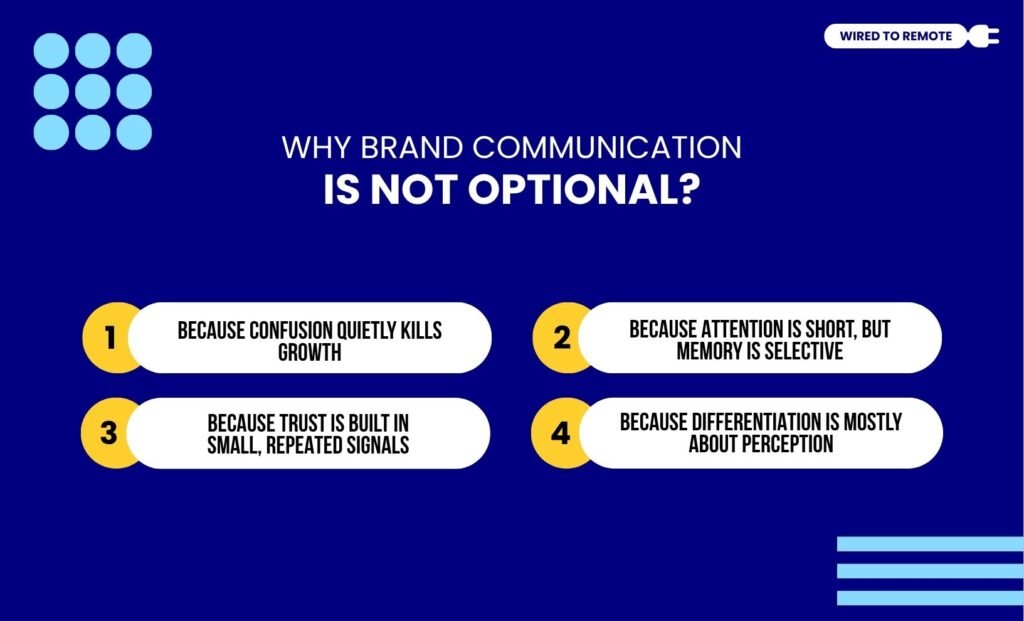
Let me make one thing very clear – brand communication isn’t really optional, it’s essential. And in this section, I’m going to break down why.
1. Because Confusion Quietly Kills Growth:
A user lands on your website. They scroll for ten seconds. Then they leave.
Not because your product is bad, but because they could not quickly answer: “What does this brand actually do for me?”
Moreover, confusion rarely shows up in reports. You won’t see a metric called ‘unclear messaging,’ but it shows up in bounce rates, low conversions, and poor recall.
Clarity is not a nice-to-have. Instead, it is a growth lever.
2. Because Attention Is Short, But Memory Is Selective
People see hundreds of messages every day. Most of them disappear instantly – only a few stick.
What makes something stick is not creativity alone. Instead, it is consistency. When a message repeats in slightly different ways across platforms, it starts to feel familiar.
Moreover, familiarity builds comfort, and comfort increases the chance of action.
As a result, without consistent communication, every interaction feels like the first one. You keep reintroducing yourself. That slows everything down.
3. Because Trust Is Built In Small, Repeated Signals:
Trust does not come from a single campaign.
Instead, it builds when:
- Your website says one thing, and your product delivers the same.
- Your ads promise something, and your emails follow through.
- Also, your tone stays steady, even in customer support.
When these signals align, people stop questioning you. That is when decisions become easier.
4. Because Differentiation Is Mostly About Perception:
In many markets, the actual product gap is small. So the decision shifts.
Moreover, people choose based on:
- Which brand feels clearer?
- Which one feels more relevant?
- Also, which one feels easier to understand?
That feeling comes from communication, not features alone.
What Strong Brand Communication Looks Like In Practice?
This is where most advice becomes vague. So let’s break it down into real, usable parts.
1. A Clear Core Message That Does Not Try To Do Too Much
Most brands try to say everything at once. That creates noise. Moreover, a strong brand picks one central idea and builds around it.
For example:
- Not “we offer marketing, tech, consulting, and growth solutions.”
- But “we help small businesses get consistent leads without ads.”
One is broad and forgettable. The other is specific and easy to hold. Also, understand that clarity often feels restrictive at first, but it makes your message sharper.
2. A Consistent Voice That People Can Recognize:
Your voice is not just tone. It is how you structure thoughts.
So, do you:
- Get to the point quickly?
- Use simple words or technical ones?
- Sound conversational or formal?
These choices should stay stable across platforms. Moreover, when your voice shifts too often, people cannot form a clear impression of you.
3. Messaging That Reduces Effort For The Audience:
Good communication feels easy to process.
It does not force the reader to:
- Decode jargon.
- Re-read sentences.
- Guess your meaning.
Instead, it guides them step by step. This is where many brands lose people. They assume the audience will “figure it out.” Most won’t.
4. Repetition Without Becoming Boring:
Repetition is necessary, but it needs variation. Moreover, you don’t repeat the same sentence.
Instead, you repeat the same idea in different forms:
- Posts.
- Case studies.
- Short videos.
- Testimonials.
Over time, the idea becomes familiar, even if the format changes.
5. Alignment Between What You Say And What You Show
If your messaging says premium, your visuals, pricing, and experience should match that. Moreover, if your tone is friendly, your customer support should reflect it.
Any mismatch creates doubt, and doubt slows decisions.
Where Most Brands Go Wrong?
These mistakes are common, and they are costly.
1. They Chase Cleverness Over Clarity:
A clever line might sound good internally, but if the audience has to think too hard, it fails.
Moreover, clear beats clever almost every time.
2. They Focus On Output, Not Coherence:
Posting regularly is not the same as communicating well. Moreover, you can publish every day and still feel inconsistent if your message keeps shifting.
Also, frequency without alignment creates noise.
3. They Speak From The Inside Out:
Many brands describe themselves from their own perspective:
- What did they build?
- How does it work?
- Why do they think it matters?
But the audience is asking:
- What problem does this solve for me?
- How does it fit into my life or work?
That shift in perspective changes everything.
4. They Ignore The “Unseen” Moments:
Not all communication is planned.
So, think about:
- A delayed response to a customer query.
- A confusing checkout message.
- Or even a cold email reply.
These moments shape perception as much as your main campaigns.
5. They Change Direction Too Quickly:
Brands often panic when results don’t come fast.
So they:
- Rewrite their messaging.
- Change their tone.
- Try a completely new angle.
This resets whatever familiarity they had built. Moreover, consistency needs time – without it, nothing compounds.
How To Improve Your Brand Communication (Without Overhauling Everything)?
You don’t need a full rebrand to see progress. Instead, you can start with these steps:
1. Simplify Your Main Message:
Ask someone outside your business to read your homepage. So, if they cannot explain what you do in one sentence, rewrite it.
2. Audit Your Last 15 Pieces Of Content:
Do they sound like the same brand? If not, identify where the tone or message shifts. And that is where you strike – find the gap and fix it.
3. Remove Unnecessary Words:
Look for phrases that add length but not meaning. You just have to cut them. Also, simpler sentences are easier to trust.
4. Align One Key Journey:
Pick one path, like take your customer from ads to the landing page and finally to the email. Also, make sure the message stays consistent across all three.
5. Document Your Voice And Message:
Not in a complex brand book. But just a simple guide:
- What do we say?
- How do we say it?
- What do we avoid?
This helps your team stay aligned.
Brand Communication Is Essential: Grasp It, Don’t Ignore It!
Brand communication is not about sounding impressive. Instead, it is about being understood, remembered, and trusted.
Moreover, that only happens when your message is clear, your voice is steady, and your intent stays consistent over time.
Also, most brands try to do more. As a result, the better ones focus on saying less, but saying it well, and that is what people remember.



Leave A Comment