
Porto is a European city that gets under your skin fast. Consequently, it attracts a massive, vibrant digital nomad scene.
I have lived and worked remotely in this coastal hub as a market trends analyst. Therefore, I have watched Porto’s economic landscape shift firsthand.
Initially, I used to think, what is so different about Porto? What really attracts igotal nomads to choose this northwestern city in Portugal as their digital nomad destination?
Because, as per my research, Porto, as well as Lisbon, are some of the top ten European cities for remote work in 2026. (Source: The Resident)
And I found my answer once I went there. You see, the city pairs its historic architecture with exceptional remote-work infrastructure.
However, the town’s changing real estate market presents a major catch for budget travelers. Specifically, sudden price hikes in short-term rentals can easily derail your financial planning. Therefore, you cannot simply wing your expenses if you want to protect your bank account.
You actively need a realistic, data-backed budget.
In this blog, I bring to you the ultimate breakdown of the cost of living in Porto as a digital nomad.
Therefore, keep reading!
Cost Of Living In Porto At A Glance (2026 Metrics)
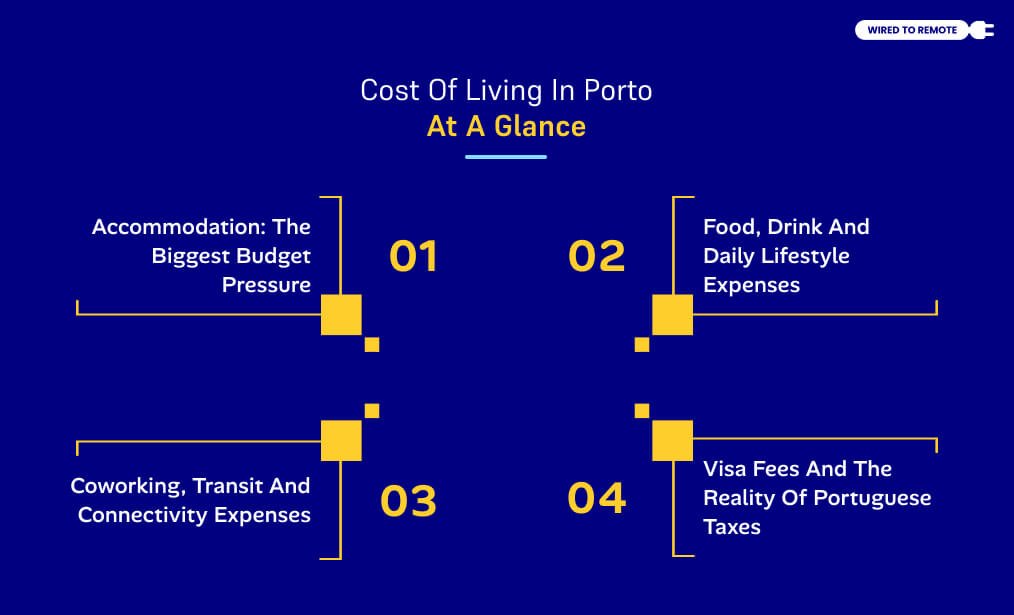
You must understand exactly where your cash goes to budget effectively. According to macro market data, the absolute baseline cost of living in Porto for a local sits around $1,143 per month.
However, a solo digital nomad moving through the city with a mid-range lifestyle faces an aggregate cost of living in Porto of roughly $3,102 per month.
In comparison, traditional expats who establish long-term roots manage a lower average of $2,062 per month. Naturally, these ranges depend heavily on your accommodation choices and tax status. (Source: Nomads)
| Nomad Metric | 2026 Market Cost (USD) |
|---|---|
| Cost of Living (Nomad Baseline) | $3,102 / month |
| Cost of Living (Long-term Expat) | $2,062 / month |
| Cost of Living (Local Baseline) | $1,143 / month |
| Cost of Living (Family of Four) | $4,001 / month |
| Median Home Purchase Price | $308,505 |
Accommodation: The Biggest Budget Pressure
Rent represents your primary financial hurdle in northern Portugal. In fact, I flag housing as the most volatile variable in your macro-budget. Furthermore, the cost of living in Porto shifts dramatically based on your neighborhood and booking strategy.
You will easily fork over a median price of $1,044 per month for a basic 1-bedroom studio apartment right in the city center. This is because short-term tourist platforms have aggressively pushed up real estate prices over the last few years.
For example, a short-term Airbnb reservation (7 days) gives a high median price of $91.00 a night, which would sum up to $2,765.00 on a monthly basis.
Alternatively, an extended hotel stay gives a median price of $79.00 a night. This would total to $1,690.00 per month.
To make good use of your budget, try to look towards the eastern side! Here, you will find residential areas like Bonfim. Additionally, you may also go over the river and into Vila Nova de Gaia.
I lived in Bonfim during my stay. As a result, I realized that settling there allows you to escape the central city premiums.
Moreover, you should bypass standard daily platform rates entirely. Instead, actively book monthly via local coliving operators or sublet directly from residents. Consequently, you will slash your housing costs closer to local benchmarks.
Food, Drink And Daily Lifestyle Expenses
While accommodation strains your wallet, the local culinary scene gives your bank account a massive break. Indeed, the thing nobody tells you about Porto is how cheap eating out still remains.
If you want to enjoy a sit-down dinner at a standard restaurant, you will spend an average of just $12.
Typically, your casual daytime drinks and laptop-friendly café runs will not break the bank either. For example, I tracked these specific everyday retail prices during my daily work routine:
- Standard cup of coffee in a café costs $1.16.
- 0.3L bottle of Coca-Cola runs $1.16.
- 0.5L draft beer in a local pub sets you back $2.33.
Clearly, this local math makes the overall cost of living in Porto highly attractive. Furthermore, cooking at home slashes your expenses even more.
Specifically, you should source your fresh produce at the historic Mercado do Bolhão on Saturday mornings.
Coworking, Transit And Connectivity Expenses
You must factor in infrastructure fees to run a seamless remote business. Fortunately, high-speed fiber internet comes standard in most apartments, easily delivering 200+ Mbps.
However, you might need a dedicated professional space to avoid home distractions. In that case, a premium coworking space with a hot desk membership averages around $342 per month for full-scale commercial setups.
Regarding mobile data backups, do not rely on expensive international roaming. Instead, actively purchase a local physical SIM or eSIM on day one. For instance, setting up a local mobile data plan averages about $30 per month for standard 10GB+ packages.
Consequently, you get a cheap, reliable hotspot whenever you work from local laptop-friendly spots. Additionally, getting around town is very affordable. An average taxi or rideshare trip covering roughly 3km (2 miles) costs just $3.49 per trip.
Visa Fees And The Reality Of Portuguese Taxes
When starting up from outside the EU, you should include regulatory costs and fiscal situations in your startup capital. Recently, the Portuguese government increased the minimum salary stipulated to €920/month.
Because the popular D8 Digital Nomad Visa requires four times the minimum wage, you must prove a stable income of at least €3,680 per month to qualify.
Beyond the income threshold, you must prepare for heavy fiscal liabilities if you become a tax resident without proper planning.
According to national brackets, Portugal applies steep progressive tax rates. Here’s how the estimated tax bill looks for specific income brackets:
| Salary Bracket | Tax Estimation |
|---|---|
| $50,000 | $21,514 |
| $100,000 | $52,994 |
| $250,000 | $145,334 |
Therefore, I highly recommend consulting a certified international tax professional before staying past the 183-day threshold. As a result, you can properly evaluate special tax regimes to shield your global revenue.
The Hidden Costs: Heating And Damp Winters

As an analyst, I must highlight the hidden financial drains that most lifestyle bloggers completely ignore. Specifically, Porto’s winters are notoriously wet and chilly.
Besides, there’s the task of managing high electricity bills.
Older Portuguese buildings tend not to have any central heating or modern insulation. That means apartments are generally very damp.
That means huge electricity bills when you run space heaters all day long. You should expect to add around $80 to $150 onto your utility bill for this winter.
Finally, if you do not check to make sure that the apartment is built properly for adequate heat before you sign the lease, your dampness will ruin your comfortable lifestyle.
Final Verdict: Is Porto Worth It For Digital Nomads?
In the end, expensive rental prices and aggressive tax curves make Porto an absolute bargain for remote workers.
In reality, our unmatched internet, crime-free streets, and mind-blowingly cheap $12 dinners stack up to an unbeatable lifestyle investment.
Honestly, just avoid the tourist traps, and you can be an affordable nomad here with ease.



Leave A Comment