

The topic of the day: Digital nomad visa France!
Working from a lovely café in Paris or a bright villa in Nice was always something that required overcoming a whole lot of logistical problems.
Maybe you put the long-stay visas and the never-ending papers into your mind, and I have to say, it can be really confusing!
Typically, you would just get a tourist visa, try to convince a remote job to a doubtful officer, and keep your fingers crossed!
However, it is 2026 now, and things have completely changed. France has finally decided to give remote workers a break.
They are giving digital nomads exactly what they have been craving: a hassle-free experience.
Whether you are coding for a big tech company in New York or freelancing for European clients, getting a digital nomad visa in France is now more straightforward than ever.
This is exactly the way you can make the “Land of Liberty” your personal workplace this year.
Digital Nomad Visa France: Quick Facts At A Glance
| Visa Length | Up to 1 year |
| Possible to Extend | Yes, typically renewable as a residence permit |
| Minimum Income Requirements | Around €32,000 – €35,000 EUR per year |
| Time for Visa Applications | Typically 15 – 30 working days, though it can take longer depending on the consulate |
Digital Nomad Visa France: Navigating The VLS-TS Visiteur (The Official Path)
Frankly, France ranks among the premier countries for digital nomads.
If you’re thinking about spending a year in France (or even longer), you’ll probably need the VLS-TS Visiteur visa (which is the long-stay visa that also acts as a residence permit). Consider this your “gold standard.”
With this permit, you prove that you can financially support yourself. Also, you don’t have to get a local job in France. This contrasts with the old short-term tourist entries.
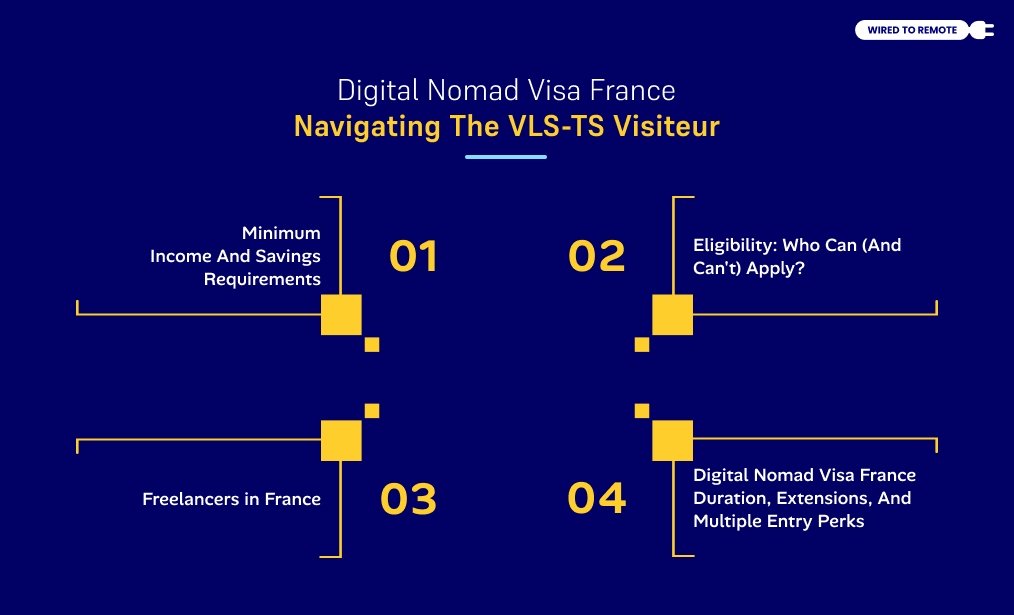
A. Minimum Income And Savings Requirements
The French government prioritises experienced professionals when issuing this type of permit.
However, how do you get one of these? You will be required to demonstrate that your minimum yearly income is sufficient.
This figure is linked to the minimum wage in France (SMIC), which is roughly 32-35 thousand euros.
Besides that, you will have to show through a personal bank statement that your funds have been stable over a long period.
Actually, your bank statement will be the proof that you are not financially dependent on the state. Normally, the stability should be over the last 3-6 months.
B. Eligibility: Who Can (And Can’t) Apply?
France’s digital nomad visa is only for those who carry out their work abroad, in other words, whose companies are registered outside France.
Nevertheless, if your local payment is via a French branch of your foreign employer, you do not qualify for the nomad visa.
Therefore, you will have to obtain a regular employee work permit.
Furthermore, from the beginning of 2026, non-EU/EEA nationals will have to submit their visa applications through their local consulates (this also applies to U.S., U.K., and Australian citizens).
Alternatively, EU citizens can reside and work in France without a specific visa.
C. Freelancers in France
Do you have a freelancing lifestyle in mind that would allow you to work remotely from Paris? Well, if that’s you, I have some essential information for you!
The idea of setting up a working station in a beautiful park or even a cafe seems really enticing. However, the visa regulations for digital nomads in France are quite complicated.
To begin with, France does not have a nomad visa. Most people, in fact, get the Profession Libérale (self-employed) visa to stay longer.
Remote work for foreign clients is no problem at all. On the other hand, if you were to work locally or serve French clients, then you might also have to either form a business or pay local taxes.
In fact, this is why, for example, local freelance activities such as workshops or direct social media management are illegal if conducted without proper documentation or registration.
The main requirements and restrictions are as follows:
- No Separate Visa: Remote workers do not have a dedicated “auto-entrepreneur” (simplified freelancer) visa.
- Income Restrictions: If you do not register a business as a French entity, you cannot earn money from French sources.
- Permitted Work: Your clients should be foreign.
- Financial Means: Typically, applicants demonstrate financial means of about $3,545 per month.
- Other Options: You can become self-employed with the Profession Libérale visa.
At the same time, the Passeport Talent is for certain highly skilled projects that help France remain economically attractive.
- Up to 90 Days: Non-EU nationals can work remotely for up to 90 days (for some nationalities, no visa is required).
D. Digital Nomad Visa France Duration, Extensions, And Multiple Entry Perks
The digital nomad visa in France (VLS-TS) has been criticised and has sparked controversy, but one of its biggest advantages is definitely its versatility.
At first, it is valid for one year and, normally, can then be renewed for a second year or converted into a temporary residence permit.
Because it is a residence permit, you also get a Multiple Exit Re-entry Permit.
To put it simply, this allows you to take a short trip to a nearby country, such as Italy, or even return to your home country for the holidays without risking your visa being revoked.
Alternative Visa Paths For Remote Workers In France
Not everyone hits that specific salary level, and that’s fine. There are other ways to legally experience the French lifestyle from a money and time perspective.
A. Short-Stay Schengen Visa: Ideal For Brief Visits
Schengen Visa is still the number one option for freelancers and those “exploring” the country. It gives a 90-day stay allowance period within 180 days, so you could be in for about 3 months in total.
The tricky part: it’s quite often a one-entry or a limited-entry visa, depending on your nationality.
If you take a short break outside the Schengen zone, your digital nomad visa for France remains valid, and you should watch your 90-day limit.
B. The 4-Year “Talent Passport” Vs. The Nomadic Visa Legend
Probably, you came across the news of a “special 4-year nomad visa.” Actually, this is mostly the Talent Passport (Passeport Talent).
Even though it offers a 4-year period, it needs a very big professional engagement, generally a top-level artistic, technological, or innovative business project that would have a positive impact on France’s economy.
As far as nomads are concerned, the VLS-TS Visiteur is the most practical option for bringing a long-term perspective.
The 2026 France Tax Guide For Digital Nomads
We should discuss the big issue for remote workers: taxes.
The French tax department (DGFiP) was made to be very closely connected with immigration data by 2026.
A. 183 Day Rule And Tax Residency
In France, you are usually regarded as a domestic tax resident if you are present in the country for more than 183 days in any one calendar year, or if the country is considered your “center of economic interests”.
While you are there, your principal home should be in France; therefore, you will be a French tax resident.
After being in France for more than 183 days, the individual must register for a tax number (SPI) and declare worldwide income.
B. Foreign Sourced Income vs. Local Taxation
Here is the good news!
Under the French digital nomad visa (VLS-TS Visiteur), if you earn all your income outside France and your stay is below the residency limit, you are generally not subject to French taxation on that income.
On the other hand, if you become a resident, you will probably have to use Double Taxation Avoidance Agreements (DTAAs) to make sure you are not paying tax twice, i.e., in your home country and in France.
Step-by-Step Application: How To Apply For Digital Nomad Visa France?
So, you want the dream of living and working from a café in Paris? Well, France does not have a standalone “Digital Nomad Visa” in name only, but they have a couple of very good options that will allow you to do just that.
Here is a very simple, human-to-human guide to applying for a Digital Nomad Visa in France (or at least the closest thing to it).
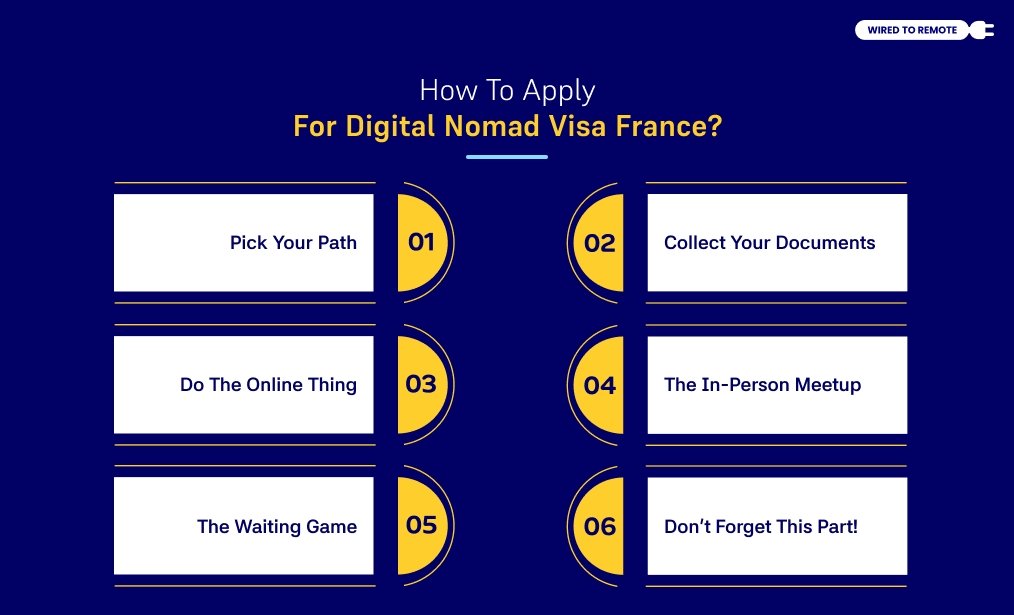
Step 1: Pick Your Path
First, you will have to decide which “vibe” fits your work:
- The “Visitor” Way: This is great if you work for a company abroad and just want to live in France. You will promise not to do any work for French companies while you are there.
- The “Freelancer” Way: Select this if you wish to set up a business or get French clients while living there.
Step 2: Collect Your Documents
Then you will need to put together some basic “proof” that you are ready for the move. Think of it as a checklist for a big journey:
- Money in your bank account: Present your earnings of at least €1, 400 to €1, 800 a month.
- A home base: You will need a lease agreement or at least a long-term Airbnb booking for the first few months.
- Insurance: Get travel insurance that covers at least €30,000 in medical costs.
- Proof of work: A letter from your employer saying that they allow you to work from France would be great.
Step 3: Do The Online Thing
Now, visit the official France-Visas portal. It’s very user-friendly!
You will register and enter your data, and the system will display the exact set of documents you need based on your place of residence.
Step 4: The In-Person Meetup
After you submit things online, you have to go to a visa centre (like VFS Global or a Consulate) in person.
- Smile for the camera: They’ll take your photo and fingerprints.
- Pay the fee: It usually costs around €99 for the visa itself, plus a small service fee.
Step 5: The Waiting Game
Then, you just wait. It usually takes anywhere from two weeks to a month to get the “Yes!” Once you get your passport back with that shiny visa inside, you’re good to go.
Step 6: Don’t Forget This Part!
Finally, once you land in France, you have to “check in” online within 3 months to validate your stay. It costs about €200, but once that’s done, you are officially a legal resident!
Using The Official France-Visas Portal
All applications go through the Official France-Visas Portal. You’ll create an account, upload your documents, and pay the fee online or at your local VFS Global/TLScontact centre.
Costs, Processing Times, And Biometric Registration
The government fee for the digital nomad visa France (VLS-TS) is roughly €99 (approx. $110 USD).
However, the total often ranges from $250 to $400 USD, including service provider fees from VFS Global or TLScontact.
Whereas the processing usually takes 15 to 30 business days.
Now, once you land in France, you have a set window (usually 3 months) to validate your visa online via the ANEF portal.
This serves as your residence permit and may require a medical visit or a visit to the local prefecture to finalise your stay permit.
Life On The Ground: Working From France’s Top Nomad Hubs
Well, France is essentially divided into “regions” based on your work style. Here are some of the popular working spaces in France as a digital nomad:
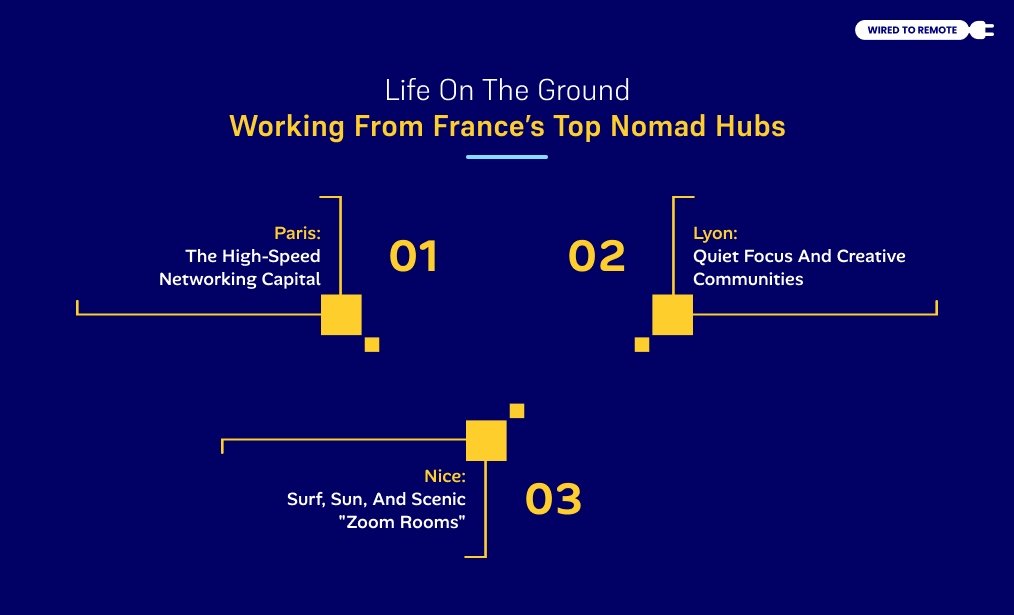
A. Paris: The High-Speed Networking Capital
Firstly, do you want to be around other entrepreneurs and a world-class culture? In that case, Paris is the place for you.
It also has the highest concentration of coworking spaces. This includes Station F and WeWork. However, be aware that the cost of living there can get really hectic.
B. Lyon: Quiet Focus And Creative Communities
Writers, designers, and anyone else interested in a more gastronomic and balanced type of environment will find no match for Lyon.
Moreover, even with its historic architecture, the internet is nowadays pretty fast, and the local culture is mainly about quality of life and heritage.
C. Nice: Surf, Sun, And Scenic “Zoom Rooms”
Finally, Nice is a place for remote workers who want to stroll along the Promenade des Anglais while working. This is an up-and-coming location for 2026. Additionally, it is a little more relaxed. Therefore, the local tram or a bicycle will definitely be your mode of transport to the seaside cafes.


Leave A Comment