
The HR automation landscape has been witnessing rapid advancements in the past few years. And thanks to automation, HR departments can now work more effectively and efficiently.
With eight years of remote working experience under my belt, I can tell you one thing: automation is a game-changer, especially for HR professionals in the corporate setup.
How? By automating exhausting tasks on a daily basis, HR professionals can now spend more time on people-first initiatives that will help an organization achieve its goals.
Moreover, primary HR processes like offboarding, onboarding, recruiting, leave tracking, payroll, and timekeeping are essential to any organization.
However, completing these obligations ends up drowning most HR departments in tedious – not to mention time-consuming – paperwork and administrative duties.
In fact, according to a Deloitte survey, 57% of HR professionals spend all their work hours on completing administrative tasks. (Source: Deloitte survey)
Moreover, considering automation can easily speed up and streamline daily HR operations, businesses are more and more lending towards using automation wherever possible.
In fact, adoption of HR automation has grown by almost 600%, and that too in the last two years only. (Source: Workato report)
As a result, embracing HR automation as soon as possible is perhaps your best shot – the idea is to ensure your business stays future-ready and does not get left behind in the rat race.
And that is precisely why I am here – to discuss HR automation, its primary benefits, and more importantly, how to implement it in detail.
Stay tuned!
What Is HR Automation?

Human Resource (HR) automation uses algorithms and software to mechanize and digitize time-consuming and repetitive administrative tasks.
Moreover, with automation, HR departments can streamline operational processes, reduce human errors, and improve efficiency.
This, in turn, helps HR professionals to save time, focusing on more value-adding and strategic duties.
In addition, significant technological advancements have appeared – why? To meet the management demands of the modern workforce.
And automation is one of these advancements – embracing them is an absolute necessity for virtually any organization that wants to stay competitive and viable.
Key HR Processes You Can Automate:
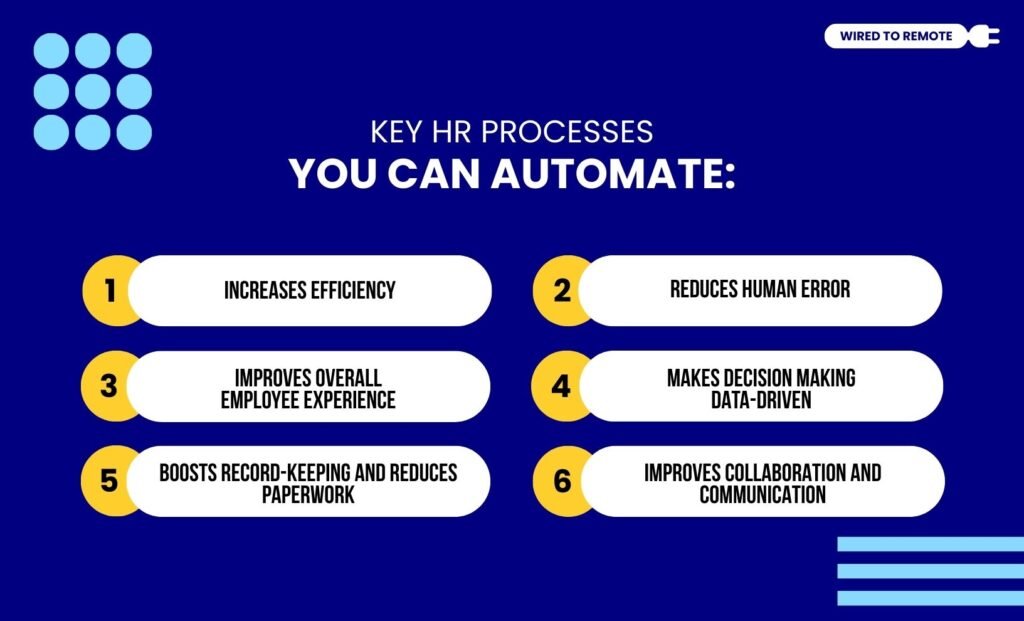
Many HR functions involve repetitive steps that are ideal for automation.
As a result, once you automate tasks accurately, you can easily simplify almost all stages of the employee lifecycle.
So, I have done my best to highlight all the possible tasks that you can automate for the HR department.
Of course, this section is open to discussion, and you can always suggest what else we can automate in the same department.
1. Recruitment And Candidate Screening:
Hiring teams often receive hundreds of applications for a single position – and choosing the right resource for the right role tends to get exhausting.
As a content manager for the past 3 years, I can tell you how difficult and frustrating it is to find the right candidate.
Currently, I am screening resumes that the HR team is sharing with me – and while I am not screening at a base level, it is still taxing to go through resume after resume.
And imagine, if I am feeling tired screening a few CVs, then how time-consuming and taxing it is for someone at an initial stage to do the same?
This is where automation can literally save the day!
With the right tools, you can filter resumes, rank candidates based on keywords, and schedule interviews automatically.
Also, this speeds up hiring while ensuring qualified candidates are prioritized.
2. Employee Onboarding:
I’m sure you are already aware of what onboarding involves.
Typically, it includes multiple administrative tasks such as document collection, training schedules, and system access.
I mean, I absolutely dread the first day at work – both as an employee at a new office and a manager waiting for the employee to join.
And if you have been working for some time, you know what I mean. But for anyone who is still seeking their first job, you are in for a surprise.
Because tasks are not automated, you usually have to spend hours in the orientation process, manually filling out forms, getting your system access, and getting your training done.
Again, this is where automation can really speed things up, making life easy for everyone involved.
Automated onboarding workflows ensure that new hires receive the right information, forms, and instructions without manual follow-ups.
3. Payroll And Benefits Administration:
Processing payroll manually can lead to costly errors. And we keep saying it ‘can’ happen, while a voice at the back of my head used to say, ‘not really.’
Moreover, I was firmly against automating anything related to payroll because I was worried that relying on tools would make me slow.
It took me a long time to understand I was being very stupid – and how? I was working at a small startup in 2022 – the HR department used to take care of the payroll manually.
Unfortunately, he made an error – he credited only ₹5,000 to my account on payday, and sent my salary, ₹35,000 (at the time), to an intern who had worked for the last week of the month only.
Naturally, this experience left a bitter taste in my mouth – and I realized that without tools and automation, payroll shouldn’t be touched.
Also, HR automation software calculates salaries, taxes, deductions, and benefits accurately while ensuring compliance with regulations.
4. Leave And Attendance Management:
This is perhaps one of the most important HR processes that companies should seriously think about automating – if they haven’t done it yet.
I worked with 4 companies and 25+ clients in the last eight years. And I have spent more than four years at my current workplace.
One of the reasons why I’ve spent so long here is the transparency and well-structured operational flow.
And my experience says that without a portal to manage your leave and attendance, it is going to get very complicated, especially if you have more than 10 employees.
So with a good self-service portal, employees can request time off, while managers approve requests digitally.
For instance, I use Zimyo to track leave and attendance for my team – and my reporting head does the same. It’s easy to use, monitor data, and make reports.
Also, good automated systems track attendance, holidays, and leave balances in real time.
5. Performance Reviews:
If you have spent some time in the corporate then you are already aware of performance reviews – and how annoying these can get in the absence of the right technology.
As a content manager, I have to do around 10 performance reviews every quarter. While I have been using Zimyo for a year to do performance reviews, I do remember the days of long one-on-one meetings and manual data checking.
And trust me, you don’t want to sit on either side of the table – it is tiring for both the manager and the team member.
So, thank god, I can use automation to do reviews in peace. Automation can schedule performance reviews, collect feedback from managers, and track employee goals.
And the best part? Using automation ensures regular evaluation cycles without requiring constant HR supervision.
Why HR Automation Is A Necessity In 2026? Key Benefits
The automation of HR processes has become essential in the business world of today, and for good reasons. Here are some of the main advantages of HR automation.
1. Increases Efficiency:
HR management primarily relies on processes driven by documents. When it is done manually, things get repetitive, prone to errors, time-consuming, and very inefficient.
Moreover, paperwork typically gets ‘stuck’ on one intern’s desk or in long queues.
Also, automating HR tasks will increase efficiency and productivity across a business. This allows the entire HR department to make strategic tasks a priority.
Additionally, with automation, HR professionals can advocate for a company’s employees through coherent communication, culture building, and effective employee practices.
2. Reduces Human Error:
Handling timesheets, leave balance, and payroll manually increases the space for errors.
As a result, opting for an automated system is an excellent idea, considering it will complete these tasks consistently and quickly.
Also, with automation, you can reduce costly errors, maintaining data accuracy and compliance, which is an impossibility if you handle large amounts of data manually.
Plus, this supports fair treatment and transparency.
3. Improves Overall Employee Experience:
This is normal in every workspace – the HR staff getting bogged down by the admins and their monotonous tasks.
As a result, HR professionals have hardly any time for interacting with candidates – this leads to a bad hiring experience, even if the candidate gets the job.
With the help of automation, an HR professional can easily stay connected with candidates throughout the hiring process.
Also, employees can benefit through automated self-service. Expense reports, benefit updates, and leave requests are just a matter of a few quick minutes.
Additionally, employees can keep checking their benefit status on the portal without needing a response from HR. This leads to a much smoother and more positive experience.
Employees can check their benefit status without waiting for HR to respond, leading to a smoother and more positive experience overall.
4. Makes Decision Making Data-Driven:
HR automation allows users to monitor, collect, and most importantly, analyze all types of data.
How? By pulling information from different systems, including performance management tools, LMS, and ATS.
For instance, it can show HR how high performers are usually coming from specific sourcing channels or how onboarding bottlenecks are delaying overall productivity.
With the right amount of visibility, HR professionals can easily speed up the onboarding process, refine recruitment, and optimize training models based on outcomes or engagement.
5. Boosts Record-Keeping And Reduces Paperwork:
Paper-based systems need printed documents that have to be physically filed and stored.
With the help of automation, the need for storage reduces significantly. Also, it lowers administrative expenses.
Plus, it is so much easier to retrieve data with a few clicks instead of searching manually among large amounts of physical documents.
6. Improves Collaboration And Communication:
Automated operational workflows make task ownership and responsibilities visible.
For example, things like approval for requisitions and performance reviews can be smoother if you automate the system.
How? Because automation reduces all the unnecessary back-and-forth, helping the team collaborate more smoothly and avoiding duplication or missed steps.
Real-World Examples Of HR Automation In Action
Many organizations already rely on HR automation to streamline their operations. So, here are some real-world examples of using HR automation.
1. Automated Hiring Systems:
Large companies use applicant tracking systems (ATS) to screen resumes and shortlist candidates.
Also, these systems identify the most relevant applicants based on predefined criteria.
2. Chatbots For Employee Support:
Some organizations deploy HR chatbots that answer common employee questions about benefits, policies, or leave requests. This reduces the workload for HR staff.
3. Digital Onboarding Platforms:
Companies now use onboarding software that automatically guides new hires through paperwork, training modules, and company policies.
4. Performance Management Tools:
Modern performance management systems automatically track employee goals and gather feedback throughout the year instead of relying solely on annual reviews.
So, these examples show how automation can improve both operational efficiency and the employee experience.
Implementation: How To Introduce Hr Automation?
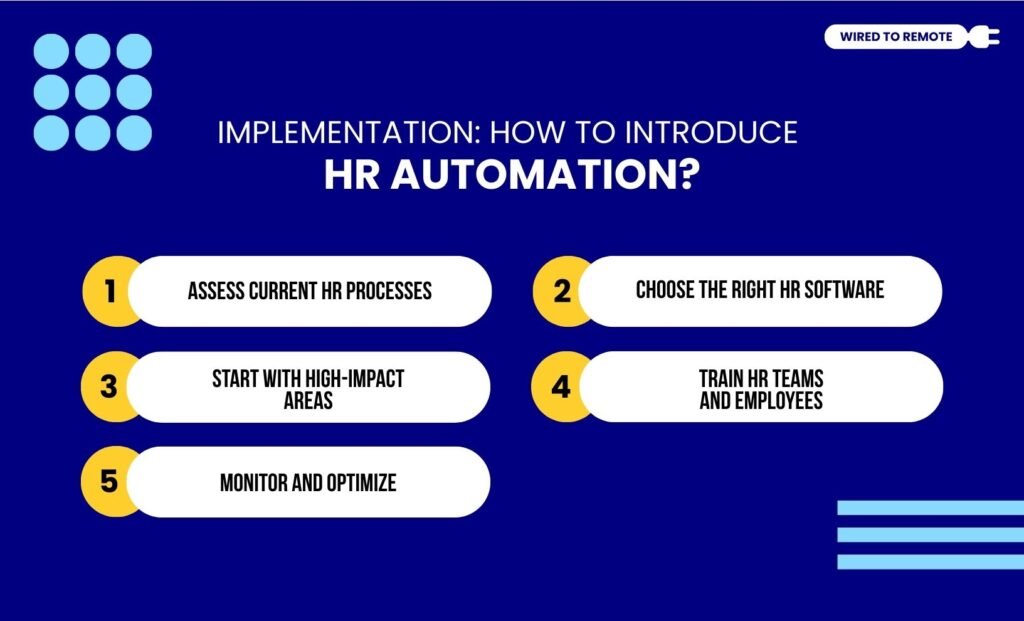
Adopting HR automation requires careful planning and a clear understanding of organizational needs.
1. Assess Current HR Processes:
Begin by identifying repetitive or time-consuming tasks in the HR department. These processes often provide the greatest opportunity for automation.
2. Choose The Right HR Software:
Select automation tools that integrate with your existing systems and support your organization’s growth. Features like analytics, reporting, and scalability should also be considered.
3. Start with High-Impact Areas:
Instead of automating everything at once, start with key functions such as recruitment, onboarding, or payroll. This allows teams to adapt gradually.
4. Train HR Teams And Employees:
Introducing new systems requires proper training. HR staff and employees should understand how to use the tools effectively.
5. Monitor And Optimize:
After implementation, regularly review system performance and gather feedback from employees to refine workflows.
Challenges And Considerations:
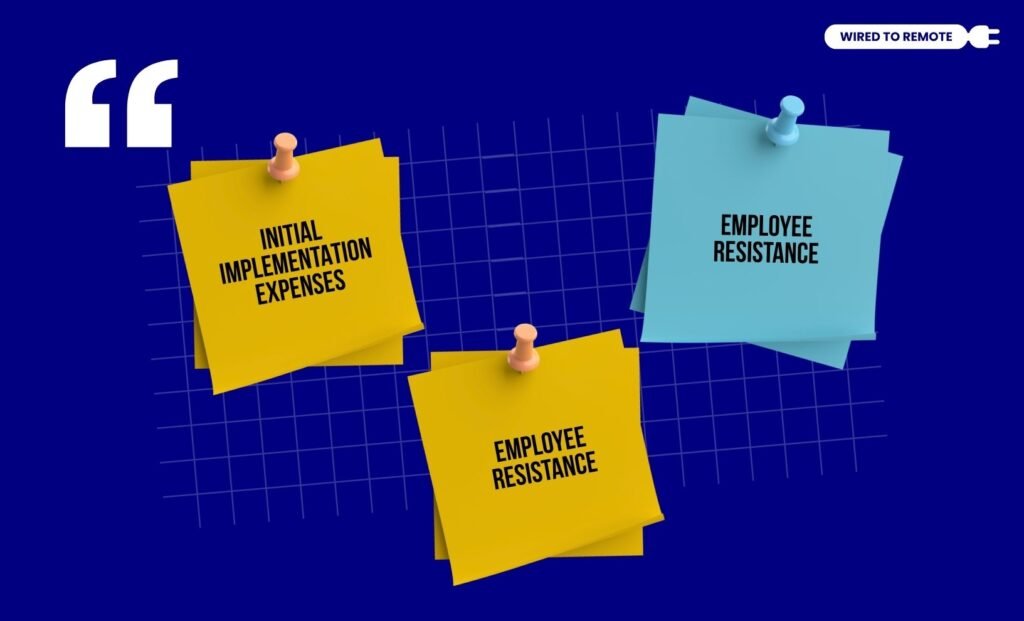
Transitioning into automation is significantly beneficial. But remember, it comes with some challenges.
As a result, you need to be aware of all potential issues that might crop up – that way, you will be ready to overcome these challenges!
1. Initial Implementation Expenses:
Of course, automation is expensive, which is precisely why traditional and small companies shy away from investing in it.
The automation software itself, system integration, and training are expensive – you need to invest a significant amount of both money and time.
These expenses are substantial, particularly for small companies.
As a result, it is imperative to secure leadership’s support early. Clearly demonstrate how the long-term benefits of automation will outweigh the initial costs.
2. Employee Resistance:
Introducing any new tool is always going to disrupt the familiar workflow.
As a result, many HR professionals worry when it comes to job security in the rising landscape of tools and automation.
Then there are professionals who don’t trust the new technology – will it even help? Will it work?
Apart from HR professionals, other employees might hesitate when it comes to using self-service features, mostly due to discomfort and unfamiliarity.
This sort of resistance can easily hurt morale, slowing down overall adoption.
3. Integration Issues:
Unless you are entirely replating your HR system, adding tools to automate some processes will need integration with existing systems.
For instance, adding a new software to manage payroll might face difficulties syncing with your benefits or time-tracking tool.
Getting the different tools and systems to talk to one another is time-consuming and complex.
However, compatibility problems that lead to extra input or data silos for ensuring consistency defeat the point of automation.
What Is The Future Of HR Automation?
HR automation continues to evolve as new technologies emerge. Artificial intelligence, machine learning, and predictive analytics are shaping the next generation of HR tools.
Future systems will likely provide deeper insights into workforce trends, helping companies predict employee turnover, identify skill gaps, and improve hiring strategies.
Additionally, advanced automation will personalize employee experiences by recommending training programs, career development opportunities, and internal mobility options.
As workplaces become more digital and distributed, HR automation will play an increasingly important role in managing talent efficiently while supporting employee well-being.


Leave A Comment