
It is no wonder that time management is a vital skill for remote employees.
That is, in a remote setup, it can be difficult to stay motivated and get work done without the right time management methods.
Now, a single method cannot work for everyone. Given that every team has different needs, a universal method cannot address these diverse needs.
That is, remote teams can easily implement or combine different methods to manage the time and organize the tasks.
So, here I have brought you a complete guide on the various time management methods that help employees to prioritize their tasks and boost their productivity.
In this blog, I will delve into—
- Relevance of time management in remote teams,
- Major methods for managing time in remote work,
- Steps to choose the right method, and more.
So, come dive right in!
Why Do Remote Teams Need Time Management Methods?

Before diving into the different time management methods for remote teams, let’s look into what time management is and why it is important.
Firstly, time management methods refer to the various techniques and practices that help individuals to organize their tasks, create a proper timeline, and deliver them without any delays.
Moreover, the right time management methods can help individuals stay motivated and productive. That is, it helps to get the work done without affecting the specificities.
So, here’s why it is important in a remote work culture—
- Improving the focus and productivity of the remote teams.
- Reducing stress and anxiety among team members with workloads.
- Ensuring a better work-life balance with a proper time management schedule.
- Prioritizing tasks and managing the workflow with the right techniques.
Key Principles Of Time Management
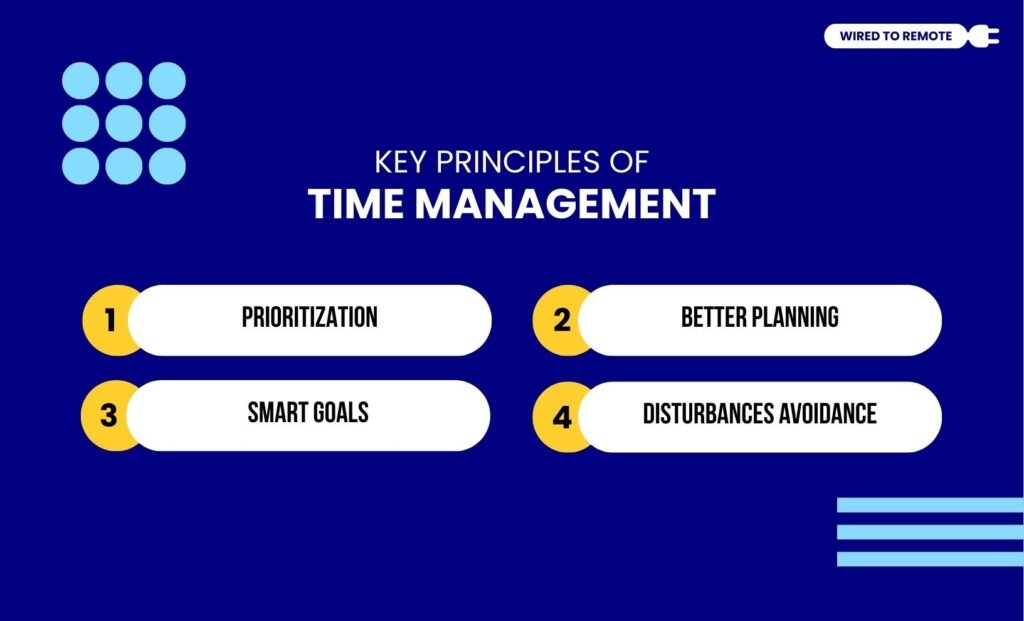
Even though there are diverse time management methods, the key principles of these techniques are the same. So, the key principles include —
- Prioritization: Firstly, the time management methods allow employees to prioritize tasks based on their urgency.
- Better Planning: Moreover, they help in better planning of time by scheduling the tasks early on, so the work can run smoothly.
- SMART Goals: In addition to this, it allows the employees to set SMART goals that are specific, measurable, achievable, relevant, and time-bound.
- Disturbances Avoidance: Finally, the techniques should help with avoiding distractions and disturbances. So, employees can stay focused on the tasks.
Top 5 Time Management Methods For Improving Remote Productivity
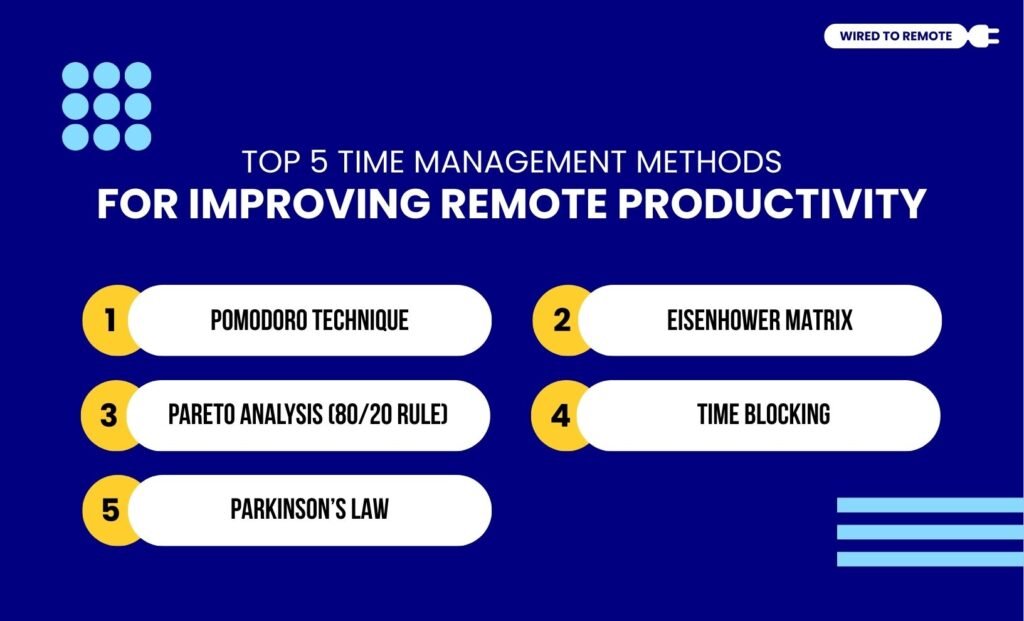
Since there are diverse time management techniques, I have curated the top 5 techniques that best work for remote teams.
So, here are the remote-friendly time management methods—
1. Pomodoro Technique
Firstly, the Pomodoro Technique allows employees to break the 30-min timeframe into two parts — 25 minutes and 5 minutes. That is, the focused time and the break time.
So, employees can choose a focused timeframe to concentrate on a task and get the work done. Then, reward themselves with the 5 minute break.
This helps them to stay productive and have a refreshed mind before getting back to work again. So, the tasks get done easily and with clarity.
2. Eisenhower Matrix
Unlike the Pomodoro technique, the Eisenhower matrix focuses more on categorizing tasks based on their urgency and priority.
That is, it allows the employees to categorize the tasks under four groups —
- Important – Urgent,
- Important – Not Urgent,
- Not Important – Urgent, and
- Not Important – Not Urgent.
So, based on the category of the task, they can decide whether to do it, delegate it, or delete it. This makes time management easier, enabling employees to focus on tasks that need attention.
3. Pareto Analysis (80/20 Rule)
Pareto Analysis, or the 80/20 rule, is a tad bit complicated. But once you get the hang of it, you can make decisions about task management in a jiffy.
So, as a time management technique, Pareto Analysis assigns a score to the tasks.
Now, based on the urgency, complication, and type of task, the score can differ. So, a highly complicated task can score higher.
Now, based on the scores, the employees can decide which task requires 80% of their time and which ones need only 20%. So, they can organize the tasks and deliver the urgent ones on time.
4. Time Blocking
Now, not all tasks can fit into the 30-minute timeframe of the Pomodoro technique. That’s where time blocking comes into play.
It allows employees to assign a chunk of the day’s time to a specific task. So, they can decide the time blocks based on the priority and task complexities.
This way, they can complete complex tasks in one go without taking breaks in between that might distract them. Enabling the team to stay focused and productive.
5. Parkinson’s Law
Unlike the other methods, Parkinson’s Law is more like a lifetime time management skill. That is, once you understand its core principle, it skyrockets your productivity.
For instance, it does not prioritize tasks or create time blocks. Rather, it forces the employees to get the work done in a short time.
That is, it allows the employees to decide how much time a task can take, and then give only 2/3rd of the time. So, the employee can be fully focused on the work.
This way, the productivity and efficiency of the team massively increase. So, they can better manage their time without procrastinating.
How To Choose The Right Time Management Methods For Remote Teams?
Now, understanding which time management technique best works for your team is the key to boosting productivity. So, here is how remote employees can choose the right methods —
- Identifying the time management needs of the remote teams.
- Choosing the method or combining methods to meet those needs.
- Experimenting with the techniques and methods before finalizing them for the remote team.
- Adjusting and modifying the methods to fit the remote team’s requirements.
So, by following these simple steps, individuals can implement the best time management techniques for their remote teams.
And, if you, too, have been procrastinating on organizing and managing the tasks, take this as a sign to choose the right method. Skyrocketing the remote team’s productivity.
FAQs
Here, I have brought you some of the common questions around the time management methods for remote teams.
Given that the best time management method depends on individual needs, there is no single method that works universally.
That is, if the remote employee needs something that helps them to keep their work organized and scheduled. Then, the Time Blocking method works the best.
On the other hand, the Eisenhower Matrix is best suited for teams working on prioritizing tasks. So, they can decide which task to work on and boost productivity.
To ensure that you are improving your time management skills, you need to identify the issues and resolve them with the right method.
That is, first track the time for each work, create a to-do list, and set SMART goals to order the tasks based on their priorities.
Then, implement any one of the time management techniques — Pomodoro, Eisenhower, Time Blocking, and Parkinson’s Law. Finally, follow the time planning.
Yes, absolutely. There is no hard and fast rule that one time management method cannot be combined with another one.
That is, you can combine the Eisenhower matrix and Pomodoro technique for focused and prioritized tasks in remote teams.
So, based on your needs, you can choose to combine the different time management methods to better manage the tasks.



Leave A Comment