

Topic of the day: Hybrid vs Remote.
The modern corporate landscape has decoupled productivity from physical real estate. For leadership teams and employees alike, this structural shift has moved beyond a temporary crisis response into a permanent operational model.
However, organizations frequently conflate execution models, asking: Is remote work the same as hybrid work?
The answer is no.
While both models reject traditional office-bound constraints, they require completely distinct technical infrastructure, communication methodologies, and legal compliance workflows.
According to data tracked by the Forbes Human Resources Council, only 12.7% of full-time employees work completely from home, whereas 28.2% engage in a hybrid work model.
This shows that the bulk of the corporate world is inclined towards offering a structured, blended kind of flexibility.
If you are trying to understand the difference between hybrid vs remote work models and which one would suit you the best, I have the perfect guide for you.
Therefore, keep reading!
What Is Remote Work And Hybrid Work?
Even though both the terms – remote and hybrid – are used synonymously, they do not refer to the same kind of work model.
So, here is a clear breakdown of what these terms actually mean.
Hybrid Work
First things first, hybrid work refers to a mixed work mode where employees work both in the office and remotely.
So, in this model, employees need to come to the office for their in-person work and also work remotely from anywhere they prefer.
Moreover, hybrid work models come with specified days for remote work and in-office work. So, the employees need to follow the work mode for the specified days.
Remote Work
Unlike the hybrid model, remote work refers to the work mode where employees work from outside the office.
So, in this model, workers don’t need to visit the office, and they can work from any location they like – their home, a cafe, another state, or digital nomad destinations.Moreover, remote work doesn’t require employees to physically work from a specific location. So, they rely on advanced technology and digital tools for conducting their work.
Hybrid vs Remote Work: What Are The Key Differences?
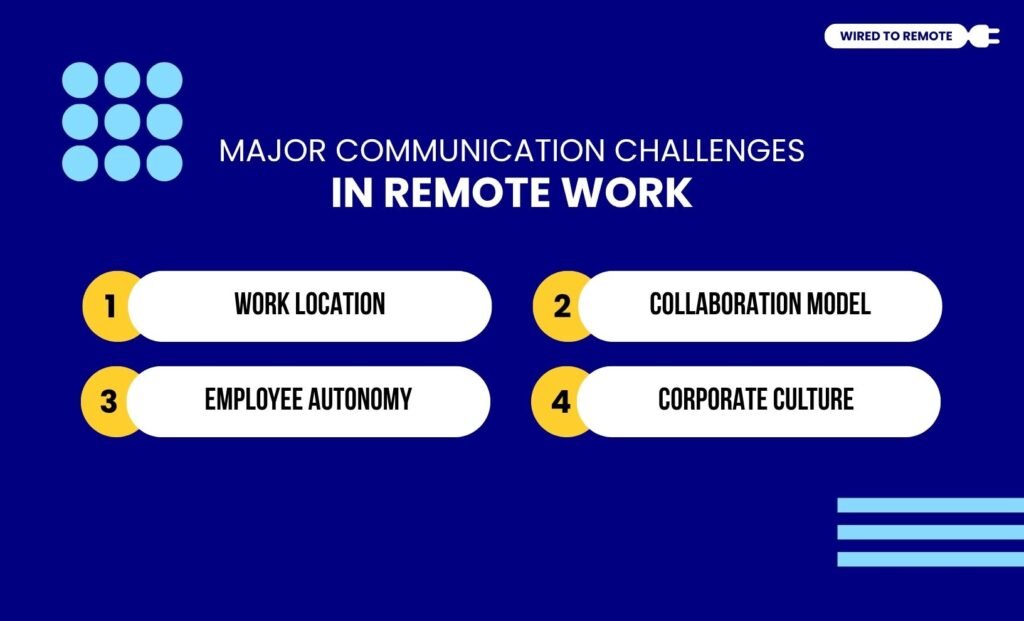
Now, to better understand how remote work varies from hybrid work, here is a detailed exploration of their key differences:
1. Work Location
Firstly, remote work and hybrid work are done from different work locations.
That is, remote work is specifically done from outside an office. So, workers can work from any location they like. Moreover, they do not need to travel to the office for work.
But hybrid work requires its employees to show up in person for a specific number of days a week. And, for the rest of the days, they can work remotely from different locations.
So, hybrid workers need to reside somewhere near their office locality to commute to work on specific days. Whereas, remote workers can stay at any location and work for the company.
2. Collaboration Model
Hybrid working models use synchronous communication as a foundation [Source: PwC]. Employees plan their in-person office days to have instant, real-time teamwork.
Being in the same place triggers unexpected idea generation and innovation through informal chats by the “water cooler”.
Still, it is quite dependent on the team members being in the same time zone and having overlapping schedules.
Meanwhile, remote models focus on asynchronous work. As the teams are located in different parts of the world and working in different time zones, real-time discussions are quite a luxury.
Operations rely on centralized project management tools like Notion, Jira, or Slack to track deliverables.
Furthermore, teams document every process transparently. This basically allows workers to contribute at different times.
This shifts the focus from constant availability to measurable output, giving employees uninterrupted deep-work time.
3. Employee Autonomy
Thirdly, since remote work gives employees the greatest work and time flexibility, it also means they have the most autonomy. In other words, employees get to choose their working time, location, and manner.
In contrast, in the hybrid model, the employees’ working hours and office days are fixed by the employer. This way, the employees have less freedom in deciding their working time, method, and location.
4. Corporate Culture
Finally, remote and hybrid work offer different corporate cultures. That is, hybrid culture blends in-person and remote work within a single model.
So, employees get the perfect balance of both work flexibility as well as workplace communication. This way, their productivity increases, and they feel more satisfied with the work culture.
But in a remote setting, the work culture offers more flexibility and independence to the employees. So, they can work with improved productivity and have job satisfaction.
As the report from Resolve.ai shows about corporate culture in hybrid or remote work:
In today’s ever-evolving workplace, flexibility, empathy, and inclusion are more critical than the traditional command-and-control models-ensuring that employees can bring their best selves to work every day. As a people-centric approach to workforce management, this work model gives employees the freedom and flexibility to work wherever and whenever they want.
Pros And Cons Of Hybrid Vs Remote Work Models

Even though both remote and hybrid work models offer different work cultures, they both come with a set of benefits and challenges. So, here is a breakdown of the pros and cons of each work model.
Pros And Cons Of Remote Work
Although remote work is becoming the new norm, it has some unique challenges. So, a simple breakdown of its pros and cons can highlight its benefits and common issues.
| Pros | Cons |
|---|---|
| 1. Offers more work and time flexibility to employees. | 1. Lack of in-person workplace communication. |
| 2. Allows employees to have more focus and productivity. | 2. Low cross-functional team collaboration. |
| 3. Access to a larger talent pool. | |
| 4. Requires zero office space and employee commutes. |
Pros And Cons Of Hybrid Work
Unlike remote work, hybrid work offers a more balanced model with a mix of both in-person work and remote flexibility. But still, it comes with some challenges. So, its pros and cons are:
| Pros | Cons |
|---|---|
| 1. Offers a balanced work model by blending office and remote work modes. | 1. Instances of inequality in employee participation are present in the office. |
| 2. Allows employees to have more face-to-face communication. | 2. Less flexible work culture. |
| 3. Enables employees to collaborate with diverse cross-functional teams. | 3. Lack of employee autonomy to choose when and where to work from. |
| 4. Clearly sets the work mode for weekdays for streamlined workflow. |
How To Implement Remote Or Hybrid Work Models?
Since remote and hybrid work models have quite a few differences, implementing each model needs a different framework.
Remote Work Model
So, for a remote work model implementation, here are a few things to consider:
- Ensuring the work culture is collaborative and communicative.
- Using advanced communication tools for workplace communication.
- Clearly defining the remote work policies for the employees.
- Prioritizing video meetings to mitigate miscommunication and other remote challenges.
Hybrid Work Model
Similar to the remote work model, the hybrid model implementation should be done with a few considerations:
- Using digital tools to facilitate employee participation from both in-office and remote locations.
- Embracing innovation to have a virtual alternative to off-site meetings.
- Designing flexible workplaces for both on-site and off-site workers.
Hybrid vs Remote: Which One Should You Choose As An Employer?
Choosing between a hybrid and a remote work model depends on your organizational culture, operational workflow, and talent strategy. Neither framework is universally superior. Each serves distinct business goals.
When To Choose Hybrid Work?
The hybrid model is ideal if your business relies heavily on spontaneous, creative collaboration and physical mentorship.
It suits organizations with existing office real estate that want to maintain a strong physical corporate identity.
Choose hybrid if:
- Your workflows require frequent, real-time, face-to-face team alignments.
- You primarily source talent from local or regional markets.
- You want to provide flexibility without completely abandoning the office structure.
When To Choose Remote Work?
A fully remote model is best if your operations are task-driven, highly documented, and independent of a centralized hub.
It fits companies aiming to eliminate overhead expenses and scale rapidly without geographic limits.
Choose remote if:
- You want to source top-tier talent globally, completely unrestricted by borders.
- Your team is built to thrive on asynchronous communication and measurable output.
- You want to grant maximum autonomy to your employees to boost retention.
Ultimately, evaluate your team’s daily operational needs. If relationship-building and local presence are vital, choose hybrid. If borderless scaling and extreme autonomy match your vision, go fully remote.
Hybrid vs Remote: Which One Should You Choose As An Employee?
Deciding on the right model really comes down to what kind of lifestyle you have in mind, what stage you’re at in your career and how you like to work the most.
Choose Hybrid Work If You:
- Enjoy lots of social interaction.
- Need a physical workspace.
- Just starting your career.
Choose Remote Work If You:
- Value top flexibility.
- Perform well in solitary deep-focus activities.
- Are proficient in digital communication.
Basically, look at what really motivates and keeps you productive during the workday as well as maintaining a work-life balance when you decide.
Once you have that, you will know which one to choose between hybrid vs remote work models for your career.
Hybrid vs Remote: The Future Of Corporate Culture

Having a remote team or a hybrid team can provide immense benefits like improved productivity, work flexibility, and better work-life balance.
As per the official PwC Remote Work Survey, “83% of employers see remote work as a success” metric. (Source: CutShort) And I feel that speaks a lot.
So, the future of corporate culture promises a workplace with most companies switching to remote or hybrid models. Providing the perfect blend of flexibility and work-life balance.
Now, with this complete guide highlighting the differences between hybrid and remote work, you can choose the one that best suits your needs. So, go ahead and kickstart your career with the right kinda work model.



Leave A Comment