
Most marketing teams don’t struggle with ideas. They struggle with execution.
For instance, a campaign sounds great in a meeting. Then it turns messy, tasks overlap, people wait, and deadlines slip. No one is fully sure who owns what.
That gap between idea and execution is where workflow management matters. Not as a rigid system, but as a way to make work predictable and repeatable.
Let’s go deeper.
What Marketing Workflow Management Really Means?
A workflow is the path your work takes from start to finish.
It is not just a checklist. Instead, it is a sequence with a logical structure. Moreover, each step depends on the previous one – each handoff matters.
For instance, take a simple blog post again:
- Topic selection.
- Brief creation.
- Writing.
- Editing.
- Uploading.
- Promotion.
Now here’s the difference between a weak and a strong workflow.
So, while a weak one says, “Write a blog,” a strong one will say:
- Topic approved with keyword and angle.
- Brief shared with examples and structure.
- Draft submitted in two days.
- Editor reviews within 24 hours.
- Final version uploaded with SEO checks.
- Promotion scheduled across channels
So you see, it’s literally the same task, but the clarity each instruction offers? Very different.
The Hidden Cost Of Poor Workflows:
Most teams underestimate how much time they lose. Moreover, it is not just delays; it is a silent waste.
Remember that a good workflow removes noise. Instead, it creates a calm, steady pace at which you can be at your most productive.
In this context, let’s check out the hidden cost of a poor marketing workflow management:
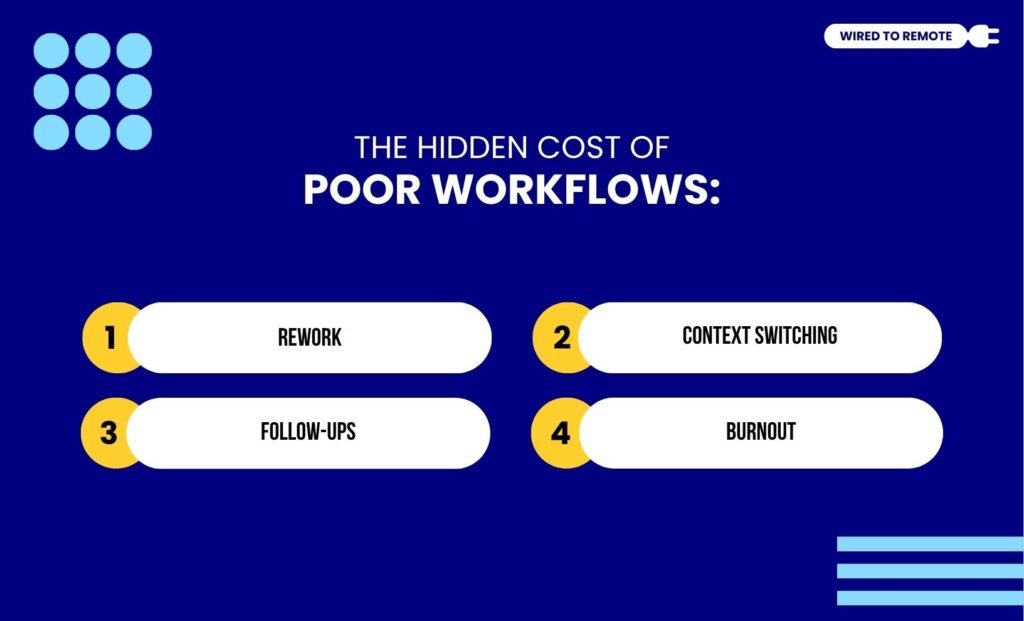
- Rework: A writer creates a draft. It gets rejected. They start again. That is double the effort for one task.
- Context Switching: People jump between tasks because nothing is clearly lined up. This breaks focus. Also, it slows down work.
- Follow-ups: “How is this going,” or “Did you check that,” or “Who is doing this?” These messages seem small, but they add up daily.
- Burnout: Unclear work creates pressure. Moreover, people feel busy but not productive, and that drains energy over time.
What A Good Workflow Looks Like?
So, when a workflow works well, you can notice it immediately.
For starters, work moves without constant reminders. People don’t ask basic questions. Also, deadlines feel achievable, not stressful.
On that note, here are a few signs of a mature workflow:
- Tasks are clearly defined before they start.
- Owners are known without asking.
- Reviews happen on time.
- Work does not pile up in one stage.
- Everyone can see the status at any time.
Additionally, if it feels almost boring, then that’s a good sign.
How To Build A Marketing Workflow Management Plan?
So, let’s refine the earlier steps with more depth.
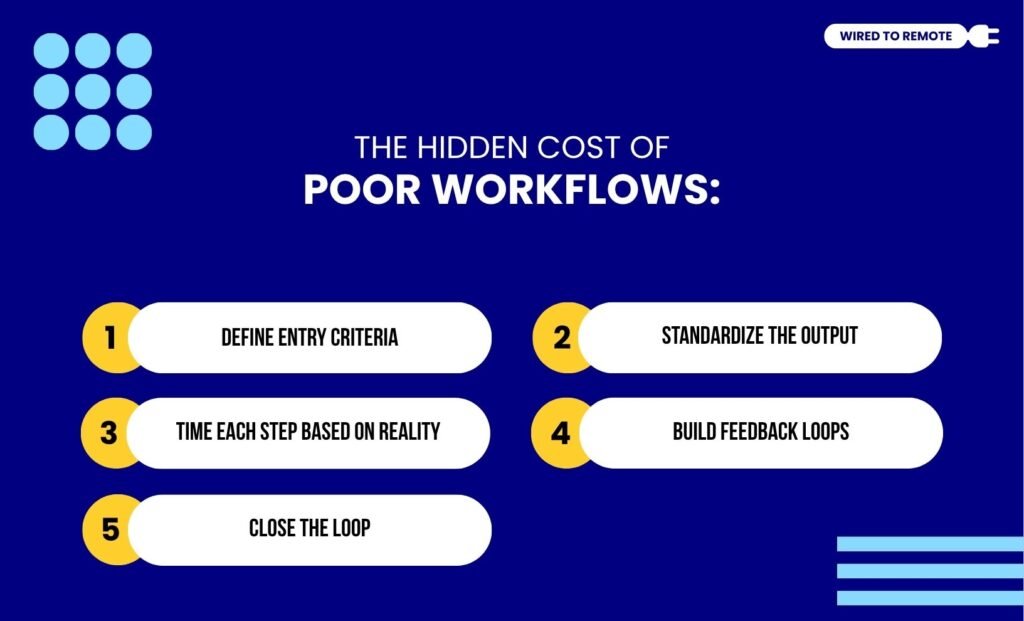
Step 1: Define Entry Criteria
Before a task starts, certain things must be ready.
For example, writing should not begin unless:
- Topic is approved.
- Keywords are finalized.
- The target audience is clear.
- The goal of the piece is defined.
This will help you to avoid half-baked work.
Step 2: Standardize The Output
Each step should have a standard output. Not just “done,” but “done in a specific way.”
For example, in the writing business, you need:
- A clear introduction.
- Structured headings.
- Keyword placement.
- Internal links.
This reduces going back and forth during editing.
Step 3: Time Each Step Based On Reality
Most teams guess timelines. That’s the problem. Instead, look at past work.
So, if editing takes one day on average, plan for that, then add a small buffer. Why? Real timelines reduce stress and missed deadlines.
Step 4: Build Feedback Loops
Feedback should be structured, not random.
Instead of vague comments like “improve this,” use:
- What needs to change?
- Why does it need to change?
- Example of a better approach
This improves quality over time.
Step 5: Close The Loop
A task is not done when it is delivered. It is done when it is accepted – and you have to make this clear.
For example:
- Editor marks content as approved.
- Manager signs off.
- Task moves to “complete.”
- No loose ends.
Marketing Workflow Management: Common Bottlenecks (With Real Fixes)
So, now let’s go deeper into typical problems and bottlenecks that can hamper your marketing workflow management, causing unnecessary delays in the overall operational workflow.
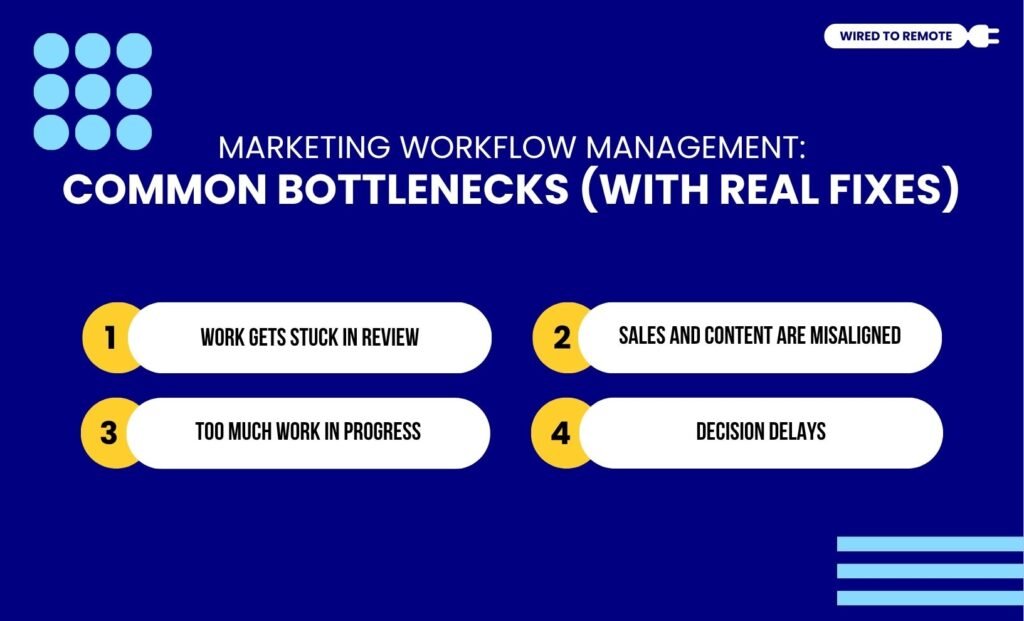
Bottleneck 1: Work Gets Stuck In Review
This is one of the biggest delays.
Why does it happen?
- Reviewers are busy.
- No deadline for feedback.
- Too many reviewers.
Solution:
So, here’s how you can fix it:
- Assign one main reviewer.
- Set a strict review window, like 24 hours.
- Limit feedback rounds.
As a result, you will see the overall pace and productivity improve immediately.
Bottleneck 2: Sales And Content Are Misaligned
This is common in guest posts or service models. So, while Sales promises fast delivery, the content team struggles to keep up.
Solution:
So, here’s how you can fix it:
- Creating a shared timeline.
- Defining realistic delivery slots.
- Not overcommitting.
- Alignment reduces chaos.
Bottleneck 3: Too Much Work In Progress
Teams start many tasks but finish few. The result? It leads to an unnecessary pile-up
and currently, I am stuck with too many pending projects.
Of course, I am running a 10-member team to work for 20 people. And while that is a common problem content managers deal with daily, it can really screw things up.
Solution:
So, here’s how you can fix it:
- Limiting active tasks per person.
- Finishing tasks before starting new ones.
- This is simple but powerful.
Bottleneck 4: No Clear Priority System
Everything feels important. But the reality is not everything is important, and usually tasks are called ‘important’ because someone somewhere forgot to assign them within the right time.
In my 8-year-long corporate career, 90% of all the urgent deliveries I made were the result of someone’s incompetence to inform in a timely manner.
Solution:
So, here’s how you can fix it:
- Fix it by tagging tasks as high, medium, or low priority.
- Also, review priorities weekly.
How To Make Workflows Work For Your Team?
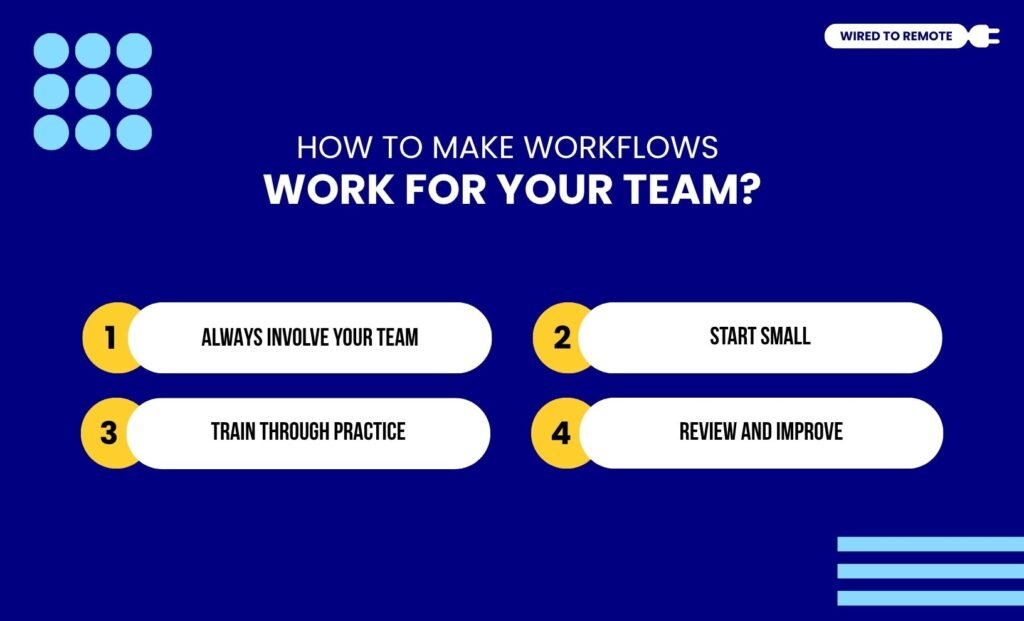
A workflow on paper is easy, but making people follow it is harder.
Yep while drawing a marketing workflow management is easy, it is not always easy to actually make people follow it.
So, here’s how to make it stick.
1. Always Involve Your Team:
Don’t design workflows alone.
Instead, just ask your team:
- Where do you face delays?
- What confuses you?
This builds better systems and buy-in.
2. Start Small:
Don’t fix everything at once. Instead, pick one process, work towards improving it, and then expand. Remember, small wins build momentum.
3. Train Through Practice:
Don’t just explain your marketing workflow management plan to your team. Instead, use it in real tasks. Why? Because people learn faster by doing.
4. Review And Improve:
No workflow is perfect. But if you frequently review it, then you can improve it. As a result, set a simple review every two weeks – I would suggest bi-monthly reviews for the best results.
In this review, ask:
- What slowed us down?
- What can we simplify?
Then re-set, adjust, and implement – soon, you will see that workflow has improved significantly.
A Deeper Look At The Role Of Tools:
Tools should support your workflow, not define it. So, if your process is clear, even a basic tool works well. However, if your process is messy, even the best tool fails.
As a result, while choosing a tool, think in terms of behavior:
- Can people update tasks easily?
- Can everyone see progress?
- Is communication tied to tasks?
If yes, you’re set. Also, avoid overcomplicating with too many features.
The Long-Term Impact Of Marketing Workflow Management:
When workflow management improves, the effect compounds.
- In the first month, you notice better clarity.
- In three months, output becomes consistent.
- In six months, scaling becomes easier.
You can handle more work without chaos – and that is the real goal.
Moreover, marketing workflow management is not about strict rules. It is about removing friction from work.
Also, when your process is clear, your team spends less time figuring things out. And more time doing meaningful work.
Start simple. Fix what slows you down. Then build step by step.



Leave A Comment