
Quick Answer
Miscommunication during remote work is one of the worst culprits for the downfall of organizational productivity, the birth of strict informational silos, and the drop of employee morale. Since remote teams are mostly communicating via text-based, asynchronous channels, they miss out on the most important nonverbal means of communication such as tone and physical gestures, which directly result in misinterpretations, the duplication of work, and the delay of projects.
Miscommunication during working remotely may actually cost an employer as much as $12,506 per employee annually. It might sound surprising, but it is true.
In fact, 33% of project failures were attributed to bad communication, according to the Project Management Institute (PMI), Grammarly Business, and Pumble in their reports.
They also noted that when communication channels fail, over 50% of hybrid professionals feel demoralized.
Using precise digital tools and actively identifying gaps in communication can help avoid these losses to productivity.
Understanding the Impact of Miscommunication During Remote Work

Since remote workers are located in different places, miscommunication among them can have a great impact on the productivity of the organization. Moreover, miscommunication during remote work can affect overall employee performance.
Why Miscommunication Happens in Remote Teams
So, the recurring question remains, why does miscommunication happen in remote work? Well, to put it in simple words, in hybrid work culture employees don’t get the chance to physically interact with each other.
This creates a limitation on effective communication among the employees. Affecting employee performance and project progress.
Moreover, when there are constant issues with network connectivity and telecommunication services, remote workers fail to have proper communication. Interruption in meeting calls and low bandwidth issues can disconnect the workers leading to delays in project completion.
Another reason for miscommunication during remote work is the complicated written communication systems. Remote employees most often communicate through written messages or emails. However, it can be difficult to relay the tone of the message causing misinterpretation of texts.
Consequences of Miscommunication for Productivity
These communication challenges can affect the productivity of the employees. For instance, imagine the manager sending an email delegating tasks to his employees for an urgent deadline. But, because of poor network connectivity, the text message doesn’t reach the employees.
So, the workers won’t be able to complete the task within the deadline. This affects the organization’s performance and employee productivity.
Similarly, imagine a scenario, where the manager sent over a short text about the project deadline, without mentioning important details. He must have assumed that the worker would be able to interpret the message properly.
However, the employee misinterprets the text and ends up taking unnecessary actions. This causes issues with the project’s progress and hampers employee productivity.
How Miscommunication Affects Team Morale
Poor communication or miscommunication in a remote work setting can greatly affect team spirit, the level of employee fulfillment, and collaboration among team members.
Findings from studies revealed that more than half (50%) of remote workers say miscommunication is a problem affecting their team morale, which in turn influences their satisfaction with their job.
Workers may have to bear heavy emotions and stress because colleagues cannot be reached for an honest discussion in a timely manner about such problems.
It also impacts employee performance due to the limited number of work-related conversations within the organization.
Moreover, miscommunication can impact team collaboration. When remote workers cannot deliver their ideas and discuss the project challenges, they feel unappreciated and undervalued.
This prevents them from further contributing to the business meetings with their ideas in the future. Thus, it affects team morale and team collaboration.
What Causes Miscommunication During Remote Work?
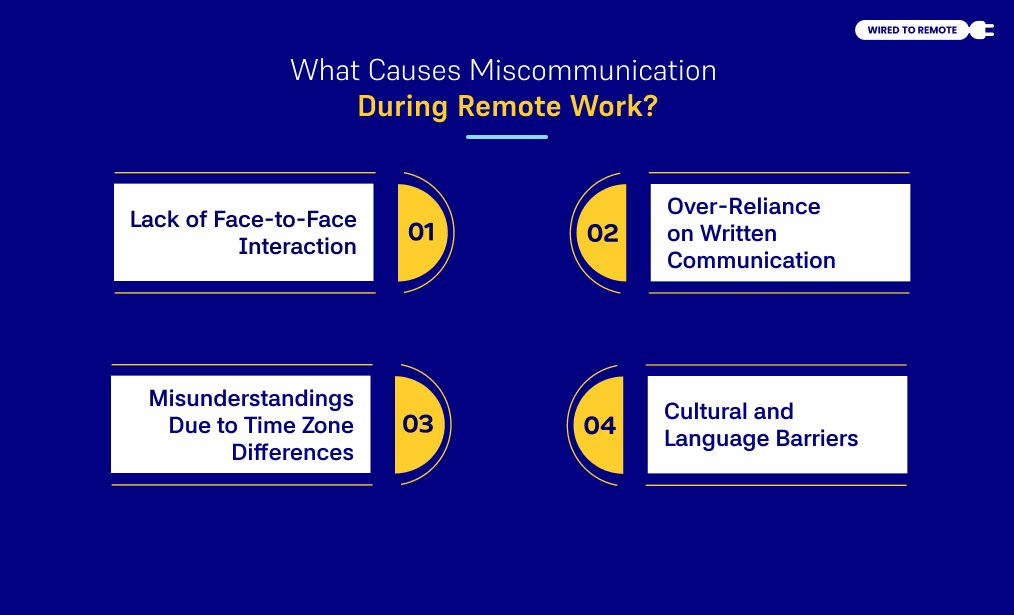
Miscommunication during remote work can be caused by a lot of reasons. Here are some common causes of miscommunication in remote work:
1. Lack of Face-to-Face Interaction
In a remote work culture, employees don’t get the opportunity to have face-to-face interactions with their colleagues. This lack of physical interaction causes misinterpretation of information and miscommunication in the workplace.
2. Over-Reliance on Written Communication
Remote work tends to overly rely on written communication channels for workplace communication. However, sole reliance on written communication can feel mechanic and impact employee morale and job satisfaction. Moreover, written communication can also cause issues of misinterpretation of tone and delayed communication.
3. Misunderstandings Due to Time Zone Differences
Having time zone differences among remote employees is very common. And this time zone difference can affect workplace communication in remote work culture.
When employees are not connected and available at different work hours, there can be misunderstandings as there is no direct communication. Workers are unable to directly resolve issues and discuss work leading to miscommunication.
4. Cultural and Language Barriers
Another issue with different time zones is diversity in culture and languages. This can cause barriers to having effective communication during remote work.
Moreover, cultural and language barriers can become stressful for the employees, making them less satisfied with their jobs.
Strategies to Recognize Miscommunication Early
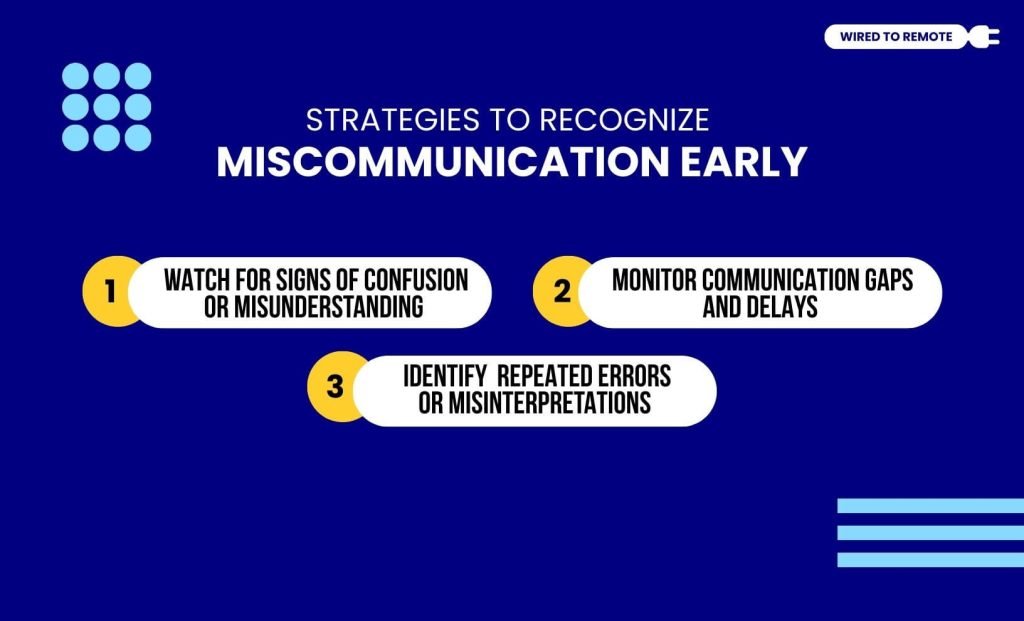
It is important to recognize miscommunication during remote work early to avoid the disastrous consequences of ineffective information flow.
In order to identify the early stages of miscommunication, you can use the following strategies:
1. Watch for Signs of Confusion or Misunderstanding
Look out for the first signs of miscommunication, that is, workplace confusion and misunderstanding. If an employee is unable to complete his tasks, directly enquire about his difficulties. Try to identify the cause of his confusion and misunderstanding to recognize the pattern of miscommunication in remote work.
2. Monitor Communication Gaps and Delays
Another strategy to identify miscommunication is by monitoring delayed project submissions and visible gaps in effective communication. When you properly monitor these communication gaps and delays, you’ll find the cue for miscommunication in its early stages.
3. Identify Repeated Errors or Misinterpretations
One of the most effective strategies for miscommunication identification is looking out for repetitive employee mistakes and misinterpretation of information. When the workers are repetitively making errors in their work and important tasks, you should know that miscommunication is happening.
Effective Communication Practices to Avoid Miscommunication in Remote Workplace
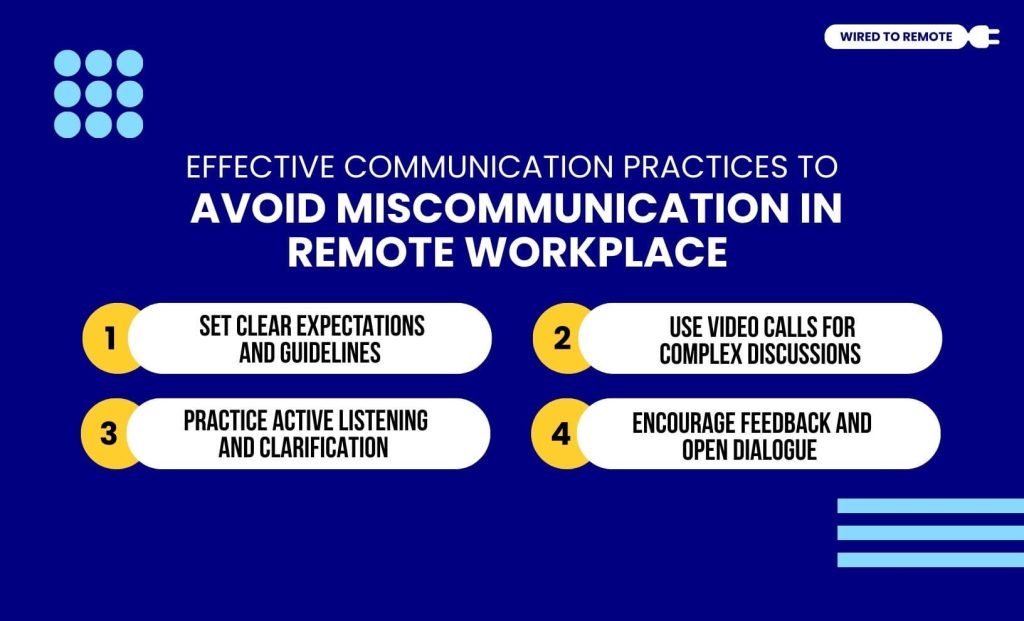
To prevent miscommunication in remote work it is important to follow some effective communication practices. Some of these practices include:
1. Set Clear Expectations and Guidelines
It is important to let the employees know about the company’s expectations and communication regulations to maintain effective workplace communication. You should clearly set your employee expectations and communication guidelines for remote workers to follow and avoid miscommunication.
2. Use Video Calls for Complex Discussions
Having direct communication in remote work can help in resolving issues with complex tasks and projects.
More than written communication, direct interaction can help in solving them faster and manage the progress of the projects.
You can try to use video calls and virtual meetings to arrange direct communication between the employees and the managers.
3. Practice Active Listening and Clarification
Engage in active listening in virtual meetings and clarify doubts if you have any. Practice active listening and clarify doubts to prevent miscommunication and misinterpretation of instructions.
4. Encourage Feedback and Open Dialogue
To ensure that remote workplace communication is effectively happening, employees can be encouraged to give feedback.
You can conduct an employee survey and encourage them to openly communicate their feedback.
This employee feedback can be analyzed to understand how the communication channels are ensuring effective remote work communication.
Tips To Avoid Miscommunication During Remote Work
- Be clear and concise in written communication.
- Confirm understanding by asking follow-up questions.
- Use emojis and tone indicators to avoid misinterpretation.
- Establish regular check-ins to clear up confusion.
- Set up standard operating procedures for common tasks.
- Break complex topics into smaller, manageable parts.
- Use shared documents for transparent communication.
Tools and Techniques to Enhance Remote Communication

There are countless tools and communication technologies available in the market that can help in improving communication in remote work.
Let’s delve into some of these tools and techniques to avoid miscommunication during remote work.
Best Tools To Reduce Miscommunication During Remote Work
To ensure that the remote workers are effectively communicating, you can employ various digital apps and tools. These communication tools can help them avoid the challenges of miscommunication and ensure better workplace communication.
- Microsoft Teams
Microsoft Teams is a one-in-all communication platform. It enables remote workers to conduct virtual meetings, share important documents, send text messages, and have separate groups for different departments.
- Slack
Another communication app that helps remote workers to communicate is Slack. This tool ensures real-time communication across different locations. It effectively establishes communication for time zone differences between the employees in remote work.
- Zoom
Apart from Teams, Zoom meetings are efficient for having work meetings and virtual calls. This helps remote employees to discuss work issues and complex business decisions through direct communication.
These tools and techniques can help in clarifying information for remote workers and avoid issues of miscommunication. Moreover, using a communication tool for remote workplace communication can enhance employee productivity and team performance.
Implement Collaboration Tools (e.g., Asana, Trello)
Apart from the communication tools, various project management tools can be used to establish team collaboration. Additionally, with the help of these project management tools, work instructions for tasks are delivered without the issue of misinterpretation.
Some of the project management and team collaboration tools are:
- Asana
Asana is designed mostly for task management and communication between the employees in real time.
With this tool you will be able to easily and systematically organize each employee’s individual tasks so that a clear picture of project tasks will emerge as well as instructions for each task.
It is equally useful in tracking each task and getting updates and communicating in real-time for clarification purposes in case of misinterpretations.
- Trello
Remote work productivity can really benefit from managing tasks with something as flexible as Trello.
It is a great software to monitor the development of the projects and allow remote workers to work together instantly.
Thanks to Trello, distant workers will always have a clear idea of where the projects stand and their parts within the team.
Can Visual Aids And Written Summaries Reduce Miscommunication During Remote Work?
Another way of preventing miscommunication is by using visual aids as well as giving out written summaries during team meetings.
The use of visual aids will allow you to put your ideas across clearly and communicate better with a culturally and linguistically diverse audience.
In addition, written summaries handed out during team meetings can eliminate a lot of misunderstanding between workers.
Workers suffering from a lack of communication can refer back to the summaries in written form to get a clear idea of what they misunderstood or got wrong.


Leave A Comment