
Quick Answer
A temporary Schengen visa permits digital nomads to work during short holidays. However, this option carries a major downside. It restricts your stay to 90 days within any rolling 180-day period.
Furthermore, the visa strictly bars you from taking local employment. Long-term relocation requires a national visa for your destination.
Fortunately, countries like Portugal and Malta offer specific digital nomad visa regimes. These programs allow you to establish a legal, long-term home base.
What A Schengen Visa Actually Is
I think a lot of confusion around this topic starts with a basic misunderstanding of what a Schengen visa is actually for.
It’s a short-stay visa that lets non-EU citizens move across 29 European countries without separate border checks at each crossing.
It was never designed with remote workers in mind – it’s a tourism and short-business-trip instrument, and that mismatch is exactly why so many digital nomads run into trouble trying to stretch it into something it isn’t.
That said, I don’t think it’s fair to write off the Schengen visa entirely for nomads. Used correctly, it’s genuinely useful for short work-travel stints, client visits, or testing out a country before committing to a longer-term move.
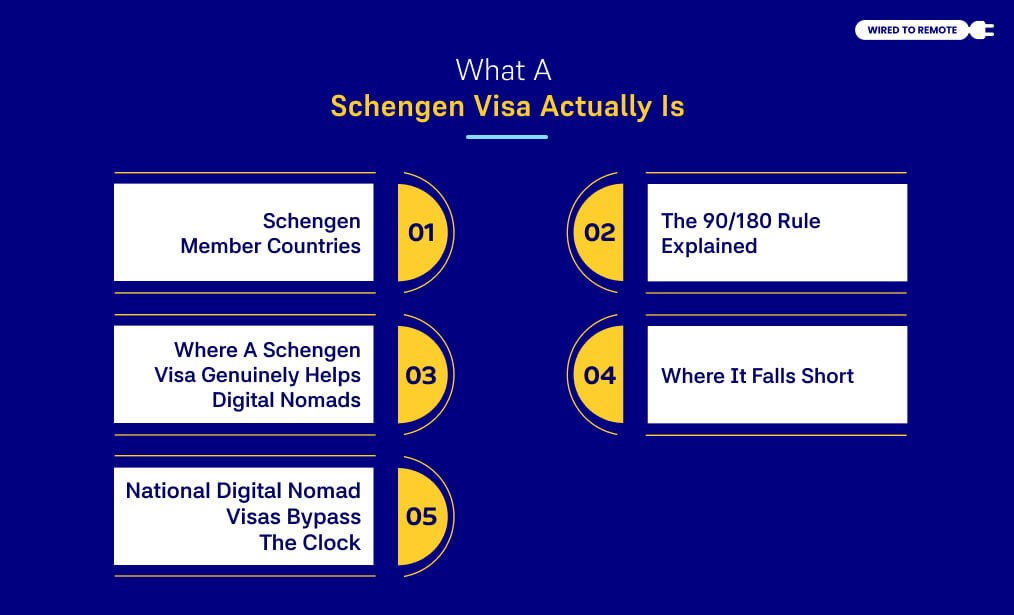
Schengen Member Countries
The Schengen Area consists of 29 European countries. These nations officially abolished internal border controls.
A single Schengen visa allows you to stay legally in member countries. This permit grants entry for up to 90 days within a 180-day period. It acts as a free travel pass across the member states.
- Austria
- Belgium
- Bulgaria
- Croatia
- Czech Republic
- Denmark
- Estonia
- Finland
- France
- Germany
- Greece
- Hungary
- Iceland
- Italy
- Latvia
- Liechtenstein
- Lithuania
- Luxembourg
- Malta
- Netherlands
- Norway
- Poland
- Portugal
- Romania
- Slovakia
- Slovenia
- Spain
- Sweden
- Switzerland
The 90/180 Rule Explained
This is the part that trips up almost everyone, so I want to be precise about it.
Under a standard Schengen visa, you can spend a maximum of 90 days within any rolling 180-day period, counted across all Schengen countries combined – NOT per country.
The window looks backward from any given day, not forward from your entry date. This basically means you can’t simply leave for a weekend and reset your count.
As of April 2026, the EU’s Entry/Exit System is fully operational and tracks every border crossing automatically through biometric data. This has closed the loopholes that some nomads used to rely on with inconsistent passport stamping.
Practically, this means a Schengen visa supports a “90 days in, 90 days out” travel rhythm reasonably well. However, it was never built to support someone trying to live in one apartment in Lisbon or Athens for a full year.
Where A Schengen Visa Genuinely Helps Digital Nomads
I’ll give credit where it’s due: for nomads who want to move between countries rather than settle in one, a Schengen visa is still one of the more flexible instruments available anywhere in the world.
You can work for clients outside the Schengen Region. This applies when you stay temporarily in France, Germany, or Italy for a few weeks. You do not count as a local worker.
A single Schengen visa simplifies your travel process. You no longer need a separate visa for each new Schengen country. This single permit benefits you if your work requires multiple client visits or events across the region.
Where It Falls Short
Where the Schengen visa stops being useful is the moment you want legal certainty for a longer stay in one place.
It doesn’t authorize you to work for a company based in the country you’re visiting, and immigration officers are generally more cautious with remote workers than with typical tourists.
That’s because location-independent income makes your intentions harder to verify at the border. This is exactly the gap that dedicated digital nomad visas were created to close.
National Digital Nomad Visas Bypass The Clock
If your plan is to actually settle somewhere rather than keep moving, a national digital nomad visa is the better tool, because it exempts your time in that specific country from the shared Schengen day count.
The Malta digital nomad visa enables you to settle in Malta for over 90 days. You can still take visa-free short trips across the rest of the Schengen Area. Standard short-stay rules still govern these side trips. [Source: Immigrant Invest]
The Portugal digital nomad visa and the Greece digital nomad visa follow this exact same logic. Both programs gain popularity quickly. They successfully overcome the long-stay issue. A simple Schengen visa cannot match this benefit.
It’s worth noting these visas don’t dissolve the 90/180 rule entirely – they only exempt time spent in the issuing country.
If you’re on a Portuguese digital nomad visa and spend a month in Croatia, that month still counts against your shared Schengen allowance.
What About Non-Schengen Alternatives?

Not every nomad wants to stay in Europe at all, and I think it’s worth mentioning the alternatives briefly, since the “right” visa really depends on your priorities.
The Mexico digital nomad visa and Brazil digital nomad visa both offer longer, more straightforward residency timelines outside the Schengen system entirely, without the rolling-window math to track.
If your priority is climate, cost, or simply avoiding Schengen’s day-counting altogether, these are worth researching on their own terms rather than trying to force a European itinerary to work.
For nomads who want European access but a different legal pathway, the Latvia golden visa is another option worth knowing about – it’s investment-based rather than income-based, which makes it a fit for a different kind of applicant than the typical remote-work visa.
Comparing Your Options Across The Best Nomad Destinations
If you’re still weighing where to actually go, it helps to zoom out.
Among the best countries for digital nomad lifestyles, the honest answer is that no single visa type wins across the board – it depends on whether you want to:
- Move frequently (Schengen visa).
- Settle in one EU country for a year or more (a national digital nomad visa).
- Skip Europe’s rules altogether (Brazil, Mexico, or similar).
I’d encourage anyone deciding between these to map out roughly how much time they actually plan to spend in one place before choosing, since that single factor determines almost everything else about which visa route makes sense.
Practical Steps Once You’ve Chosen A Path
Whichever direction you go, a few practicalities apply regardless of visa type.
If you want an authentic commercial existence but feel unready for a full-time physical lease, a Virtual Office service can rescue your business.
Specifically, this option offers you a valid local address for crucial matters like banking and invoicing. Consequently, this solution works smoothly in most nomad-friendly countries.
Moreover, when you plan a temporary relocation, checking local coworking membership plans provides valuable insights. As a result, you can better compare your alternatives instead of renting the first space you encounter.
Ultimately, you should focus your search on community-driven coworking solutions, such as Hot Desk coworking options.
My Take On Schengen Visa
A Schengen visa is a genuinely useful tool for digital nomads who want to travel through Europe on a rotating basis, and I wouldn’t discourage anyone from using it that way.
But if what you actually want is a stable home base – a real apartment, a routine, a coworking membership you don’t have to abandon every three months – a Schengen visa alone won’t get you there.
That’s a job for a national digital nomad visa, and the sooner you’re honest with yourself about which of those two goals you actually have, the easier this whole planning process becomes.



Leave A Comment