

Topic of the day: Selecting the best coworking membership plans.
Choosing a workspace used to be a once-a-decade decision involving long-term commercial leases and heavy upfront investments.
Today, the world has shifted toward a “Subscription Economy” for offices. Known as Workspace-as-a-Service (WaaS), coworking offers the agility that modern professionals demand.
However, the “growth of flexible work” has led to a dizzying array of options. By 2026, the global coworking market is projected to exceed $29 billion, with over 41,000 spaces worldwide. (Source: DropDesk Spaces)
In this blog, we will talk about the following things:
- How does a coworking membership plan work?
- Major types of coworking membership plans.
- Comparison between Coworking and other alternatives.
- How to choose the right coworking membership plan?
Therefore, keep reading!
How Coworking Membership Plans Work
Coworking membership plans are basically subscription agreements that offer individuals and groups the use of shared workspaces.
Different from traditional office leases, which are usually long-term, these plans generally run on a monthly basis or with a pay-as-you-go system.
Working together, members of such plans get to share amenities such as access to the following:
- High-speed internet.
- Conference rooms.
- Printing facilities.
- Coffee.
And the best part is that you get all of these without any overhead costs.
Generally, members select a tier that suits their lifestyle the best. For instance, some of these include:
- Hot desk, which is available on a first-come, first-served basis.
- Dedicated desk just for them.
- Fully private office.
All you do is pay your monthly fee, use a digital app or keycard to check in, and get to work right away.
Popular Types Of Coworking Membership Plans
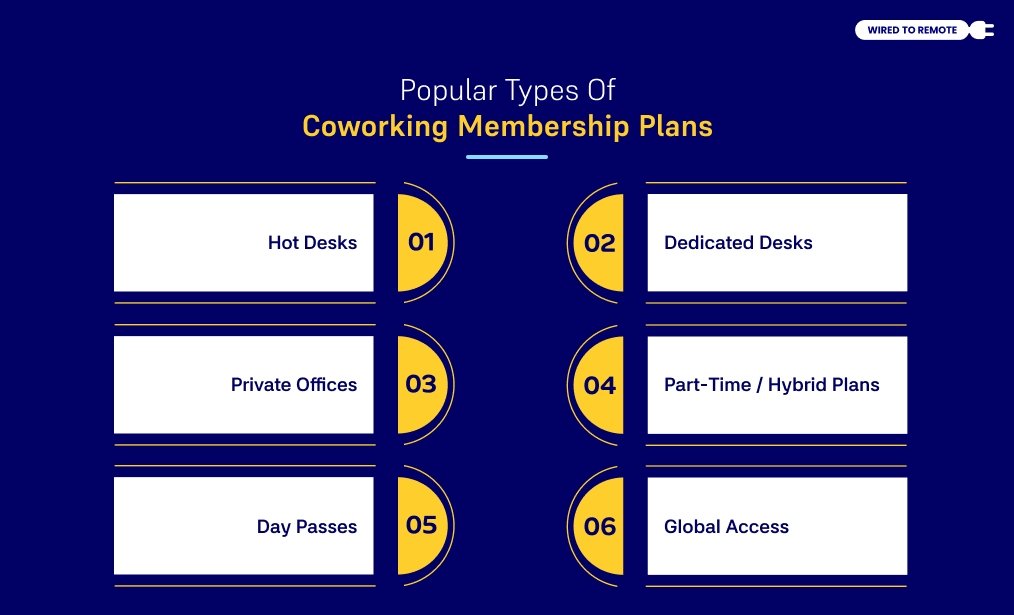
Finding the right plan is about balancing cost with your need for consistency and privacy. Here is a look at the coworking membership plans based on their types:
| Type | Monthly Cost | Best For | Key Advantage |
|---|---|---|---|
| Hot Desk | $150 – $350 | Freelancers & Nomads | Maximum flexibility; lowest cost |
| Dedicated Desk | $300 – $550 | Daily users & Creatives | Consistent setup; personal storage |
| Private Office | $600 – $2,000+ | Startups & Small Teams | Soundproofing & secure branding |
| Hybrid Plan | $100 – $250 | Part-time / Hybrid workers | Only pay for the days you use |
| Day Pass | $20 – $50 (Daily) | Travelers & Drop-ins | No commitment; on-demand access |
| Global Access | $250 – $400 | Remote & Mobile teams | Work from any city in the network |
Now that, hopefully, you have the basic idea about each of these plans, let us get to know about them in detail:
1. Hot Desks
- Definition: Non-assigned seating in an open-plan area.
- Average Cost: Approximately $215/month in the US.
- Best For: Freelancers and digital nomads who prioritize low costs and high networking.
Initially, hot desking allows employees to pick desks on a first-come, first-served basis in open spaces, costing approximately $150 to $215 per month in the US. In premium markets, it can even go above $600.
Without the constraints of long-term leases and physical offices, it has a very low entry barrier, and the layout is geared towards collaboration.
In most cases, this is the main reason why people consider this the best option for freelancers and digital nomads who want to network actively. (Source: Archie App)
2. Dedicated Desks
- Definition: A specific desk reserved just for you, often with a lockable cabinet.
- Average Cost: Roughly $325/month in the US – about 20-30% more than hot desks.
- Best For: Regular users who want to leave their monitor or personal items overnight.
Secondly, dedicated desks offer a personally reserved workspace with lockable storage. On average, in the US, according to Launch Workplace, they cost $325 monthly – about 30% more than hot desks.
As a result, they are the top option for daily users who need a consistent routine and would like to keep their monitors or other equipment at the office overnight.
3. Private Offices
- Definition: Fully enclosed, lockable suites within the larger coworking facility.
- Average Cost: Ranges from $500 to $2,000+ per month, depending on team size and location.
- Best For: Startups and small teams (2 – 20 people) needing privacy for sensitive calls or client meetings.
Third on the list of coworking membership plans and their types, we have private offices. Additionally, these offer fully enclosed, lockable suites within a coworking facility.
Ranging from $500 to $2,000+ monthly depending on capacity and location, they are the premier choice for startups and small teams seeking absolute privacy for operations, sensitive calls, and professional client meetings.
4. Part-Time / Hybrid Plans
- Definition: Bundles that offer a set number of days (e.g., 5 or 10 days) per month.
- Average Cost: Depends.
- Best For: Hybrid workers who only need a professional setting a few times a week.
Next, part-time or hybrid plans bundle a set number of access days (like 5 or 10) monthly. Also, the costs vary based on volume and location.
For instance, a 5-day pass might cost $70 to $150 a month, while a 10-to-12-day pass could range from $150 to $250+. However, this entirely depends on the city and the brand’s premium nature.
Additionally, they are the premier choice for hybrid workers and side-hustlers needing a professional, distraction-free setting a few times a week without paying for full-time access
5. Day Passes
- Definition: Single-day access to open workspace.
- Average Cost: Between $20 and $50 per day.
- Best For: Travelers or those who usually work from home but need a “focus day.”
Day passes grant single-day access to communal open workspaces. Furthermore, averaging between $20 and $50 daily in the US, they are the premier choice for business travelers needing a reliable setup.
Additionally, remote employees also often choose this. Especially the ones seeking a change of scenery and a high-productivity “focus day” away from home distractions
6. Global Access
- Definition: Memberships (like those from IWG or WeWork) that grant access to an entire network of global locations.
- Cost: Depends.
- Best For: Distributed teams and frequent business travelers.
Finally, there are global access plans that grant network-wide access to hundreds of international locations. Moreover, when it comes to cost, these generally average $200 to $350+ monthly.
Additionally, they are often the premier choice for distributed teams and frequent business travelers needing guaranteed, professional workspaces with reliable Wi-Fi, conference rooms, and amenities, no matter what city or country they are visiting.
Comparison: Coworking vs. The Alternatives
Is a coworking membership actually better than your kitchen table or a traditional lease?
Coworking vs. Working From Home (WFH)
While WFH is free, it often comes with a “loneliness epidemic.” Furthermore, research shows 88% of members report reduced isolation after joining a coworking space.
Additionally, 85% of members feel more motivated in a professional setting compared to a home office.
Coworking vs. Traditional Office Leases
Secondly, the financial gap is also significant. For instance, in major cities, companies can save $11,000 to $13,000 per employee per year by switching to coworking.
Traditional leases often require 6 – 12 months’ rent as a security deposit. Additionally, one needs to pay thousands in upfront setup costs for furniture and IT. On the other hand, coworking has zero upfront build-out costs. (Source: NoBrokerage)
How To Choose The Right Coworking Plans For You?
To select the best plan, there are a few things that you might have to think about. For instance, you can consider these five key factors:
- Work Style: Choose based on your need for privacy (Private Office) or collaboration (Hot Desk).
- Location: Many members prefer spaces within a 15-minute commute.
- Budget Transparency: Check for hidden costs – meeting room rates can be expensive, with rates averaging around $45 per hour.
- Amenities: Ensure necessary tools, such as specialized video conferencing or professional mail handling, are provided.
- Scalability: Opt for providers allowing easy upgrades as teams expand
Questions To Ask Yourself
To avoid “paying for what you don’t use,” ask yourself these four questions:
1. How often will I actually go?: If it’s less than 2 days a week, a Day Pass or Part-Time Plan is more cost-effective.
2. Do I deal with sensitive data? If yes, a Private Office or at least a Dedicated Desk with a locker is essential for security.
3. Is location worth the premium? Premium CBD (Central Business District) locations offer prestige but higher rates.
Tip: Consider Suburban Coworking – 65% of new memberships are now for locations within a 15-minute commute of home.
4. Are there hidden fees?: Always check the policy on meeting room credits. Some plans include them, while others charge a median hourly rate of $45.
Frequently Asked Questions (FAQ)
Here are some of the questions that people often ask about coworking membership plans. Take a look at them before you leave:
In many regions, yes. For freelancers and business owners, workspace memberships are often considered a legitimate business expense.
One of the primary benefits of coworking is scalability; you can move from a hot desk to a 10-person private office in as little as 24 hours.
Most plans include a monthly allotment of “credits” for meeting rooms. Additionally, once used, you typically pay a discounted member rate for additional hours.



Leave A Comment