

Starting work at 9 am and ending it precisely at 5 pm is a super-human task.
Especially for remote workers, who log in from diverse locations, punching in and out right on time is technically impossible.
That’s why time clock rounding exists. This simple method helps employees and employers to round up odd minutes to the nearest time.
So, it becomes easier to calculate their work hours and create the payroll. But this rounding up of time is not done randomly.
That is, there are certain rules and methods that companies adopt to ensure that there is transparency between the employers and the employees.
So, if you are wondering how the time clock rounding helps with accurate time tracking in a remote setup, I have got you covered. In this blog, I am going to explore—
- Its basic characteristics,
- How it works in a remote team,
- Some legal and compliance aspects, pros and cons, and more.
So, come dive right in!
What Is Time Clock Rounding?
First things first, time clock rounding is a standard practice of simplifying odd minutes into the nearest standard time.
That is, in corporate settings, the employers often round up the punch-in/out times of the employees to create a standard payroll structure.
For instance, if an employee clocks in at 8:53 AM, then it will be rounded up to 9:00 AM for simpler time calculations. But the employee loses their 7 extra minutes.
So, a standardized method is used to track the work hours, which is unbiased and beneficial for both the employers and the employees.
Common Time Clock Rounding Intervals

Given that odd minutes can be standardized using various methods, here are some of the common rounding methods—
- 15-Minute Rule: The hour is divided into four quarters, and odd minutes are rounded up or down to the nearest quarter.
- 5-Minute Rule: Time is divided into 5-minute slots. So, odd minutes are rounded up to the nearest 5-minute frame.
- 6-Minute Rule: Often referred to as decimal rounding, it converts the odd minutes to a decimal point for easier calculations.
How Time Clock Rounding Works For Remote Teams?

Now, these three time clock rounding methods work differently for remote teams. So, knowing each one’s workflow is crucial for better implementation.
1. 15-minute Rounding
Also known as the 7-minute rule, this is the most widely adopted rounding method.
Typically, it breaks down an hour into four parts and rounds up the odd minutes to the closest quarter.
Now, to decide whether to round up or down, it follows the 7-minute rule. That is, if the odd minute ranges from 1 to 7 minutes, then it will be rounded down.
But if the odd minutes range from 8 to 14 minutes, it will be rounded up.
That is, if the time is 8:51 AM, it will become 8:45 AM. Similarly, for the time 9:28 AM, it will become 9:30 AM.
2. 5-minute Rounding
Similarly, the 5-minute rounding method divides an hour into 5-minute blocks. So, each odd minute can be rounded up to the nearest 5-minute time frame.
That is, if the time is 9:03 AM, then it will be rounded up to 9:05 AM for simplified time tracking. Making it easier for employers to track the time.
3. 1/10th Hour Rounding
Unlike the above two methods, the 1/10th Hour method follows a complicated mathematical equation to find the decimal point of the odd minutes with respect to the hour.
Generally, it is used to simplify the total work hours for calculating the payroll. So, it rounds up the minutes into decimal points of the hour.
That is, it uses the formula—
Decimal Hours = Odd Minutes / 60
So, if the time is 9 hours 42 minutes, then the rounded-up time becomes 9.07 hours. Making it easier to calculate the total work hours.
What Are The Legal And Compliance Aspects Of Time Clock Rounding?

Even though time rounding helps to simplify the time tracking for remote work, it should not only benefit the company.
So, there are certain guidelines and legal aspects associated with the process. Some of these aspects include—
1. FLSA Guidelines
According to the Fair Labor Standards Act (FLSA), all kinds of USA employers are supposed to track and record employee work hours accurately.
That is, employers are supposed to implement proper software to track employees’ work hours. Also, they should use standardized rounding methods to manage odd timings.
But the regulation prioritizes the employees’ benefits and neutrality of the method over the biased benefits of only the employers.
2. Other Legal Compliances
Apart from the FLSA guidelines, there are other legal regulations that employers need to comply with while tracking employees’ workhours. Some of these include—
- Following the standard 7-minute rule,
- Maintaining fairness towards all employees,
- Avoiding wage theft with biased rounding methods.
So, remote teams need to create policies that adhere to these regulations and comply with these legal aspects. Avoiding time rounding issues even in a remote work setup.
Pros And Cons Of Time Clock Rounding In Remote Teams
Although the time rounding practices offer countless benefits, it comes with a set of challenges. So, here are the pros and cons of time clock rounding for remote teams—
| Pros | Cons |
|---|---|
| 1. Simplifies time entries with manageable and standardized time roundings. | 1. Issues with legal compliance when practices solely favor employers. |
| 2. Providing flexibility to remote workers with their punch-in/out times for better management. | 2. Affect the company culture by making the employees feel watched. |
| 3. Prevents time theft by offering a standard practice for tracking time. | 3. Small and irregular rounding can affect the consistent time tracking practice. |
Common Mistakes With Time Clock Rounding
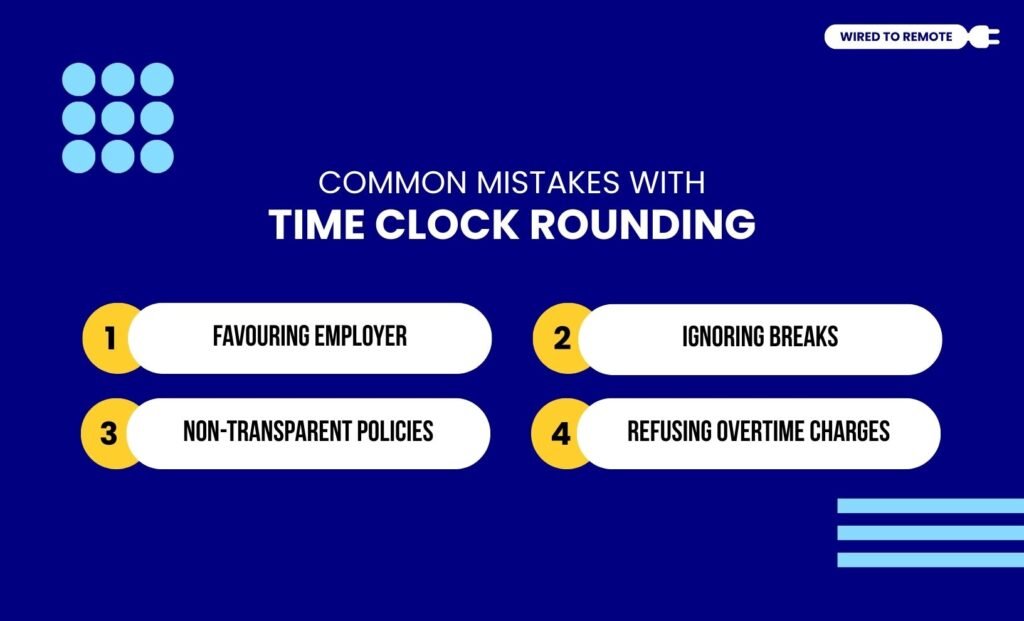
Making mistakes while rounding up the time can impact both the company culture leading to various legal issues. So, here are some methods to avoid making common mistakes—
- Favouring Employer: If the rounding up solely favors the employers, then the practice should be updated. So, it favors the employees, too.
- Ignoring Breaks: Only checking the total work hours without considering the break time can affect the accuracy of the data. So, the policy should consider breaks properly.
- Non-Transparent Policies: Not providing a transparent policy or communicating the exact process of work hour calculation can create distrust. So, ensure the policies are transparent.
- Refusing Overtime Charges: Only paying for the work hours and not for the overtime can demotivate the employees. So, employers should provide proper compensation for overtime work.
Avoiding these mistakes can ensure that the remote team is working in a proper company culture, where their efforts and time are valued.
So, if you haven’t implemented any of these time tracking methods, this is your sign to do so. Just choose an automated system to track and accurately record employees’ punch-in/out timings.
FAQs
Here, I have brought you some common questions about time clock rounding that most remote workers look for.
Yes, absolutely. In most countries, time clock rounding is considered legal in workplace management. Especially in the USA, the FLSA legalizes time clock rounding for remote employees.
Generally, the 7-minute rounding rule is most commonly prevalent in remote work. Since it is legally compliant, it has become the standard rounding rule.
That is, for 1 to 7 minutes, the rounding goes down to the nearest quarter hour. And, for 8 to 14 minutes, the rounding goes up to the next quarter hour.
Yes, absolutely. Unlike the contrary belief, time rounding can significantly affect overtime payrolls of remote employees. That is, the 6 to 15 minutes rounding up becomes convenient for calculations.
But it should become neutral when calculating the overtime pay. This way, employers can consistently manage the overtime charges without creating biased or illegal payments.
Yes, absolutely. Given that there are certain legal rules and compliance with time clock rounding, most companies follow a standardized rule.
So, if the employees feel that the compensation is inadequate or that the practice benefits only the employers, they can challenge the rounding practices.



Leave A Comment