

Remote work and productivity are list opposite poles. But with the right strategies and methods, they can form a strong magnetic connection easily.
Ensuring remote work is boosting productivity without overwhelming the employees.
Now, one such method is time blocking. As a productivity method, it helps in breaking the entire time frame into smaller bits for better task management.
Moreover, it allows remote employees to juggle meetings, emails, and an endless list of workloads efficiently. So, they can manage multiple projects without a system crash.
But the real question is— “How to use Time Blocking to improve productivity in remote teams?” Well, no need to look any further, I have got you covered.
In this blog, I am going to explore the diverse aspects of time blocks and their strategies by focusing on—
- Its basic characteristics,
- Benefits for remote teams,
- Steps to implement it in a remote setup, and more.
So, come dive right in!
What Is Time Blocking?
Before jumping into how to use time blocking in remote work, let’s understand its basic characteristics and methodologies.
For instance, time blocking is a productivity method that allows employees and employers to break the entire work hour into smaller blocks.
Now, based on the priority of the task, the time blocks are created. That is, if the task requires complex management, then it is set for a longer time block.
But if it is a simple task that can be managed within one time block, then it is set for a shorter block. This way, the entire day can be brokendown into diverse blocks with specific tasks.
Why Do Remote Teams Need Time Blocking?
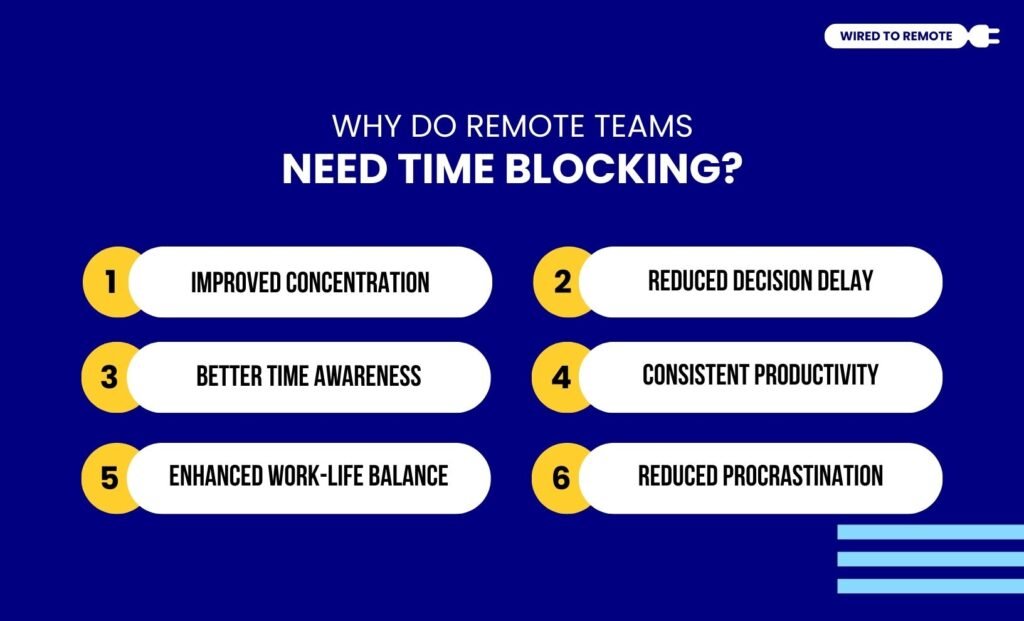
Given that time blocking massively improves work productivity, it is readily implemented in remote teams. But apart from the productivity, it offers other benefits to manage time.
Some of these benefits of using time blocking in remote work include—
- Improved Concentration: Firstly, using the time blocking method can help ensure that the employees are working with full concentration. That is, they focus on allocated tasks in time blocks without being distracted.
- Reduced Decision Delay: Also, it reduces the delay in making important decisions about task management and workload. So, managers can delegate the prioritized tasks to specific time blocks, which reduces the delay.
- Better Time Awareness: Moreover, it improves the time awareness of the employees. So, they can manage their tasks without being distracted by inaccurate planning.
- Consistent Productivity: In addition to this, the time blocking provides the start and end times for a task. So, employees can focus on a specific task during the time period. Boosting consistent productivity in the workforce.
- Enhanced Work-Life Balance: Moreover, for remote work, time blocking enhances the work-life balance. That is, the dedicated time blocks create the boundary between work and personal life.
- Reduced Procrastination: Finally, the specific time blocks break the long hours into smaller periods, making task management less intimidating. So, the employees can avoid procrastination and focus on the work.
How Time Blocking Works In A Remote Setup?
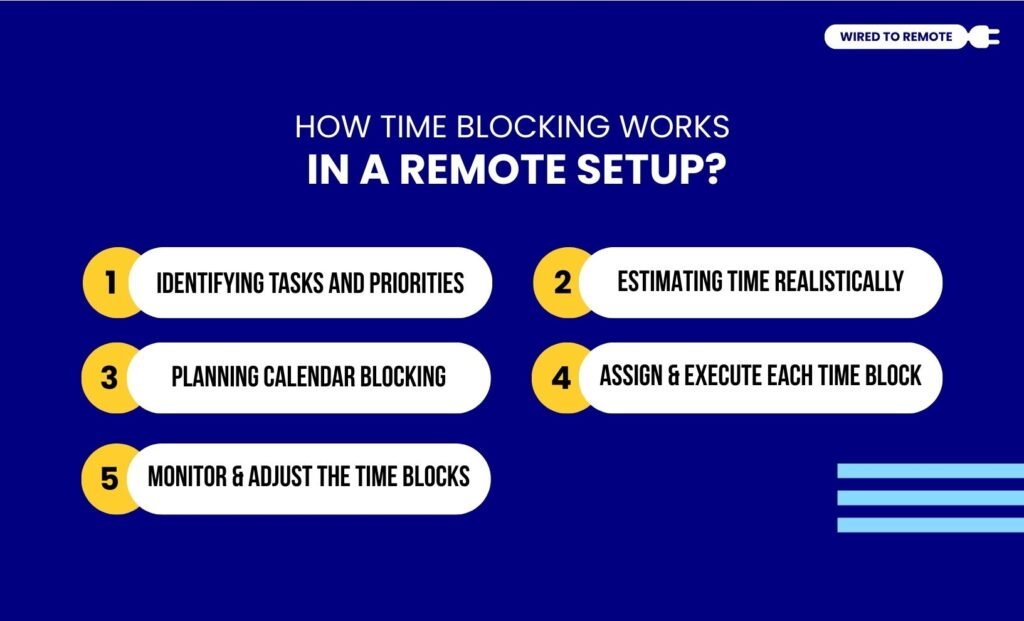
Now, time blocking works through categorization and task prioritization. That is, employees can schedule the time blocks based on the importance of the tasks.
So, here is how to implement the method in a remote system—
1. Identifying Tasks And Priorities
Firstly, employees need to understand how the tasks are categorized. That is, they need to identify the priority tasks and tackle them with importance and urgency.
2. Estimating Time Realistically
After that, employees need to create realistic time blocks. That is, they need to assign specific time blocks to tasks based on their importance.
So, the employees can create a calendar planner to map out the estimated time blocks, have buffers, and manage multiple tasks based on priority.
3. Planning Calendar Blocking
Apart from the work-related tasks, remote workers need to balance their personal lives, too. That is, they need to include buffer time, breaks, and rests in between tasks.
So, they need to plan the daily timeframe or the monthly calendar while balancing tasks and breaks simultaneously.
4. Assign And Execute Each Time Block
Now, simply creating the time blocks is not enough. That is, it is imperative that the employees stick to the time block schedule and focus on the assigned tasks.
So, when they follow and stick to the schedule, they can easily finish the tasks on time. Avoiding delays or unnecessary extension of the time blocks.
5. Monitor And Adjust The Time Blocks
Finally, managers can monitor how the current time blocking schedule is performing. Then, they can adjust the time blocks for the weeks and months.
That is, based on the productivity performance of the tasks, the time blocks can be readjusted. So, the new schedule addresses the issues with better planning.
How To Avoid Common Time Blocking Mistakes?
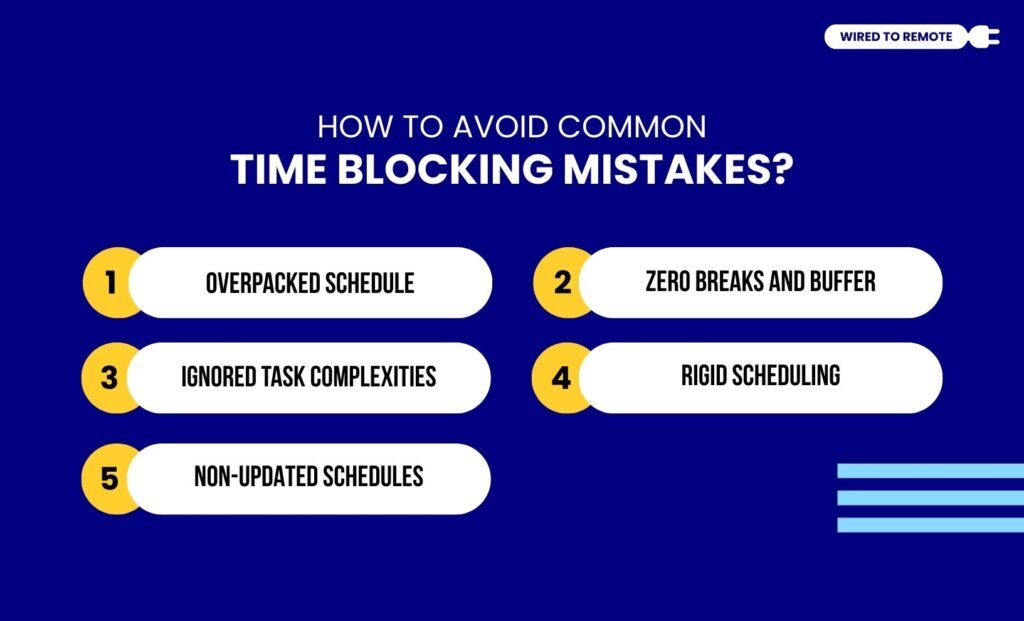
Now, there can be certain common mistakes with time blocking that most remote employees often encounter. So, here are some of the troubleshooting methods for these mistakes—
- Overpacked Schedule: Firstly, overpacking the schedule can leave the employees feeling exhausted and unable to deliver the tasks on time.
- Zero Breaks and Buffer: Moreover, ignoring buffer time and breaks can often lead to mental fatigue. So, it is important to keep at least 10 to 15 minutes buffer in between tasks.
- Ignored Task Complexities: Also, time blocks should be created based on task complexities. So, employees can avoid going beyond the time frame to complete the task.
- Rigid Scheduling: Additionally, rigid time blocks can create panic and affect the swift handling of emergencies. So, it is better to keep the scheduling flexible.
- Non-Updated Schedules: Finally, keeping the same schedule for all kinds of tasks is not right. Rather, adjust and update the schedules based on the task priorities.
Things To Keep In Mind While Creating Time Blocks
Now, knowing all about time blocking is not enough. Rather, remote employees need to keep a few considerations in mind while creating time blocks.
So, some of these key considerations include—
- Using buffers and breaks in between time blocks for a smooth workflow.
- Planning the schedule to save workforce energy and improve efficiency.
- Batching similar tasks under the same time blocks to avoid unnecessary switching.
- Color-coding the planner for better visual task management.
- Reviewing and optimizing the planning or scheduling on a weekly or monthly basis.
So, by keeping these few considerations in mind, remote workers can manage tasks within a time frame while boosting productivity.
Now, if you are still wondering whether to use time blocking for your remote team, take this as a sign. Just follow the steps listed above and transform the workforce into a productive machine.
FAQs
Here are some of the common questions around time blocking for remote teams that most employees look for.
Generally, time blocking ensures that the entire work hours are utilized productively. But if there is no space in between the blocks to buffer the timeframes, then it can feel rigid.
So, employers and employees must schedule the time blocks in such a way that there is a buffer time of at least 15 minutes between two blocks.
Based on the complexity of the tasks, you can modify the buffer time. Generally, it is better to add around 10 to 15 minutes of buffer time in between simple hourly blocks.
But if the tasks are complex, then it is safe to keep a 30 minutes buffer time. This way, employees can better manage their workflow, prepare for the tasks, and rest in between.
Yes, absolutely. Time blocking evidently breaks down the entire work hour into smaller sections. Creating a structure for the workflow, scheduling specific tasks, and managing the time.
So, employees can avoid feeling overwhelmed and manage their daily tasks properly.
Moreover, it increases predictability, task prioritization, and multitasking, which helps in reducing work stress effectively.
Given that time blocking is not a rigid method, missing a time block is not the end of the world.
That is, employees and employers can either reschedule the task for a different time frame or adjust the schedule to fit in the time block within the timeline.
But the entire readjusting or rescheduling depends on the priority of the task. That is, if the task is important, it can be readjusted, else, it can be rescheduled.
Yes, absolutely. Time blocking is an excellent productivity method for managing creative work. That is, it ensures that the creative task is handled with high focus and zero interruptions.
Moreover, the scheduling of creative tasks in advance can help in reducing the cognitive workload, distractions, and aligning productivity with business goals.



Leave A Comment