

Workplaces have changed forever after COVID-19. It has been years since most of us working in remote or hybrid models.
So, understanding the employee utilization rate has become all the more important in this modern landscape.
Most market data says an employee utilization rate of 70-90% is great for remote employees. Here, the standard is similar to that of the office employees.
However, sometimes the productivity of remote employees working on billable projects is higher.
I completely agree with it as the interruptions are fewer, the stress of the commute is gone, and the schedule is more flexible.
It’s like, “You deliver when it is needed the most.”
But how do you determine the optimal employee utilization rate? How does an optimized employee utilization rate help a business?
Hi, today’s blog, I will give you a brief idea of what the employee utilization rate is, how to calculate it, why it is important, how to improve it, common pitfalls, and more.
I will also talk about how the optimization of employee utilization rate is possible for remote workers and digital nomads.
What Is Employee Utilization Rate?

Employee utilization rate is an easy calculation to compare how many hours an employee has worked on billable projects against administrative and non-billable tasks.
So, the formula to calculate the employee utilization rate is:
(Billable Hours for an Employee/Total Available Hours) x 100 = The Percentage of Employee Utilization Rate
For example, suppose the available working hours for an employee are 216 hours in a month. Furthemore, the billable hours are 192.
Now, the monthly employee utilization rate is (192/216) x 100 = 88.88%
This is a good employee utilization rate, as a 70-90% employee utilization rate for in-office and remote employees is considered healthy, where the employee is able to achieve a work-life balance.
The Employee Utilization Rate Differs From One Industry To Another
However, this employee utilization rate differs from one industry to another. For example, for someone in an IT company, 75% is a decent employee utilization rate. It is the same for professional services.
On the other hand, if you are working in the production and manufacturing sector, the same will shoot up to 80-90%.
Employee Utilization Rate Differs From One Job Role To Another
Furthermore, the employee utilization rate will keep varying based on your job role, seniority, responsibilities, and administrative duties.
For the juniors or the ones at the production level, a company looks for a higher utilization rate. However, the senior employees or managers are expected to have a lower employee utilization rate.
It is because they have to balance many non-billable or administrative tasks, such as training and mentoring, along with the core production work.
Have a look at the table below to understand how the employee utilization rate changes across seniority levels.
| Junior/Entry-Level Employees | 90% |
| Experienced Production Staff | 70-90% |
| Team Leaders and Managers | 30-50% |
| Executives and Directors | Usually do not have high billable targets. They focus more on strategy making and business development. Moreover, they help to maintain high-level client relationships. |
There is a reason why the team leaders, management, and the directors have a lower employee utilization rate.
If the utilization rate of a senior employee is higher, there will be burnout.
At the same time, the ones in junior job roles need to have a higher utilization rate, as a poor percentage here indicates inefficiency and poor project management.
Overall, when there is a balance between the utilization rates of the seniors and juniors, the targets become more realistic, and the billing dates become more accurate, optimizing revenues.
Billable And Total Productive Utilization: Two Aspects Of Employee Utilization Rate
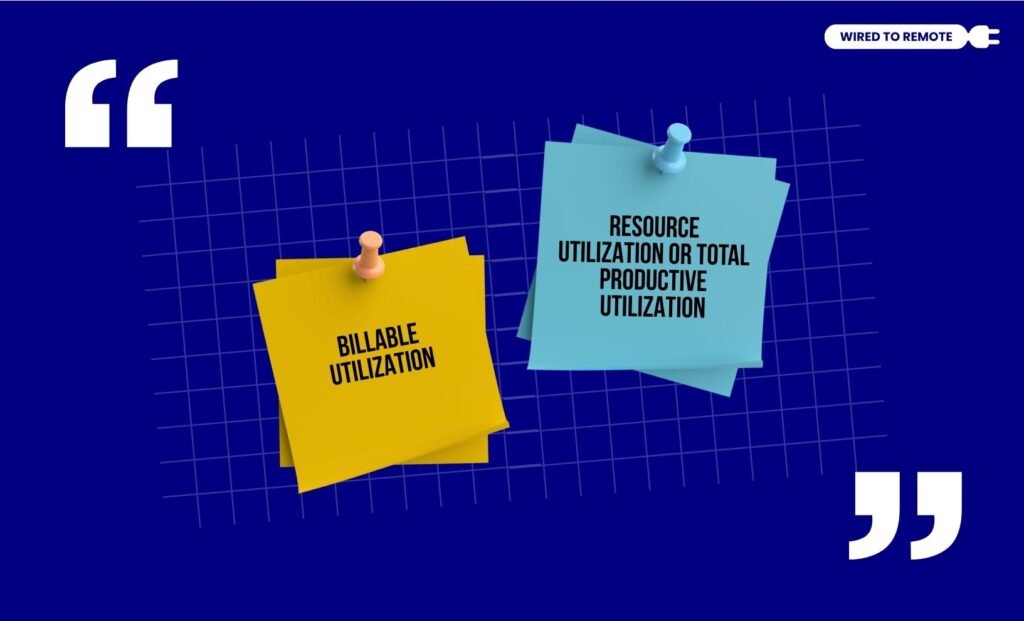
Now, the employee utilization rate has two distinct aspects. The first one is billable utilization, and the second one is total productive utilization or resource utilization.
1. Billable Utilization
Billable utilization means the billable hours of an employee against the total work hours available.
The formula for calculating billable utilization is (Billable Time/Hours Available)x100
For example, suppose your working hours in a week are (9×5) = 45 hours. And you dock in (8×5) = 40 hours in a week under a billable project.
Then, your billable utilization per week will be (40/45)x100 = 88.88%.
2. Resource Utilization Or Total Productive Utilization
Resource Utilization measures the productivity of an employee. It includes how many hours you have worked for the clients and the internal or non-billable time you have spent.
The formula for calculating resource utilization is (Time Tracked/Total Time Available)x100.
Why Employee Utilization Rare Matters: The Benefits of Tracking Employee Utilization Rate

Employee utilization rate matters for a better insight into workforce productivity and efficiency. It further helps with capacity planning and staffing.
In addition, it supports budget planning and forecasting. It also helps in employee engagement and maintaining the workload balance.
Overall, it supports revenue growth, profitability, and competitiveness.
1. Finding The Capacity Utilization Rate Of A Team
By using the employee utilization rate, you can calculate the average capacity utilization rate or the capacity utilization rate of a team.
There is a simple formula for calculating the average capacity utilization rate.
Calculate the total employee utilization rate and divide it by the number of employees.
For example, suppose there are four employees with an utilization rate of 90, 85, 80, and 75%, respectively. So, the average capacity utilization rate will be:
(90%+85%+80%+75%)/4 = 82.5.
2. Identifying The Ideal Profit Margin
Suppose you want to make a profit of 20% in your business, and the average cost of the timing of an employee is $100000.
Furthermore, let’s assume that the overhead cost for each employee is $15000.
Now, the formula for calculating the ideal profit margin is:
(Resource Costs+Overhead Costs)x The Percentage of the Ideal Profit Margin.
So, in this case, the ideal profit margin will be:
($100000+$15000)x20% = $23000.
3. Optimal Billing
At this stage, you will have to calculate the following:
- The Cost of All the Resources
- Overhead Costs
- Profit Margin
Then, you will have to divide this result by the average hours every employee works.
For example, the average yearly working hours for the employees is 2000 hours in a year. Now, the optimal billing formula will be:
(Resource Costs+Overhead Costs+Profit Margin)/Average Employee Hours.
So, according to our calculations, it will be:
($100000+$15000+$23000)/2000 = $69.
It means that the best pricing will be $69.
However, this optimal billing is calculated when the resource utilization rate is at 100%. At the first step, we found that the employee utilization rate for this calculation is 82.5%.
So, the optimal billing rate will be the optimal billing rate/the employee utilization rate.
Thus, the result will be $69/.825 = 83.63.
Understanding Good, Bad, And Optimal Employee Utilization Rates
Across various industries, the average employee utilization rate for someone at the production level is around 75 to 90%.
However, for the team leaders and managers, the same is expected to be around 30-50%.
Now, 100% employee utilization rate is never a healthy practice as it does not leave any room for planning, training, strategy-making, or growth. It also indicates serious burnout.
Moreover, it means that there is no time for wellness programs to boost employee efficiency.
At the same time, when the employee utilization rate is consistently below 60-70%, it means underutilization.
Underutilization can happen because of a lot of reasons. It may indicate that employees are unable to generate revenue, which will cover their costs. This may even imply poor project planning, and many employees have insufficient work.
How To Improve Your Employee Utilization Rate? Know The Best Practices For Digital Nomads
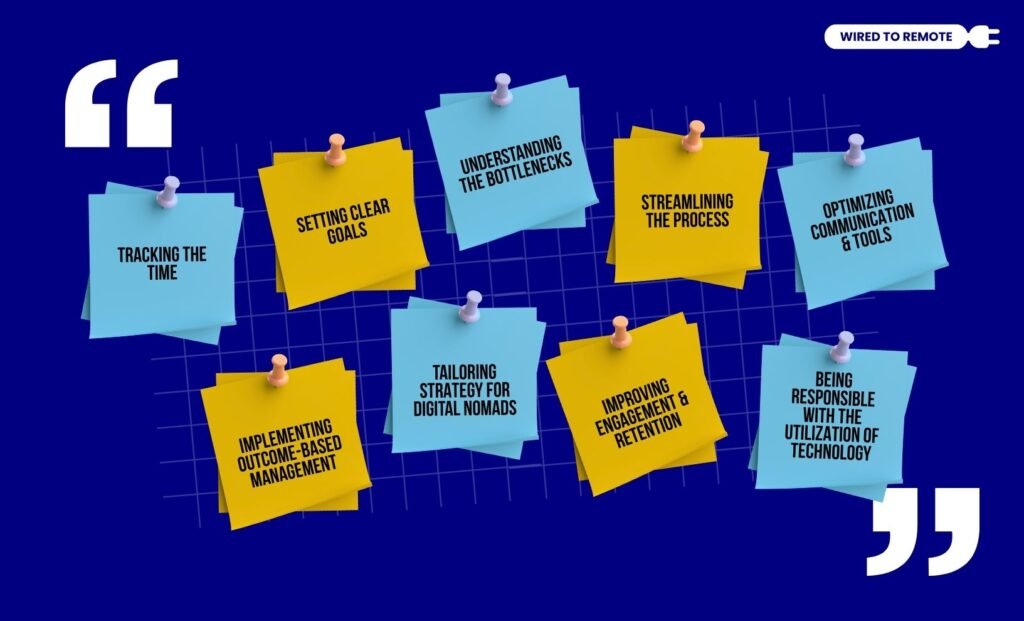
In order to optimize your utilization rate, you have to ensure that you are managing your resources correctly.
In this way, you can ensure that they are most productive and efficient.
Also, optimizing the employee utilization rate has become all the more crucial for remote employees or employees with a digital nomadic lifestyle.
There needs to be a strategic shift with centralized workflow management, having concise SOPs or standard operating procedures, and asynchronous communication.
Here are more details.
1. Tracking The Time
It is the first step toward understanding the utilization rate of your employees and resources.
Once you track time and have the data, you will identify the areas of improvement and, if there is any need for better time management.
2. Setting Clear Goals
Your goals will depend on your specific business objectives. So, what are your objectives?
- Reducing Costs?
- Boosting Productivity?
- Improving Customer Satisfaction?
Your employee utilization rate optimization efforts will be on track once you choose the right business objective.
3. Understanding The Bottlenecks
Inefficient employees, failed equipment, or ill-managed workflow are the main bottlenecks. Once you identify the bottlenecks and you know how to fix or eliminate them, you will optimize the employee utilization rate.
4. Streamlining The Process
Sometimes repetitive and mundane tasks can be the bottlenecks. Check if those tasks can be automated to avoid unnecessary errors and delays.
5. Optimizing Communication And Tools
Asynchronous communication, standardized documentation, and centralized workflow management are the basics for ensuring outcome-based management.
Asynchronous Communication
Suppose an employee is doing deep research for any specific project or writing a research-heavy piece, and you constantly text them over Microsoft Teams or Google Hangouts.
The timeline and quality of work both suffer. So, based on the nature of the job, you have to sometimes let go of the lure of real-time communication.
You can use tools such as Notion or Slack and other project management platforms to update the progress of a project daily. The concerned workers and management of the project can read the updates at their convenience.
Centralized Workflow Management
Project management software, such as Jira or Trello, helps in maintaining transparency. Everyone associated with the project has a bird’s-eye view of the individual and holistic developments of the project.
It is more essential for digital nomads as everyone works in silos.
Standardizing Documentation Or SOPs
Make sure that the documentation of your Standard Operating Procedures (SOPs) is objective and has a defined step-by-step process.
There is no room for vagueness, and little should be left for interpretation. The last thing you want is Chinese Whispers.
6. Implementing Outcome-Based Management
You have to set SMART goals for employees. When everyone has to do something Specific, Measurable, Achievable, Relevant, and Time-bound, they will know what is expected of them daily and weekly.
Translate the SMART goals into Objectives and Key Results (OKRs) or Key Performance Indicators (KPIs) to set the priorities clearly for remote employees.
Don’t set targets assuming 100% capacity, as there will be breaks, meetings, and other administrative requirements.
Moreover, assess the quality and timely delivery of an employee instead of the time they are online.
7. Tailoring Strategy For Digital Nomads
Digital nomads will work across various time zones. So, you have to communicate the time zone or the window you expect them to be available and working.
Also, ensure that they have a consistent and trusted connectivity setup. Moreover, ask them to keep you informed about their in-transit days so that you don’t smell danger of missing deadlines.
8. Improving Engagement And Retention
Alienation is the biggest problem for us who have been working in remote models for the longest time.
Building Virtual Connections
You can organize virtual hangouts, coffee breaks, or team-building sessions to foster virtual connections.
It helps, as I once had to deliver an assignment in 2.5 days, which was originally meant to be a 5-day-long project for Amazon.
I was working with a team of 10 new joiners whom I had never met in person, thanks to the COVID-19 lockdowns.
Every day, we used to have a coffee break or talk about our favorite movies/books at 5:30 PM. It helped us connect and deliver the work big time.
One-On-Ones
Every Friday, we used to have our check-in meetings to understand the work progress and roadblocks.
Regular one-on-ones are important. This helps to share healthy feedback and foster trust among the team members.
Moreover, when you know the roadblocks or the areas you are lagging, you can do better resource allocation. You know where to pitch in.
Employee Appreciation
In addition, once a month, as the project lead, I used to announce the name of the best performer for the month.
The best employee for the month was called the “Star of the Month,” and their name featured on the company’s notice board.
Employee appreciation is important to keep everyone motivated, whether in-office workers or remote workers; everyone loves to be appreciated.
9. Being Responsible With The Utilization Of Technology
With remote workers and digital nomads, you can use time tracking tools such as Clockify or Toggl. However, you have to be responsible here.
You cannot indulge in over-monitoring or micromanagement with technologies such as mouse clicks, as these lead to anxiety, lack of motivation, and burnout.
Furthermore, meetings are not the space or tools to check whether your remote employees are working or not. Organize meetings when there is a need for communication or conveying some essential ideas.
Moreover, there will be occasional pauses, and you cannot haul up anyone for the same. If you notice any problem with an individual consistently, try to figure out the bottlenecks with data and resolve the issue.
What Are The Tools And Techniques For Tracking Employee Utilization Rate?
Time tracking, workforce analytics, and resource allocation are three important pillars for optimizing the employee utilization rate.
| Tools To Optimize Employee Utilization Rate | Utility |
|---|---|
| Time Tracking Software | Tracks the hours employees spend on a project Helps evaluate productivity and scope for improvement |
| Workforce Analytics | Analyzes Patterns to Understand Progress and Bottlenecks Helps in Resource Allocation Helps in Optimizing Individual and Team Performance by Identifying the Gaps |
| Resource Allocation | Tracks the Capacity and Availability of Employees Scale Staffing Demands Based on Workloads Minimizes Idle Time |
Common Misconceptions And Pitfalls About Employee Utilization Rate
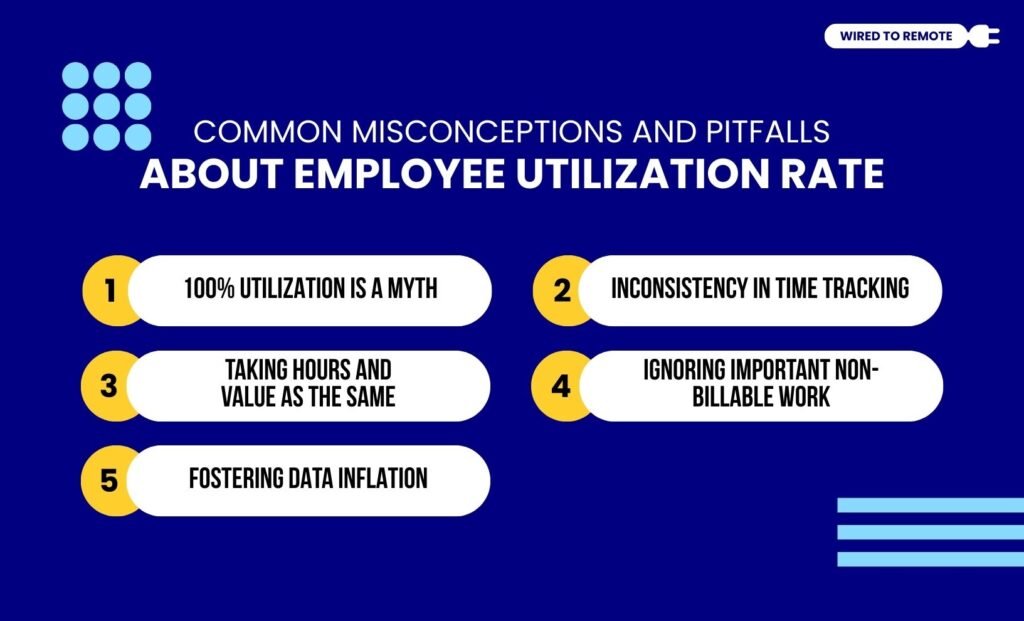
When employees are facing serious burnout, and there is a consistent drop in output, you have to understand that there is something wrong in your calculation of the employee utilization rate.
You can avoid such a scenario once you identify the common misconceptions and pitfalls.
1. 100% Utilization Is A Myth
100% utilization can never be the benchmark, even 95% is pretty high as the employee utilization rate.
It eliminates the scope for training, learning, and development. Also, 100% utilization leads to employee burnout and impacts the quality of work.
2. Inconsistency In Time Tracking
If you are managing a department, you have to track the time accurately. If the data is flawed, you can end up showing your people less efficient than they are.
3. Taking Hours And Value As The Same
A high employee utilization rate does not mean high profitability. Value does not mean the time an employee spends on task. It is about the impact and the efficiency of the employees.
4. Ignoring Important Non-Billable Work
Training, internal meetings, and mentorship programs are important tasks for the growth and development of an employee, a team, and an organization.
These are all non-billable tasks. However, you cannot ignore them if you want to optimize employee utilization with a growth mindset in the future.
5. Fostering Data Inflation
Are the targets set by you unrealistic? You are forcing your employees to inflate their reporting hours.
Thus, data becomes unreliable, and you fail to understand the more serious or deeper operational inefficiencies.
What Are The Challenges In Achieving A Balanced Employee Utilization Rate?
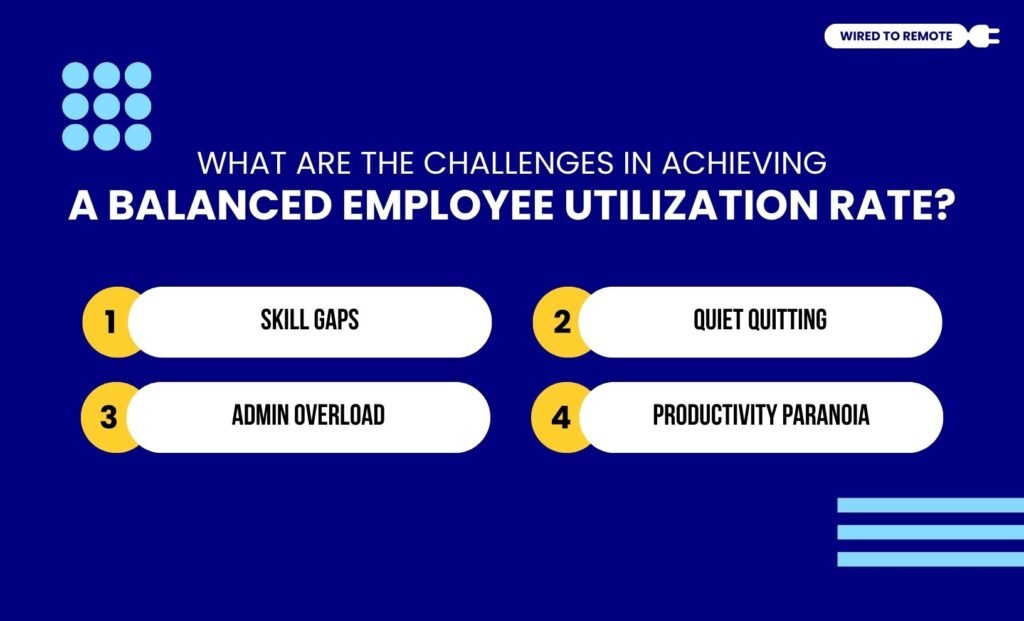
Skill gaps, quiet quitting, admin overload, productivity paranoia, and unclear goals are the main challenges in achieving a balanced employee utilization rate.
1. Skill Gaps
For optimal employee utilization, you have to assign a task to the employee who has the skills and efficiency to complete it.
Otherwise, there will be delays and quality gaps, ultimately leading to missed deadlines and sales.
2. Quiet Quitting
If the burnout is severe because you calculated an unrealistic employee utilization rate, employees will stop giving their best or engaging.
So, though they are still working with your company, they have withdrawn themselves.
3. Admin Overload
Are your employees spending more time on meetings, administrative work, and business development due to an improper strategy making?
This is a classic example of admin overload, impacting the optimization of employee utilization rate.
4. Productivity Paranoia
Productivity paranoia is the biggest challenge in optimizing the employee utilization rate, considering we are in 2026, and according to a Zoom article on hybrid work statistics, around 75% of business leaders are going to adopt this model by 2026.
So, if you constantly think that your remote workers are less productive, you are limiting the potential for optimization.
Case Studies On Employee Utilization Rate

Here, I want to highlight two case studies of Automattic and GitLab, which, as fully remote companies, have successfully optimized their employee utilization rates.
1. Automattic/Wordpress.Com
Automattic has developed a healthy remote work culture and improved its employee utilization rate based on asynchronous communication.
It now prioritizes documentation over meetings. Thus, it has improved its employee retention rate and engagement.
2. GitLab
GitLab, as a fully remote company, thinks that this model helps boost their productivity. There is an improvement in transparency, and they have cut down the onboarding time drastically, boosting overall efficiency.
Other companies to improve their employee utilization rate while working on a remote model are the BT Group of the UK, Apollo Holdings, etc.
Employee Utilization Rate For Digital Nomads: Helping In Balancing Productivity And Employee Well-Being
Calculating employee utilization rate is going to be a key factor in optimizing the productivity of companies working on a remote/hybrid model.
With the right calculation, micromanagement is going to get replaced by responsible monitoring that ensures work is on track with impactful performance.
Also, it will help avoid burnout and leave scope for adequate training and mentorship programs essential for long-term development.
Overall, employees remain motivated, and they never feel alienated or withdrawn, even after working remotely from different parts of the world.
Employee Utilization Rate: Frequently Asked Questions (FAQs)
Here are the frequently asked questions and answers about the employee utilization rate.
A utilization rate will tell you how efficient your team is, the capacity for new work, and whether they are facing burnout or not.
Furthermore, it helps us understand whether the seniors are doing low-value work and the need for freeing up their bandwidth for strategy making or more administrative work.
No, employee utilization cannot be above or equal to 100% even at the production level. If you are calculating the rate to be 100%, you are leaving no room for meetings, training, and development.
Also, 100% utilization rate will lead to quick burnout and poor productivity.
You should measure the employee utilization rate weekly or monthly. However, that does not eliminate the need for real-time measurement.
However, sickness and unexpected tasks can hamper daily measurements. So, weekly or monthly check-ins are the best way to measure the utilization rate and the efficiency of an employee.
Again, very frequent measurements or real-time measurements can be turn-offs for real employees. Moreover, personally, I feel it is demoralizing.
Employee utilization is a calculation of how many hours an employee has worked on a billable project.
On the other hand, productivity helps us understand the tasks completed, and it is a measure of efficiency.
So, a high employee utilization rate is never a measure of high productivity. In fact, if you want a very high utilization rate, at around 95-100%, the overall productivity can go down due to burnout and no scope for training and development.



Leave A Comment