
Quick Answer
According to the U.S. Department of State, Greece is classified under a Level 1 Travel Advisory, the safest ranking available, advising visitors to exercise normal precautions.
Violent crime is exceedingly rare. The main security risks to navigate are opportunistic petty theft in major urban transit hubs, seasonal environmental hazards like wildfires, and localized infrastructure stability.
Remote work allows people to replace traditional offices with inspiring new environments. Greece embraced this change rapidly. The country now ranks as a top destination for digital nomads worldwide.
However, moving your digital life and daily routine overseas requires careful planning. You cannot simply look at beautiful sunset photos.
You must understand the factual reality of local security, infrastructure, and everyday living conditions beforehand.
Main facts support the conclusion that Greece is a safe place. You can rest assured if you already booked a ticket for your next remote work trip.
But a truly helpful answer requires breaking down real-world data, infrastructure reliability, and practical safety measures. And that’s what I plan to do. So, keep reading!
Is Greece Safe? What The Safety Data Actually Shows
I prefer to rely on concrete numbers rather than vague personal impressions, because impressions vary wildly depending on who you ask.
Greece shows a moderate-to-high safety level. Numbeo calculated a safety score of 53.8 using 2026 data. This score puts Greece in the same safety category as France and the UK.
Greece has low rates of violent crime. However, frequent property crimes like theft offset this benefit. UK travel guidance gives Greece a similar safety rating.
The FCDO lists the top travel dangers in Greece. Petty theft remains the main issue for travelers. Pickpockets target passengers on the metro frequently.
Crowded tourist centers in Athens and Thessaloniki also carry risks.
Large governments do not warn against visiting Greece. No international warnings restrict residing in the country.
Is Greece Safe To Travel Right Now?
People ask me this question the most. Sensationalist newspaper headlines usually feature this topic. However, people facing daily risks rarely ask about it.
Recently, a few politically motivated, isolated incidents took place in Greece. Attackers set up small explosive devices. They also vandalized politicians’ houses in Athens.
International intelligence clearly shows that these events are highly targeted. They do not affect tourism, remote workers, or civil life. These events are not insignificant. However, people should not mistake them for signs of a large-scale civil safety issue.
If you are asking, “is Greece safe to travel to this summer specifically?” the answer is a definitive yes, provided you have baseline seasonal awareness.
Here are some of the critical Greece safety shortcuts that you should know:
- Universal Emergency Line: 112 (Connects to police, ambulance, and coast guard anywhere in the EU)
- Greek Tourist Police: 171 (Offers English-speaking assistance for travelers and administrative issues)
- Fire Service Hotline: 199 (For reporting or tracking immediate wildfire hazards)
Wildfire risk is highest between April and October on the Greek mainland and islands. The Greek government runs a highly efficient emergency alert system called the 112 network.
This network automatically sends evacuation and safety alerts directly to any phone connected to a Greek cell tower at the local level.
Labor strikes occasionally cause sudden halts to ferry connections, railways, or city buses. Unions usually declare these strikes a couple of days in advance.
Travelers and remote workers must add extra time to their schedules during the peak season. This buffer prevents people from getting caught in a sudden crisis.
Petty Theft: The Risk You Are Actually Likely To Face
While violent crime against travelers is a statistical anomaly in Greece, petty theft is the exception. Pickpockets operate predictably in dense, high-traffic environments.
High-risk zones in Athens include:
- The Metro System: Green Line and Blue Line are the most crowded. Metro lines Green (Line 1) and Blue (Line 3) carry passengers from Monastiraki to Athens International Airport.
- Crowded Public Squares: Be careful in Monastiraki Square and Syntagma Square. People get jammed between tiny pathways in the Plaka area too.
- Specific Neighborhoods After Dark: If you are looking for a secure and expat-friendly place, you will love Koukaki and Pangrati. Still, it is best to keep away from the dark alleys of Omonia, Exarcheia, and Metaxourgeio in the evening.
You can prevent theft fairly easily. Put expensive things into zipped pockets of clothing. The passport should preferably be hidden in a money belt. Stay alert around you while you are moving through a crowd.
If you rent a car, make the bags absolutely invisible to outsiders in the trunk. You’ll find the trick very useful while touring peaceful areas, for example the Peloponnese.
Prefer a place with sufficient lighting for parking. Alternatively, choose a secure garage or a parking lot with pay-and-pick service.
Is Greece Safe For Solo Female Travelers?
Greece is a great destination for solo female tourists. Many solo travelers report that women can safely visit the country alone. A recent report by the WPS Index ranks Greece high for community safety.
The Georgetown Institute for Women, Peace and Security produces this index. The report also praises Greece for its inclusion of women.
Greece is very safe for women traveling completely alone. Greek culture keeps public spaces vibrant and busy. Multi-generational crowds stay out well past midnight.
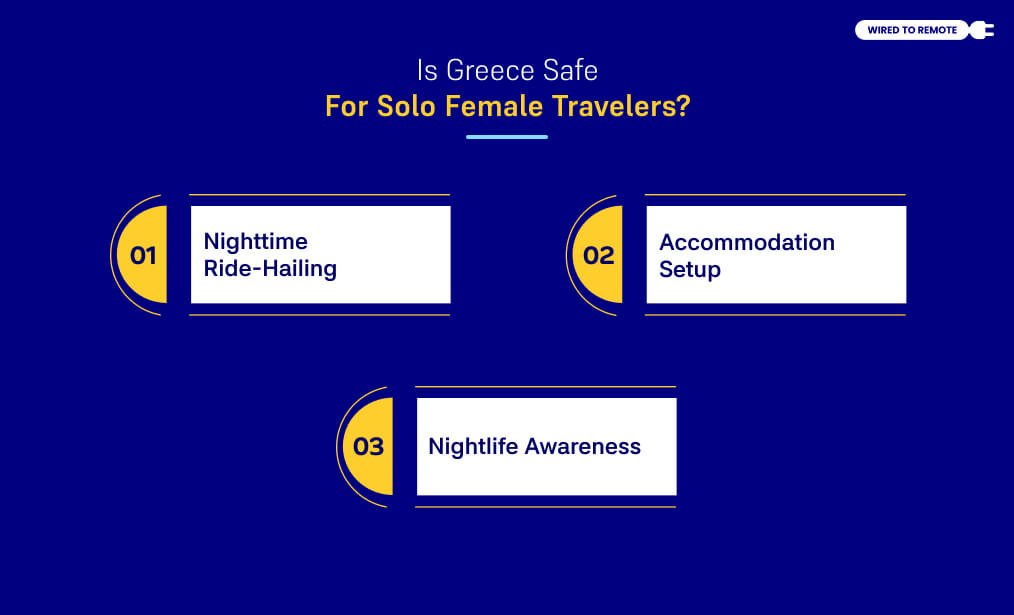
Nighttime Ride-Hailing
Avoid unmetered streetcars or taxis at night. Unlicensed drivers can create unsafe situations. Instead, use a licensed smartphone hailing service like FreeNow.
Do not flag down unmarked cars on the street because you cannot trust them. Licensed apps provide reliable rides and track your journey.
Accommodation Setup
Save your exact accommodation address and room PIN code on an offline app. Do this immediately when you arrive. Also, print a physical copy of this information.
A paper copy ensures you can find your way back if your phone breaks or someone steals it. This precaution stops you from needing a stranger’s phone.
Nightlife Awareness
Follow standard safety tips in nightlife and club districts. Avoid leaving these lively areas on foot by yourself at night.
Unfamiliar side streets often lead to quiet residential areas. These places lack the heavy foot traffic that keeps you safe.
Very few places in the world are absolutely safe for women alone at night. Greece belongs to this safer group. Countless solo female travelers visit the country and never experience any danger.
Is Greece Safe For Muslim Travelers?
The Greek Constitution guarantees religious freedom for all inhabitants and foreigners.
Muslim travelers face no legal constraints when they wear a hijab or dress in a distinctly Muslim manner. Interviewed Muslim travelers state that Greek hospitality extends to everyone.
Greeks call this concept “philoxenia.” It means hospitality to a foreigner. Most travelers feel welcomed regardless of their religion.
However, from a practical standpoint, spiritual and culinary infrastructure is somewhat uneven across the country:
| Location Type | Mosque Availability | Halal Food Access | Meal Strategies |
|---|---|---|---|
| Athens and Major Cities | Official Athens Mosque (Votanikos), various cultural centers | Readily available in Omonia and Metaxourgeio | High variety of Middle Eastern and South Asian eateries |
| Popular Islands | Virtually no dedicated mosques | Scarcely available; no certified halal butchers | Rely on fresh seafood, traditional Greek salads, and vegetarian dishes |
So, “is Greece safe for Muslims day-to-day?” Yes, absolutely. However, planning your daily routing around prayer facilities and strict halal food parameters requires noticeably more pre-travel logistics when stepping outside of Athens or Western Thrace.
Is Greece Safe To Live In Long-Term?
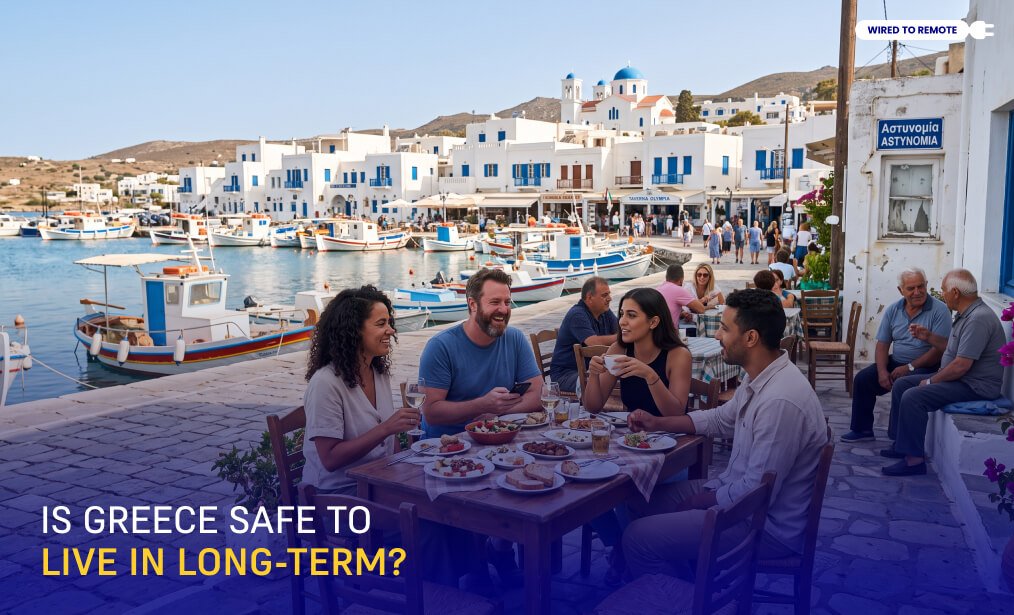
Short-term vacations and long-term residency carry completely different operational risk profiles. If you want to know, “is Greece safe to live in as a long-term resident?” the broader data says yes.
Tourists can rest assured that violent crimes remain very rare. Expats and digital nomads enjoy additional safety advantages. Long-term stays allow people to discover local communities, create reliable social networks, and learn which regions to avoid.
Always evaluate local safety alongside your finances before planning a long-term move. Living costs in Greece remain very reasonable. This affordability stands out when you compare Greece to Western Europe or North America.
Financial stability gives you peace of mind. It minimizes stress when you navigate an unfamiliar environment during an extended period abroad.
Ultimately, choosing the safest and most comfortable place in Greece depends on your specific needs. You must find the right mix of safety, local facilities, and English-speaking locals. These elements help you handle government business and daily routines easily.
Is Greece Safe For Digital Nomads Specifically?
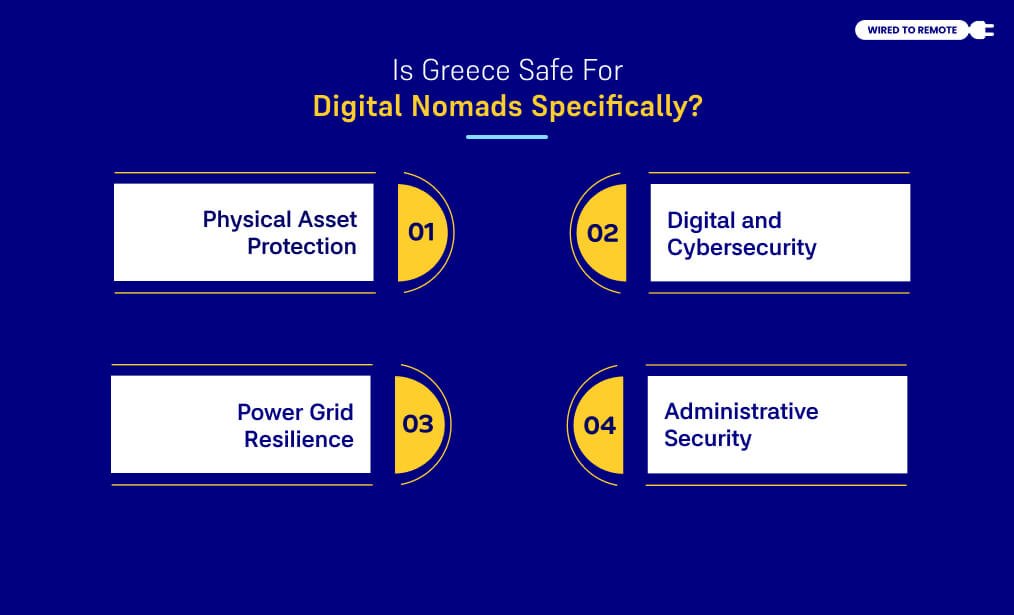
As a remote worker or digital nomad, your safety considerations look slightly different than those of a standard backpacker.
You are moving around with high-value professional assets – laptops, tablets, and smartphones – which automatically raises the stakes regarding opportunistic property theft.
Here are a few operational security tips for remote workers that you should know:
Physical Asset Protection:
You cannot leave your devices unattended on a table even for a moment in Athens or Thessaloniki. This rule applies when you work on your laptop at your favorite cafes.
Instead, choose highly rated coworking spots. According to Alliance Virtual Offices, these specific locations provide secure access control for your safety.
Digital and Cybersecurity:
Unsecured public Wi-Fi networks in tourist cafes carry high cyber-attack risks. Hackers can intercept your data easily on these networks.
Always activate a secure Virtual Private Network (VPN) before you log into company servers or bank accounts.
Power Grid Resilience:
During intense summer heatwaves, Greece’s power grid – especially on smaller, remote islands – can experience rolling brownouts or sudden power drops. For a remote worker, a blackout is a threat to your livelihood.
Always travel with a heavy-duty portable power bank and maintain a backup local 5G eSIM (such as Cosmote, which features the widest coverage network in Greece) to instantly tether your laptop if local Wi-Fi drops.
Administrative Security:
If you are relocating under the official Greece Digital Nomad Visa, keeping your legal documentation secure is paramount.
Utilizing a premium virtual office service can provide you with a secure, centralized corporate address for paperwork without publicly exposing your private residential address.
How Greece Compares To Other Nomad Destinations
To truly contextualize safety in Greece, it helps to look at how it stacks up against other popular global digital nomad hubs:
Greece vs. Bali:
Greece offers better infrastructure and safety than Bali.
Bali presents high risks of motorcycle accidents and water-borne diseases. The island also provides limited emergency medical services.
In contrast, Greece maintains safer roads and superior healthcare facilities. Strict European Union regulations ensure these high standards.
Greece vs. Latvia:
Latvia is statistically very safe and has very few burglaries. However, Latvia offers a completely different climate and lifestyle than Greece.
Greece also features a much more established expat scene and a deeply rooted community.
Travel Logistics And Beyond
Greece is a member of the Schengen Zone. Your 90-day tourist visa applies to the entire zone collectively. The visa does not reset when you cross borders between member countries.
Track your travel days carefully to avoid hefty fines or border restrictions.
Daily life in Greece is highly pleasant once you address basic safety concerns. Local street markets, called laiki agora, sell safe, inexpensive, and fresh food.
This combination of everyday safety and excellent European infrastructure creates an unmatched quality of life. Digital nomads who arrive for a few days often stay much longer than planned.


Leave A Comment